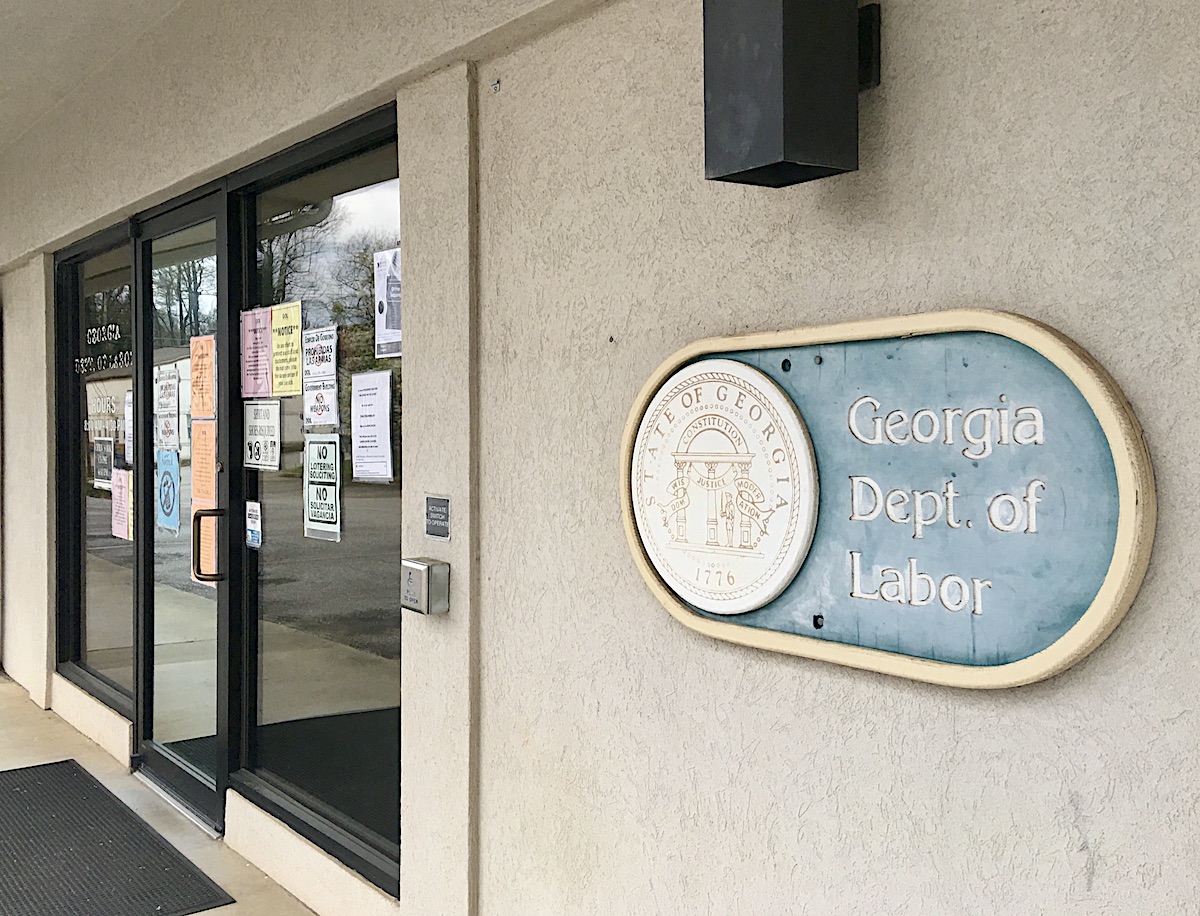
ATLANTA (GA Recorder) — The latest jobs report from the U.S. Department of Labor has some good news for Georgia.
The state’s unemployment rate dropped 0.1% to 4% in June, lower than the national rate of 5.9% and down 8.5% from the worst of the pandemic in April 2020.
“We have gained back 76%of the jobs lost in the pandemic and currently have over 190,000 job listings that need to be filled. We are working with employers across the state to fill those positions because if they continue to go unfilled, it will stall out new job creation,” said Labor Commissioner Mark Butler in a statement. “Several job sectors are already breaking all-time highs as we continue to see Georgia’s economy recover.”
The number of Georgia workers drawing unemployment fell by more than 73,000 to 105,681 for the week ending July 3, and the number of workers seeking their first unemployment claim dropped by more than 6,000, to 13,692 for the week ending July 10.
Both of those declines represented the biggest drops of any state.
“If you look at the new claim data and the decline over time, you’d say Georgia’s economy is growing; it’s been growing for a while,” said David Sjoquist, a professor of economics at the Andrew Young School of Policy Studies at Georgia State University. “The economy is looking good; there are jobs out there. So, if you want to get off of unemployment, there’s good opportunities. Whether you just want a job or because your benefits have gone down, it’s relatively easy to find a job.”
Many Georgians saw their benefits go down after June 26, when the state pulled out of extended federal unemployment pay, including an additional $300 weekly boost, and reinstated work search requirements for displaced workers filing for unemployment.
The $300 federal boost to benefits was set to expire in September.
Mark Butler (GDOL)
Labor Commissioner Mark Butler and Gov. Brian Kemp argued an early exit would spur Georgians using the expanded pandemic benefits to avoid working instead of getting a job, and the labor department sees the decreased numbers as the result of the policy change, said spokeswoman Kersha Cartwright.
“We completely attribute that to stopping our participation in the federal programs,” she said.
Another positive sign is that 90% of the new claims come from workers quitting or being fired rather than being laid off, suggesting businesses are not being forced to cut workers or run out of money.
“We’re not seeing a huge number of layoffs because people are looking for employees,” Cartwright said. “Even prior to the pandemic, we saw a higher number of layoffs than we’re seeing now.”
From the week ending July 3 to the week ending July 10, according to the department, initial claims decreased in the five types of businesses with the largest increases in claims due to the pandemic: accommodation and food services, administrative and support services, manufacturing, health care and social assistance, and retail trade.
The elimination of the expanded benefits played a role in lowering unemployment, but it is not the only factor, Sjoquist said.
“There are other states that are experiencing decreases in continuing claims that have not changed their benefits yet, so something else is going on as well,” he said. “Part of it is just the general nature of the economy, part of it is the numbers, part of it in Georgia and some other states is the change in benefits that discourages people from staying unemployed. I cannot tell you how much, but you should not attribute the bulk of it to the change in benefits.”
Since March 2020, the state has processed more than 4.9 million regular initial unemployment claims, more than the ten years prior to the pandemic combined.
Nationwide, initial claims dropped by 26,000 to 360,000, the lowest level for initial claims since March 14, 2020, when it was 256,000.
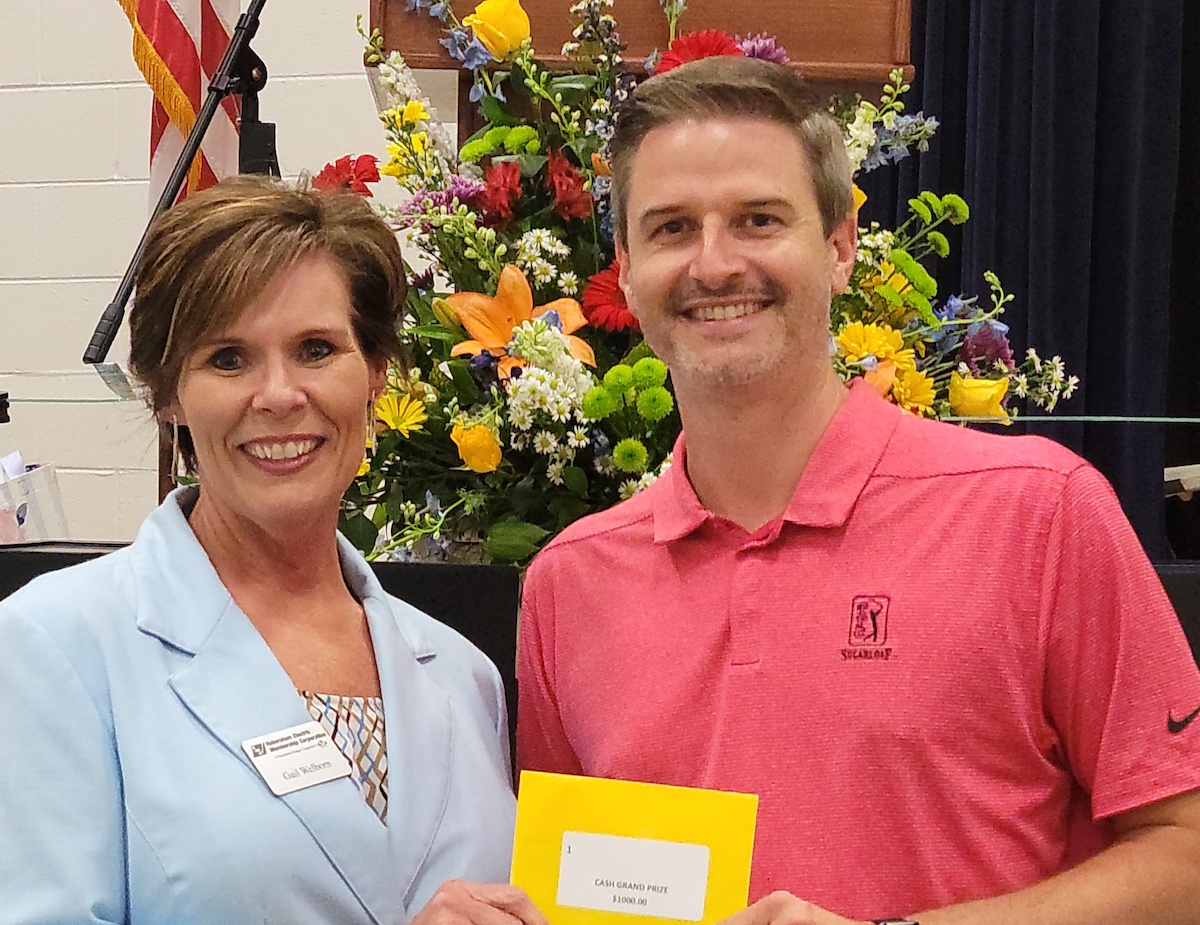
Habersham EMC's Gail Welborn presents David Little of Sautee with $1,000 cash. Little won HEMC's prize drawing during the local cooperative's annual meeting Thursday, July 15, in Clarkesville.
More than 800 members and guests attended Habersham EMC’s 83rd Annual Meeting on Thursday, July 15, at the Habersham Ninth Grade Academy. Attendees enjoyed a barbecue meal, health fair, informational booths, and entertainment by Brian Free & Assurance.
HEMC President and CEO Bryan Ferguson focused on the cooperative’s Top 5 Keys to Success in his report: Safety, customer service, enterprise initiatives, people, and teamwork. According to Ferguson, these organizational foundations will shape the future of the cooperative. He also announced a proactive approach to avoid outages and increase reliability through the use of technology. In addition, Ferguson expressed a renewed commitment to community involvement.
HEMC members elected Jeff Herrin, Kenneth McEntire, and David Foster to the Board of Directors. The Board met immediately following the business session and elected the following officers: David Wall, Chairman; Dustin Hulsey, Vice-Chairman; and Billy Cantrell, Secretary/Treasurer.
All members who registered to vote in the Board of Directors election were entered into the door prize drawings. Members who voted absentee were eligible to win a $300 grand prize and those who voted at the meeting were entered into a drawing for a $1,000 grand prize.
Ronald Parham of Cornelia and David Little of Sautee were the grand prize winners.
Habersham EMC is a member-owned electric cooperative based in Clarkesville, Georgia. It serves more than 26,000 members with 3,800 miles of line in six Northeast Georgia counties including Habersham, Hall, Lumpkin, Rabun, Stephens, and White.
Two high school skilled trades teachers from Northeast Georgia are finalists in a national teaching competition. If they win, it could reap big rewards for them and their students.
Rodney Presley and Dave Darden are competing for the Harbor Freight Tools for Schools annual Prize for Teaching Excellence. They’re among three Georgia finalists and 61 nationwide still in the $100,000 grand-prize winning competition. Presley is an HVACR and construction teacher at Lanier College & Career Academy in Gainesville. Darden teaches automotive service technology at Cedar Shoals High School in Athens. The other Georgia finalist is Jody Kemp from Peach County High School in Fort Valley.
All of the finalists are vying for a share of more than $1 million in cash prizes.
“Despite the dramatic need for a new generation of workers, research has shown that most U.S. high school students do not have access to high-quality skilled trades programs,” says Harbor Freight Tools for Schools Executive Director Danny Corwin. He says the goal of the prize is to highlight some of the most outstanding programs in the country and “celebrate teachers who are making a big difference in the lives of students.”
NEGA finalists
Reading over his competition bio it’s clear, Rodney Presley is one of those teachers making a difference. Presley was running his own HVAC company “when he saw first-hand the desperate need for highly skilled trade workers and began teaching to remedy that.”
His students showcase their skills by competing in national SkillsUSA events. They build products for sale in the school’s MetalWood design shop and construct a tiny house. Students also participate in an industry “signing day,” where they commit to careers in the trades. This past year along, nine of Presley’s students signed with employers, according to Harbor Freight.
Rodney Presley
For advanced students, Presley leads a county-wide “Habitat High” program in partnership with the local Habitat for Humanity. He also helped host a Skills Challenge for students with Georgia’s Association of General Contractors.
Darden, too, is using his expertise in the field to help students in the classroom. He incorporates his 35 years of experience as a master automotive technician into his courses. To hone his teaching skills, Darden obtained a master’s degree in workforce education in 2019 and will graduate with his Ed.S this fall.
Darden’s program at Cedar Shoals is ASE/NATEF-certified — a top industry standard. This year, his advanced students converted a former SWAT truck into a fully operational food truck. They also transformed two school buses into bookmobiles for their school district.
Darden was a finalist for last year’s Prize for Teaching Excellence.
Round two
An independent panel of judges selected the finalists from among a field of more than 700 who applied. The finalists are from 30 states. They’ll now advance to the second round of competition. Judges will narrow down the field to 18 winners who will receive cash prizes.
The Smidt Foundation funds the awards. Harbor Tools owner Eric Smidt started the foundation to advance skilled trades education in U.S. high schools. Corwin says he hopes other communities will be inspired to create similar programs for their own high school students.
The top three grand prize winners will each receive $100,000, with $30,000 going to the winning teacher and $70,000 to their schools’ trade programs. The foundation will award the 15 additional winners $50,000, with $35,000 going to each of their schools and $15,000 to each teacher.
The winners will be announced in late October. For a complete list of finalists, click here.
"Water, water, everywhere, but not a drop to drink!" Maybe, but there's plenty to play in. (Photo by Jenna Shaw)
With only a few weeks remaining before children go back to school, you may be looking for ideas of how to survive the last days of summer. With that in mind, we bring you ideas of where children can play in water, stay cool, and expend some energy.
Splash pads
Splash pads are wonderful spots for children to play in the water. It’s much better than playing in the hose in the front yard! (Margie Williamson/Now Habersham)
Children love splash pads. The splash pad in Cornelia is fairly small, but it offers covered benches, a toilet, and lots of fun. There are not many splash pads in Northeast Georgia, but there are a few within driving distances. Check out:
Yahoola Creek Park is located at 464 Mechanicsville Road, Dahlonega, Georgia 30533.
Laurel Park is located at 3100 Old Cleveland Highway, Gainesville, Georgia30506.
Don’t forget to take a change of clothing for the drive home. My grandchildren were soaking wet from head to toe.
Waterparks
Lake Lanier Islands offers the premier water park experiences in North Georgia. (Photo lanierislands.com)
Helen Tubing and Waterpark has just been recognized as one of the best in the United States. You can read about it here. It features a pool with tall slides and a lazy river ride. It also has tubing trips down the Chattahoochee River. Helen Tubing and Waterpark is located at 222 Edelweiss Strasse, Helen, Georgia 30545.
Splash Island is located at 3379 S US Highway 76 Bypass, Hiawassee, Georgia 30546. It offers an inflatable obstacle course that is fun for all ages. There is a charge based on the hour(s) of usage. Before going, check out the details and prices on their website.
There’s also a waterpark at Lake Lanier Islands. The information for it is provided below.
Lakes and beaches
Northeast Georgia has an abundance of lakes and swimming areas.
We are blessed in Northeast Georgia with an abundance of lakes, rivers, and streams. For a wonderful day at the beach, consider taking the kids to one of the nearby Georgia State Parks:
Unicoi State Park has a beach and picnic area. It also has boat rentals of kayaks, canoes, paddleboards, and pedal boats available on Friday, Saturday, and Sunday. The park has a $5.00 daily parking fee. Unicoi State Park is located at 1788 GA-356, Helen, Georgia 30545.
Tallulah Gorge State Park has a sand beach, a picnic area and a playground. It is located at 338 Jane Hurt Yarn Drive, Tallulah Falls, Georgia 30573. The park has a $5.00 daily parking fee.
Don Carter State Park is located on the north side of Lake Lanier. It offers sand beaches, a boat ramp, and picnic areas. The park’s address is 5000 North Browning Bridge Road, Gainesville, Georgia 30506.
If you want something a little “splashy-er”, try Lake Lanier Islands. It offers a large sand beach and a water park with all the trimmings. Check the website for admission costs and to make reservations. Lake Lanier Islands is located at 7000 Lanier Islands Parkway, Buford, Georgia 30518.
If all else fails
Get creative! There’s no end of how to have fun with water at home!
Two people, including a Cleveland woman, were arrested Tuesday after fleeing from Gainesville Police.
According to a post on the Gainesville Police Department’s Facebook page, a Gainesville officer responded to the area of 800 Timber Valley Way around 1 p.m. Tuesday after a 911 call about two individuals passed out behind the wheel of a black Ford Mustang. Upon contact, the officer noticed both occupants were behaving abnormally. He also reported seeing drugs in the car.
The driver, identified as Ronald Sammy Loggins, 23, from Forsyth, started the vehicle and drove in reverse, knocking the officer off his feet but clear of the moving vehicle.
“Our officer attempted to stop Loggins, but Loggins continued to flee and allegedly attempted to run over our officer again,” the post states. “Immediately after, a short pursuit took place between our officer and the black Mustang in the area of Mundy Mill Road and I-985.”
According to officials, Loggins was driving erratically and caused four crashes while fleeing. The Gainesville police officer ended his pursuit when two flat tires disabled his patrol vehicle. He requested backup from Oakwood Police, Hall County deputies, and the Georgia State Patrol.
Deputies later located the Mustang in a business parking lot in the area of McEver and Stephens Road. They took Loggins and his passenger, Amber Lynn Shaft, 26, of Cleveland, into custody.
Police charged Loggins with multiple offenses, including aggravated assault on a peace officer, fleeing with intent to elude, obstruction, possession of heroin, DUI, and kidnapping. They also charged him with numerous traffic violations.
Police charged Shaft with possession of heroin.
Gainesville Police Chief Jay Parrish says he’s thankful his department’s patrol officer came out of the situation with only minor injuries and is now recovering. He also commended the assisting agencies for ensuring “we had the best outcome.”
“This is a horrible example of how drugs poison more than just those under the influence,” Parrish adds. “This could have potentially had tragic results, but fortunately, it did not, and no injuries were reported from the crashes Loggins caused.”
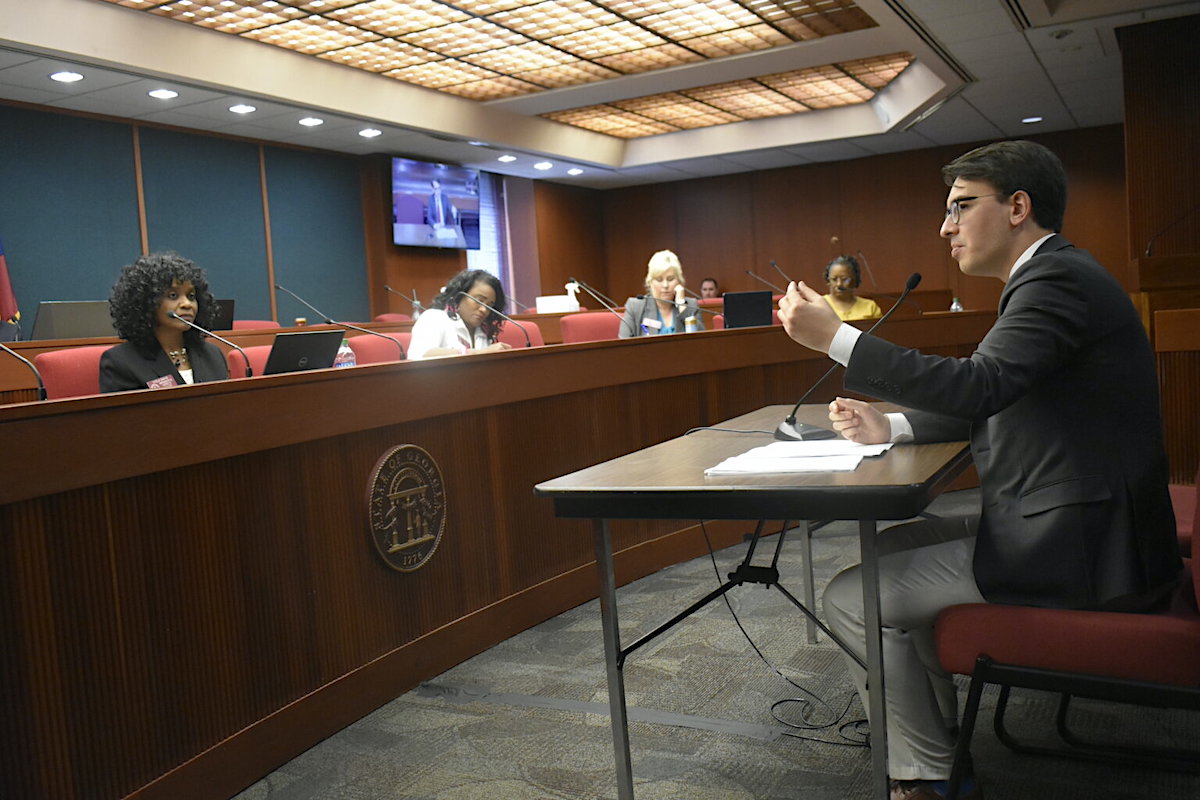
Breitbart reporter Allum Bokhari testifies about social media censorship before the House Science and Technology Committee. (Ross Williams/Georgia Recorder)
ATLANTA (GA Recorder) — What should be the balance between the free speech rights of large social media companies and those of the people who use their platforms, and should the Georgia Legislature create rules to strike that balance?
That’s what members of the House Science and Technology Committee want to know as they discussed the idea of tech censorship in a hearing Thursday, a follow-up to another meeting on the controversial topic in May. The committee is weighing whether to recommend legislation to the 2022 General Assembly.
The issue is attracting growing attention in recent months after former President Donald Trump and other conservatives have claimed big companies like Facebook, Twitter, and Google censor right-wing speech. Last week, Trump announced a class action lawsuit against those companies and their CEOs after the platforms imposed bans on him and others.
But as social media becomes more and more vital for conducting business and running for office, all Georgians should be interested in making sure the sites do not ban people for political ideas, said Allum Bokhari, a reporter at the right-wing outlet Breitbart and author of “#DELETED: Big Tech’s Battle to Erase the Trump Movement and Steal the Election.”
“Despite the fact that in some cases, people’s entire livelihood can depend on access to a social media platform, small business owners, publishers, and independent content creators currently have essentially no recourse under the law if the content moderator decides to ban them,” Bokhari said. “So you’ve got people who spent entire years of their lives pouring effort and resources and sometimes financial capital into building a presence online, and yet they have no recourse if a big tech company decides to take that all away.”
Bokhari said he favors expanding the approach Google takes with its SafeSearch program that allows users to filter out explicit or violent content. Users should also be able to decide if they want to see questionable political speech or conspiracy theories, he said.
“It just baffles me that they use that kind of technology for obscenity, but filters on so-called disinformation and so-called non-authoritative information, you can’t opt-out of them,” he said.
An attempt to bar social media companies from regulating what posts users see would not pass Constitutional muster — a federal judge recently blocked a Florida law aimed at protecting conservative speech from social media companies on First Amendment grounds.
The First Amendment applies to government censorship and protects the public’s rights to speak, worship, and assemble to protest government action, said Richard T. Griffiths, president emeritus of the Georgia First Amendment Foundation.
“But websites like Twitter or Facebook are private companies, and private companies are not subject to the disciplines of the First Amendment, where anybody can say anything on their platform,” he said. “They have the right, as private entities, to develop rules about what they consider appropriate in their universes.”
Still, there could be other ways for governments to target big tech companies, said Professor Luigi Zingales of the University of Chicago School of Business.
When dealing with a business with users that hurt a third party or create unintended consequences, governments can react with taxes, he said.
“The ad-based business model of social media is a model that produces an enormous set of externalities, from the loss of data privacy to addiction to negative political polarization, so it’s only fair to think about taxation,” he said. “And this is something that can be done at the local level; you (can) tax all the ads that are viewed by people in Georgia. This is being done by Maryland, and this can be done as a measure itself or as pressure to obtain something that, maybe at the state level you cannot obtain, but you care enough to create the pressure to do it at the federal level.”
But regulating successful companies would defy the conservative principles those regulations would be designed to protect, said Carl Szabo, general counsel of NetChoice, an industry group with members that include Amazon, Facebook, Google, TikTok, and Twitter.
“I’m an originalist, and that’s kind of why I feel so strongly about some of the things that we do see online that do raise concerns for me, as a conservative, when I see people being removed, people being, quote-unquote, de-platformed or blackballed or whatever we want to call it today,” he said. “But the other side of me, the originalist, conservative side, says, but that flies in the face of the notion that private businesses can be the arbiters of what is best for their users and their advertisers.”
Szabo pushed back against the idea that platforms are targeting conservative speech, arguing that left-wing content creators complain that their speech is censored as well.
Social media companies do not target specific beliefs, said Jim Halpert, attorney and partner of DLA Piper, who represented NetChoice in a lawsuit against the blocked Florida law. They simply want to make money by creating a welcoming atmosphere for the most users.
“Platforms want users to choose their site over others, and users want to visit sites where they know what they’re going to get, and there is a variety of choices in the marketplace for users who want different things — we can argue about market share, but a lot of this is based on the popularity of the site,” he said.
The work of determining what posts to block is difficult, especially for large sites — on average, 6,000 tweets are sent out every second, according to Internet Live Stats — and censors have to filter out content ranging from the illegal, like child pornography and threats of violence, to the distasteful, like racism or graphic images. In recent months, social media falsehoods about COVID-19 masks and vaccines has led some to worry about the spread of misinformation costing lives.
Messing with the free market could prevent companies from removing these types of posts for fear of breaking the law, Halpert said.
“If you say no moderation of political or religious content, you’re going to see more and more of these bad actors reframe their content as religious or political, add a little element of it, and then put it up online,” he said. “Do you want an internet where plaintiffs’ class action lawyers can shake down social media sites that try to make the sites more courteous or provide better online experiences for their users?”
Acworth Republican Rep. Ed Setzler, who chairs the committee, said he is concerned about reports of Georgians losing their livelihoods over bans from social networking sites, but he said the committee will take its time before writing any legislation.
“We’d do well to take a deep dive and understand, rather than act first and deliberate later,” he said. “There’s a number of states that have been active, some might say wisely, some might say unwisely, others might say wisely but hastily, and there might be opinions in-between. Our goal as the Committee on Science and Technology, as you know, is to take advantage of the out-of-session time we have over the course of the interim, delve deeply into issues, understand issues, help frame issues so that that can inform any efforts that might lead to legislation, or not, as we would contemplate action next legislative session.”
Winston “Joy” Churchill Simmemon, age 76, of Alto, Georgia, passed away on July 14, 2021, at his residence. He went peacefully, surrounded by family.
Mr. Simmemon was born on November 16, 1944, in Habersham County to the late Lamar and Donie Simmemon. In 1963 he married the girl of his dreams, Gail Elaine Simmemon. They lived together almost inseparable for 49 years. He was a good father who always took care of his children and did the best he could to teach and guide them. He was a loving Papa and “great grandfather” (Pop). Winston was a strong, proud, and good man. He was well known for giving everyone nicknames. He is loved and will be missed by many. In addition to his parents, he was preceded in death by his loving wife, Gail Dalton Simmemon; sister, Julia “Judy” Simmemon Tidwell; and brother, Robert “Tobe” Simmemon.
Survivors include his sons and daughters-in-law, Truett and Joy Simmemon, of Alto; Chad and Laura Simmemon, of Alto; daughter-in-law, Rochelle Simmemon, of Alto; grandchildren, Dedra Ramirez, Shelby Simmemon, Makayla Simmemon, and Savannah Simmemon, great-grandchildren, Mason, Kinsley, Constance, and Sarah, sisters, and brothers-in-law, Jeanette and James Campbell, of Baldwin; Cynthia and Doug Moore, of Commerce; sister-in-law, Sue Simmemon, Evelyn Dalton, and Dorothy Key, and brother-in-law, Jimmy Tidwell.
Funeral Services will be held at 2:00 p.m. Saturday, July 17, 2021, at the Whitfield Funeral Home, South Chapel, with Pastor Danny O’Kelly and Pastor John Dubios officiating. Interment will follow in Baldwin City Cemetery.
The family will receive friends from 4:00 p.m. to 8:00 p.m. Friday, July 16, 2021, at the funeral home.
Arrangements have been entrusted to the Whitfield Funeral Homes & Crematory, South Chapel at 1370 Industrial Boulevard, Baldwin, Georgia 30511. Telephone: 706-778-7123.
Joan Evans Sexton, age 76, of Demorest, Georgia, went to be with the Lord on Wednesday, July 14, 2021.
Mrs. Sexton was born on October 19, 1944, in Savannah, Georgia, to the late Henry Edward and Hazel Virginia Evans. She was a retired aviation comptroller. Mrs. Sexton was of the Baptist faith.
Survivors include her beloved husband of fifty-seven years, Richard Carl Sexton, Demorest, Georgia; daughter and son-in-law, Laura and Michael Harvey, Dawsonville, Georgia; son and daughter-in-law, Glenn and Kim Sexton, Forest, Virginia; grandchildren: Dale (Heather), Katelyn (Zane), Grant, and Chase (Hannah); great-grandchildren: Ruby, Rosie, and Blakely; several nieces and nephews.
A Time of Remembrance will be held at a later date.
Arrangements are entrusted to the Whitfield Funeral Homes and Crematory, North Chapel, 245 Central Avenue, Demorest, Georgia 30535. Phone 706-778-1700
Randy Sosebee, age 57, of Alto, Georgia, passed away on Monday, July 12, 2021.
Mr. Sosebee was born on December 21, 1963, in Hall County, Georgia to Hayden Randolph Sosebee, Sr. and Shelby Ramsey Sosebee. Mr. Sosebee was an automotive mechanic. Randy enjoyed spending time building and racing racecars. He was known for winning many races at Toccoa Speedway under the number “32 Jr.”.
In addition to his parents, he is survived by his sister and brother-in-law, Denise and Jerry Jackson, of Alto; brother, Danny Sosebee, of Alto; and Daniel Sosebee, of South Carolina; and several aunts, uncles, nieces, and nephews.
Family Memorial Services will be held at a later date with Rev. Dayton Sosebee officiating.
Arrangements have been entrusted to the Whitfield Funeral Homes & Crematory, South Chapel at 1370 Industrial Boulevard, Baldwin, Georgia 30511. Telephone: 706-778-7123.
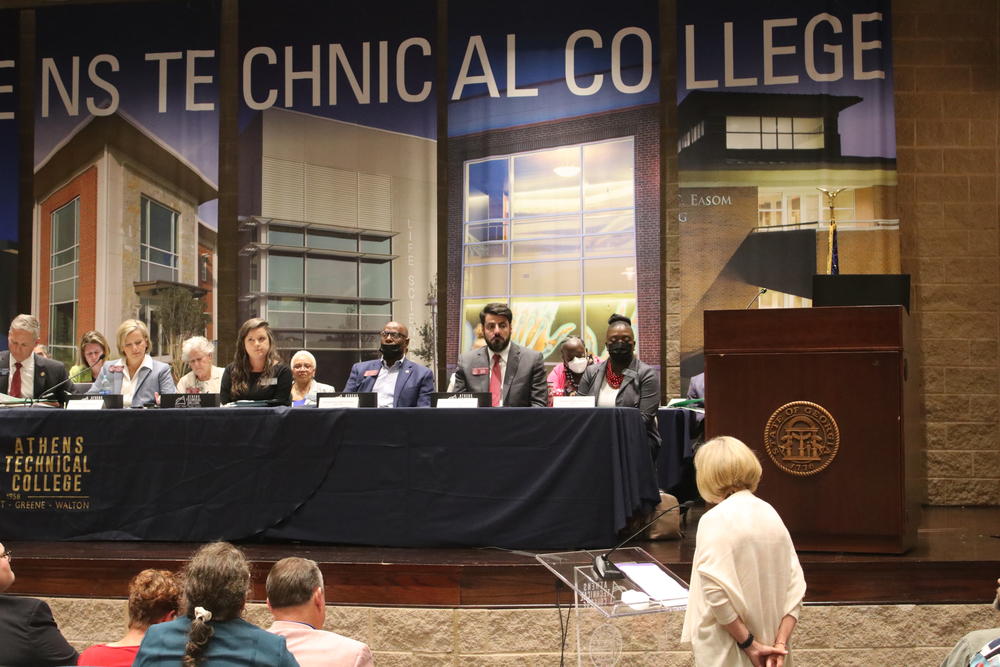
The state lawmakers who will redraw Georgia’s district lines later this year held a joint town hall hearing to gather public input July 6, 2021, at Athens Technical College. Athens resident Vicki Krugman spoke to lawmakers during the meeting.
(Sherry Liang / GPB News)
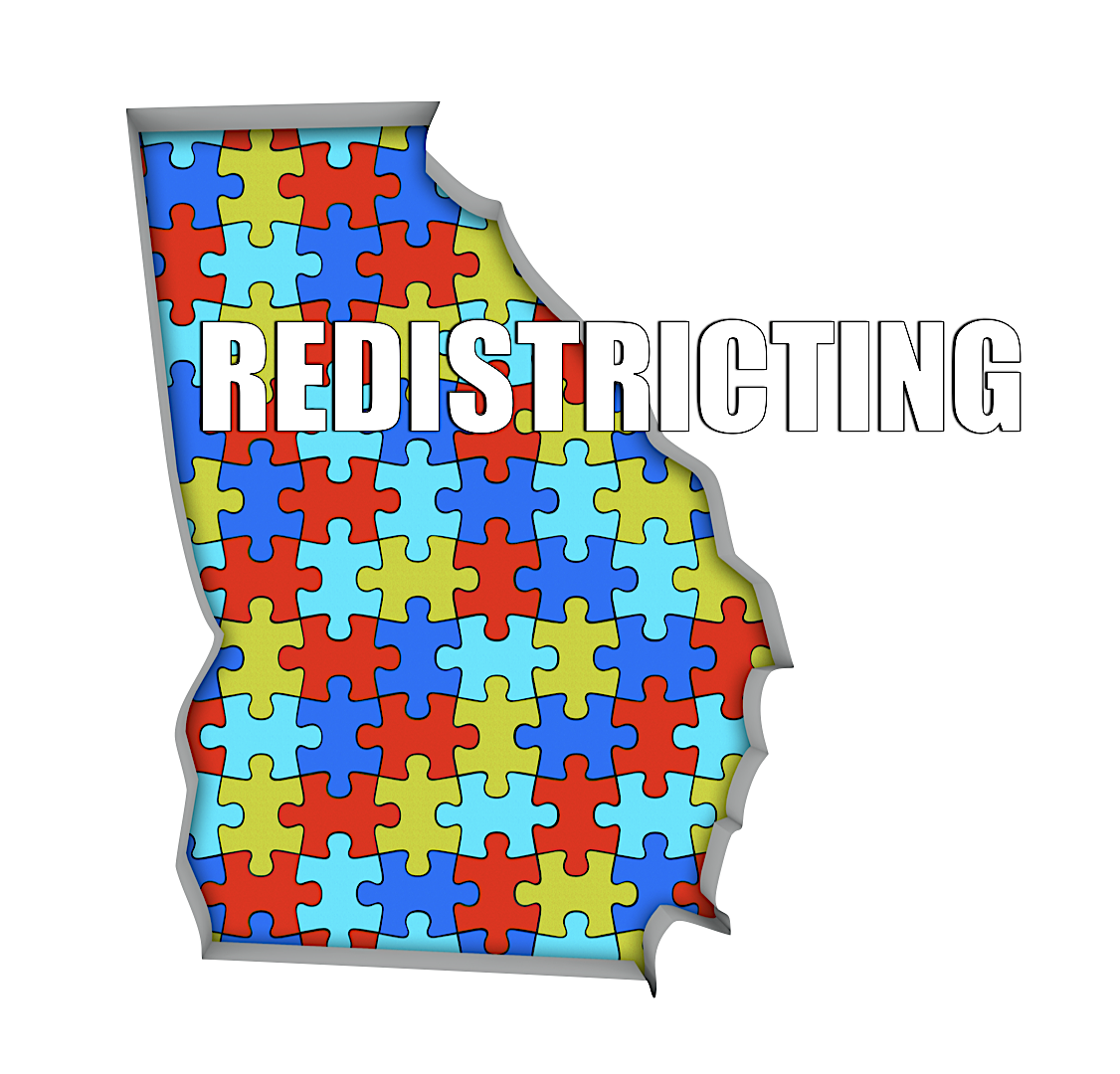
(GPB) — As Georgia lawmakers prepare to redraw the state’s congressional and legislative districts later this year, people from around the state are weighing in with their thoughts on issues they say should be considered in the process.
Emerging themes at the public hearings include keeping together communities that share common interests, greater openness and transparency in the process and ensuring that maps are drawn fairly, not for partisan advantage.
At a recent hearing of the joint state House and Senate redistricting committees in Dalton, residents in the North Georgia town of 33,000 repeatedly called on lawmakers to avoid splitting the region’s growing Latino communities when drawing new district lines.
“We ask you to please consider Latinos in the area as a community of interest in order for us to have proportional, fair representation since we share common concerns,” said America Gruner, who said she has lived in Dalton for nearly two decades since coming to the United States from Mexico.
The Latino community in Dalton has grown significantly over the years, drawn largely by the jobs in the area’s extensive carpet industry. Latinos are now the largest ethnic group in the city, making up more than 46% of the population in 2019, according to U.S. Census figures.
Gruner and others at the Dalton meeting said they worry the Latino vote would be diluted if their communities are split by district lines.
They also called on the committees to make the process more accessible by providing information in languages other than English. Those and similar appeals at other public hearings hosted by the committee have so far gone unaddressed.
Others at the Dalton hearing expressed satisfaction with the area’s current district boundaries and its representation by controversial U.S. Rep. Marjorie Taylor Greene. Area resident Bill Buoni called on the redistricting committees to group like-minded residents together.
“I want to really encourage you to be thoughtful and mindful in how we go about this process,” Buoni said. “I think it is important when we have people with shared values to keep those values together.”
Some speakers from outside Greene’s district asked that their communities be added to it.
Communities of interest
Keeping communities together has been a recurring topic at other public meetings as well.
At a session in Cumming, the county seat of increasingly diverse Forsyth County, speakers asked that maps be drawn to keep the area in one congressional district.
Thirty years ago, Forsyth County was nearly entirely white. It is still majority white, and split between two congressional districts, which also take in more diverse communities in neighboring counties.
Forsyth is represented by Republican Andrew Clyde in the 9th District and Democrat Carolyn Bourdeaux in the 7th. Bourdeaux’s election in 2020 flipped the longtime GOP stronghold from red to blue.
At the redistricting meeting in Cumming, speakers such as Forsyth resident Ed Murray said they would like to see the county represented in a single district.
“Here in Forsyth County, we’re a great community,” Murray said. “We like living with each other, we’re pretty friendly, we have good schools, good representation. And we would like to make our county whole as a district.”
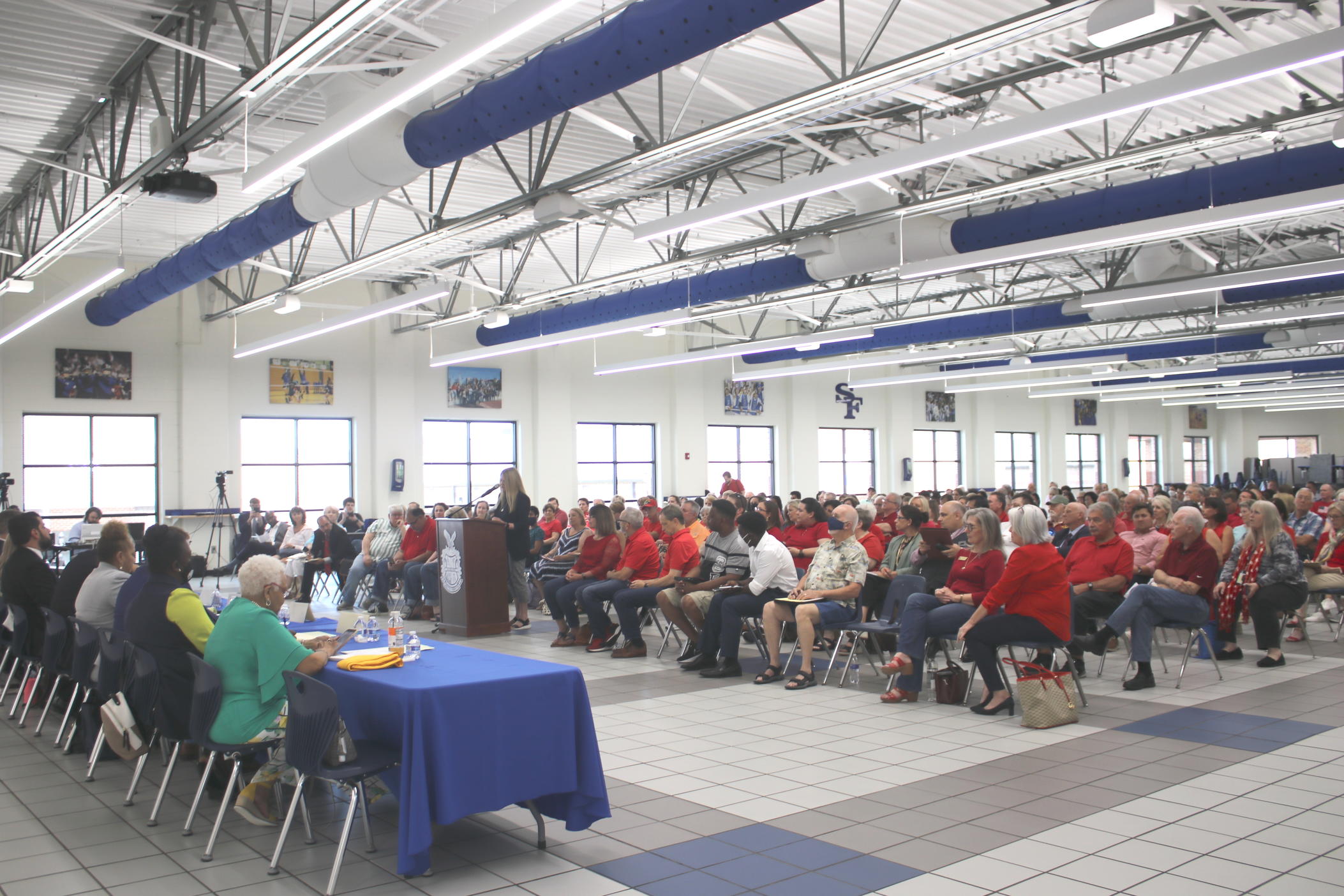
The redistricting committees held a redistricting town hall hearing on June 29, 2021, at South Forsyth High School in Cumming. The forum was one of several planned meetings statewide ahead of the politically contentious process of redistricting coming in fall 2021. (Sherry Liang / GPB News)
At the meeting in Athens, speakers also called for a realignment of their legislative districts.
Although Athens-Clarke County consistently votes for Democrats, because of the way the districts are drawn, two of its three state House representatives and both its state senators are Republicans.
The University of Georgia campus is also split across three House seats.
Logan Williamson, who studies political science at UGA, called for more accurate representation of voter preferences and the “unity of UGA’s campus” in state House districts. He said because Athens is grouped with more rural regions with different interests, residents are unable to advocate for their specific interests.
“I’ve walked through all three districts just moving between classes,” Williamson said. “As UGA students, we will move into the future to majorly impact, change and improve industry and [the] economy both in Georgia and nationally. But we are fractured in electing our representatives.”
To gain political advantage, legislators can split up cities into two or more districts. The practice, known as “cracking,” dilutes the voting power of one group in favor of another. Michael McDonald, a political science professor at the University of Florida who studies voting and redistricting, says cracking of cities is a “typical strategy for partisan gerrymandering.”
“When you combine one city, you often can get a Democratic district,” McDonald said.
“If you want to dilute the vote of those people, those Democrats living in those cities, what you do is that cracking strategy.”
Transparency and fairness
Speakers at the public meetings have consistently called on lawmakers to ensure the redistricting process is transparent and fair.
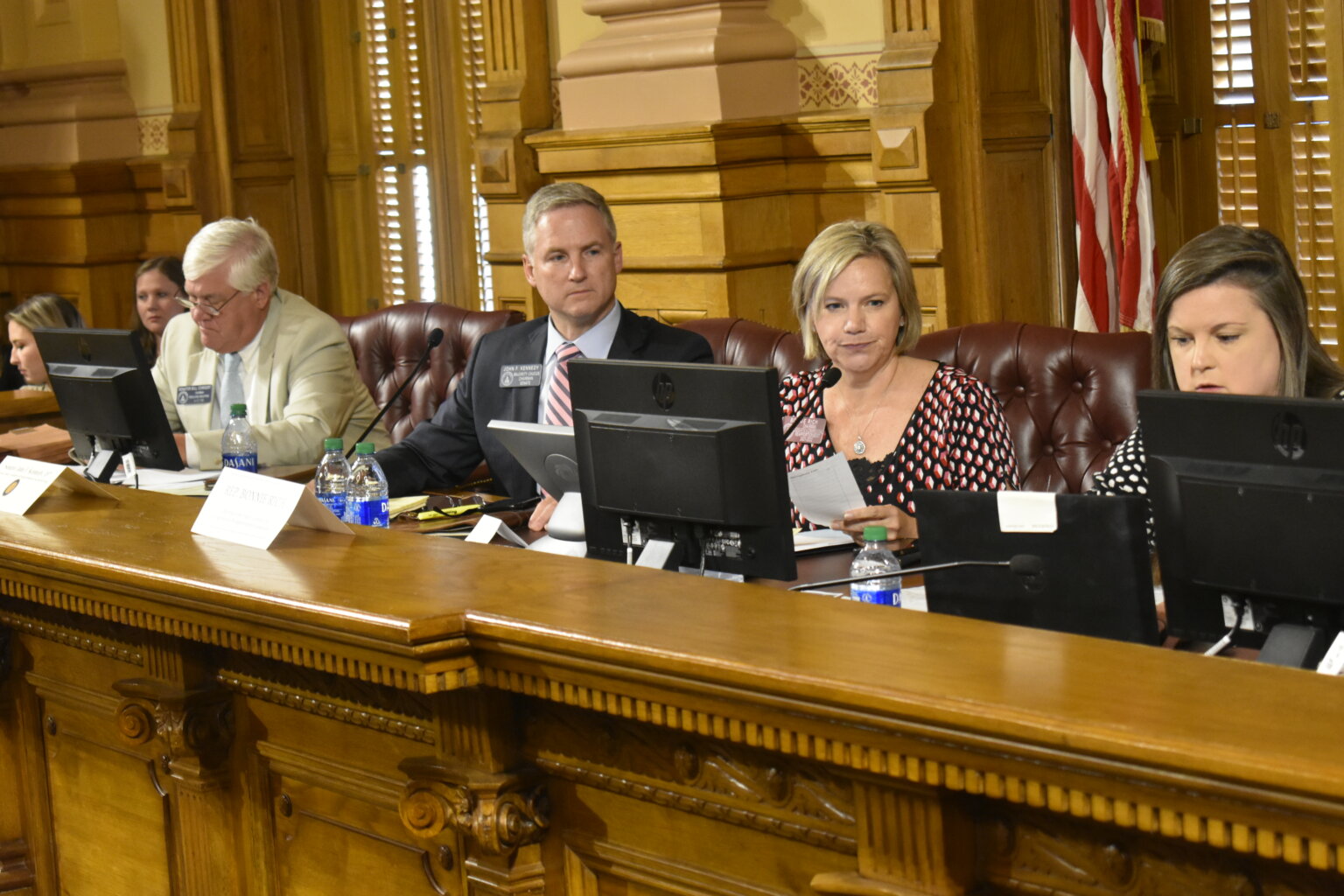
The redistricting committee chairs, state Sen. John Kennedy (R-Macon) and state Rep. Bonnie Rich (R-Suwanee) have said the purpose of the session is to get public input.
“Usually when politicians hold hearings, it’s because they like to talk, but that is not our purpose tonight,” Rich said at the first hearing June 15, which was online. “Our purpose is to hear from you, Georgians, the members of our public, our constituents.”
Formal committee meetings, during which new maps will be adopted, are expected to take place this fall after Census data is released.
State redistricting chairs Sen. John F. Kennedy and Rep. Bonnie Rich, center, are two of the key figures in Georgia’s summer-long revamp of the state’s political landscape. (Ross Williams/Georgia Recorder)
At the June 15 session, Rep. Mack Jackson (D-Sandersville), a member of the committee, asked if there would be additional public meetings once Census numbers are available. The committee chairs were non-committal.
“We don’t know yet because we haven’t gotten the data yet, and there’s not necessarily a firm deadline,” Rich said.
Another member of the committee, State Senate Minority Leader Gloria Butler (D-Stone Mountain), testified in both Atlanta and Athens. She said a fair and transparent process requires public input at all stages, including after maps are drawn.
“Georgians are entitled to not only examine the criteria used to create their own district but also provide substantive feedback on any proposed maps before they are adopted,” Butler said in Athens. “Democracy cannot happen behind closed doors. Our redistricting process must be open, democratic, and representative of the interests of all Georgians.”
Throughout the hearings, speakers called on committee members not to use redistricting for political advantage.
“Redistricting shouldn’t be as partisan as it is,” said Katy Gates, a recent graduate of South Forsyth High School. “It’s important to make sure that everyone is feeling accurately represented in their government because that’s what democracy is all about.”
How to get involved
The joint committee has scheduled additional public sessions later this month in Brunswick, Albany, Columbus and Macon. These in-person meetings will be streamed live and archived here. The committee will also hold a virtual public meeting Friday, July 30 at 5 p.m.
Georgia residents may also submit written testimony via an online form, here.
This story comes to Now Habersham through a reporting partnership with GPB News, a non-profit newsroom covering the state of Georgia.
From a free concert and fireworks in Clarkesville and an Olympics-worthy beach bash in Hall County, there’s lots happening in (and around) Habersham this weekend.
Friday in White County, catch a showing of “Inside Out,” after dark at Freedom Park with free popcorn, drinks, and popsicles. Bring a blanket to enjoy this free event for everyone in the family.
Friday in Hall County at 4:45 p.m., cheer on two Team USA Olympians during their time trials at Lanier Olympic Park. Olympians Nevin Harrison for the Canoe Sprint and Alex Lee for the Kayak Sprint will race to beat the clock to qualify for the Olympics.
Stay after (or arrive at 5 p.m.) for the Lake Lanier Beach Bash! This event is free and fun for the whole family, with inflatable waterslides, food trucks, beer and wine, contests, and a concert.
In Clarkesville on Friday, join the city for “Red, White and Tunes” at Sam Pitts Park. This free event will kick off at 6 p.m. with bouncy houses, concessions and music. Stick around for a fireworks show after dark.
Clarkesville Main Street will also present their “Red, White and Cruise-In,” featuring classic cars, trucks and bikes. This event starts at 4 p.m. and will take place in the upper courthouse lot, next to the gazebo.
Red, White & Tunes takes place Friday, July 16 in Clarkesville.
Saturday, start your day at White County Farmers Market for all your local produce, food and handmade craft needs. The market opens at 7:30 a.m. and goes to noon at Freedom Park.
Finish your week with the Ida Cox Music Series in Downtown Toccoa. This week, “The Wobblers,” from Upstate South Carolina take the stage at 7 p.m. with roots and R&B tunes.
If you want to share your event with us, submit it here.
GAINESVILLE — The North Georgia Community Foundation is now accepting applications for its 2021 Community Grant Cycle.
The grants seek to fund organizations and programs designed to improve the quality of life in North Georgia. Eligible applicants may submit an application requesting $500 to $25,000 in grant funding.
The application deadline is 5 p.m. on August 15.
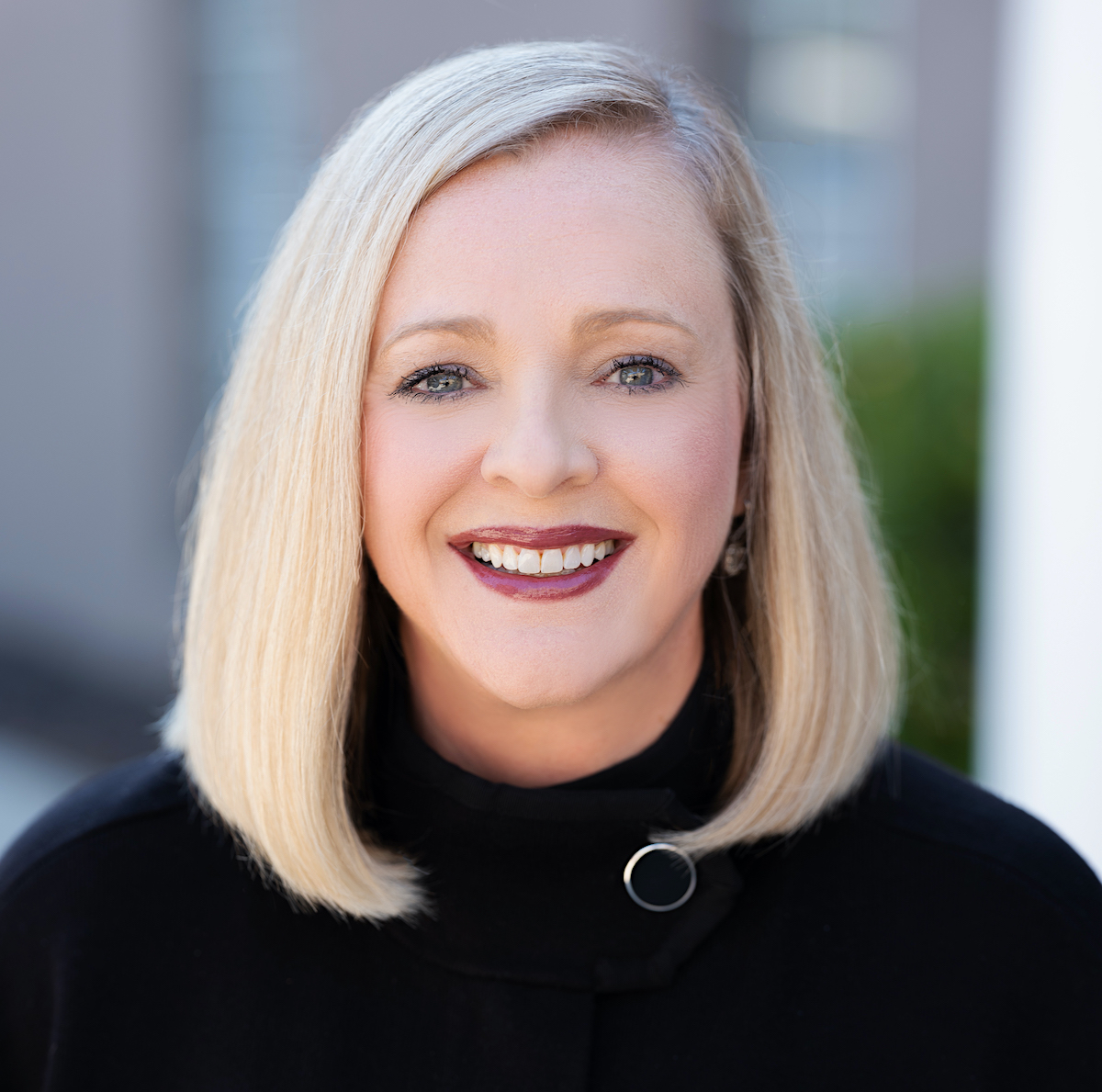
Prater
After allocating all the available 2020 Community Grant funding for COVID-19 relief grants, NGCF’s annual community grant cycle has returned.
“Over the course of these last 18 months we have sought to deepen our support for the community and facilitate grants to help meet critical needs due to the pandemic,” says NGCF President and CEO Michelle Prater. “I am proud of how we were able to provide over $1.2 Million in COVID grants and that we can now open our normal grant cycle again.”
NGCF grants provide program and general operating support to eligible organizations. Community Grants are funded by endowed unrestricted funds at NGCF and this year they will also include grants from the W. Frank and Lillie Mae Green Fund.
Organizations in NGCF’s service area may apply. This includes the North Georgia counties of Banks, Dawson, Fannin, Forsyth, Franklin, Habersham, Hall, Hart, Jackson, Lumpkin, Rabun, Stephens, Towns, Union and White.
Applications may be submitted online at www.ngcf.org/ngcf-community-grants. For more information about available grants or the application process, contact Margaux Dolenc at [email protected] or 770-535-7880.