Home Blog Page 1671

Nov. 19 is last day to request an absentee ballot for runoff election

Friday, Nov. 19 is the last day to request an absentee ballot for the Habersham County District 5 commissioner runoff election.

Georgia’s new voting laws require that absentee ballots must be requested up to 11 days prior to an election. If you are requesting an absentee ballot for the runoff, make sure you do so before 5 p.m. tomorrow.

Those 65 or older and those who are disabled who voted absentee in the Nov. 2 special election will automatically receive a runoff ballot, according to Habersham County Election Supervisor Laurel Ellison. Anyone else who voted absentee will have to request a runoff mail-in ballot if they plan to vote absentee again.

Voters may request an absentee ballot through the Habersham County Elections Office by calling 706-839-0170 or by visiting the Secretary of State’s My Voter Page. Online applications may be returned by mail, fax, email, or in person at the elections office.

The deadline for returning absentee ballots is 7 p.m. on election night, November 30. Absentee ballots can be dropped off at the Habersham County Elections Office, located in the basement of the Habersham County Administration Building.

Do you need a COVID-19 booster shot?

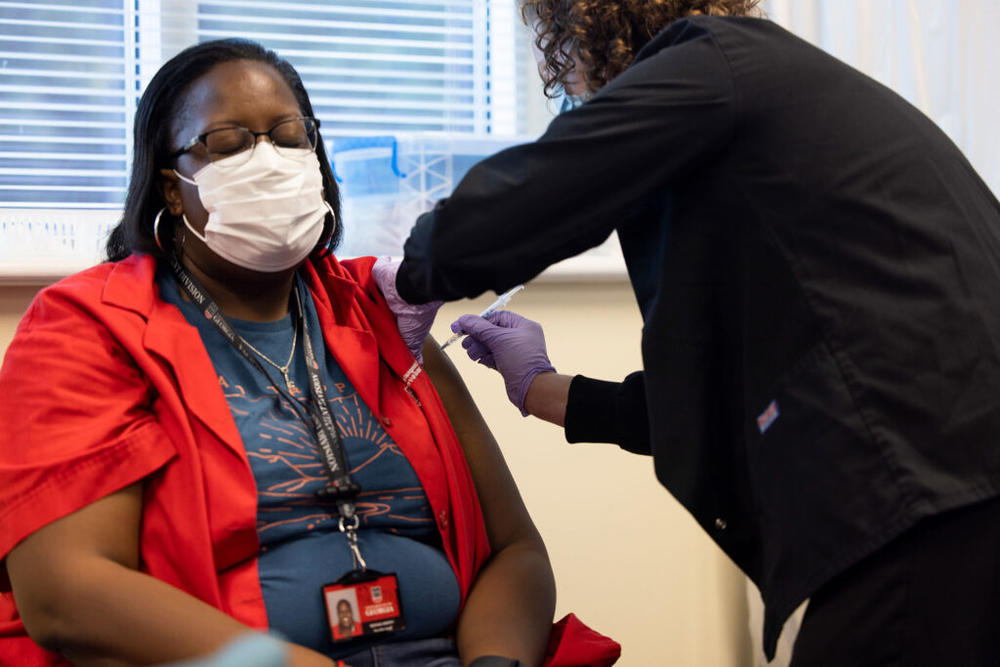
Nekesha Murphy (left) gets her COVID-19 vaccine from RN Ginn Holder at UGA's University Health Center. (Credit: Photo by Andrew Davis Tucker)

People vaccinated against COVID-19 have a more robust immune response than those who contracted the disease and recovered, according to a study from the University of Georgia.

The vaccines are still working very well, preventing hospitalization and severe disease, said Ted Ross with UGA’s Center for Vaccines and Immunology. Even as antibodies begin to wane, the immune responses that protect us are still quite good.

Whether or not someone needs a booster shot depends on that individual’s situation, Ross said.

“If you’re offered a booster shot, there’s no reason why you shouldn’t take it,” he said. “Your immune response will go up dramatically after the booster shot.”
Additionally, eligible individuals may choose which vaccine they receive as a booster dose. Some people may have a preference for the vaccine type that they originally received and others may prefer to get a different booster. The Centers for Disease Control and Prevention’s recommendations now allow for this type of mix-and-match dosing for booster shots.

MORE: Here’s how to get a booster shot in Georgia — and who should get one

Emory University infectious disease expert Dr. Jay Varkey said in a news conference last month that these boosters are the minimum number of vaccines needed to protect the most vulnerable.

“If you’re over 50 and if you have chronic medical conditions, you should get a booster,” he said. “And some of these chronic medical conditions are actually quite common, so this includes being overweight, having diabetes, having high blood pressure or having chronic heart disease, kidney disease or lung disease.”

Booster shots might also reduce transmission of the SARS-CoV-2 virus that causes COVID-19, UGA’s study, published in Frontiers in Immunology’s Vaccines and Molecular Therapeutics, shows.

“Some people may have gotten all three vaccinations and they still have a weak immune response to the vaccine, so having other people vaccinated is still helpful, said Ross, who led the study.

Ross added that after about six months, most people over age 65 have had a four-fold drop in concentration of antibodies from their peak when they got vaccinated. For younger people, it can range from two- to four-fold.

“On average, older people wane more quickly,” Ross said. “Therefore the booster shot is definitely taking them not only back to the level they were, but actually exceeding that original peak.”

Every year, a certain number of people die from influenza. Most of them are quite elderly, Ross said, and they generally have underlying health conditions.

Though both influenza and COVID-19 may not be lethal to most of the population, sickness definitely takes a huge toll on the economy, with people taking their kids out of school, having to miss work and such, he said.

“I mean, that’s where the economic toll is, in the millions to billions range, annually in the U.S., just for flu,” Ross said.

Because COVID-19 is new, researchers are still evaluating immunity. After another six to nine months, Ross said, we’ll know more about whether folks will benefit from future boosters.

For information about COVID vaccines or to schedule a vaccination appointment visit dph.ga.gov/covid-vaccine or vaccines.org.

This article appears on Now Habersham through a news partnership with GPB News

GHSA tables vote on Class A plan

The Georgia High School Association conceded Thursday that it can’t solve Class A’s problems in a day, so the reclassification committee tabled any vote on reorganization until public- and private-school representatives can meet and haggle further with the GHSA staff and executive director Robin Hines.

Ten Class A private schools have pulled out of the GHSA this month to join another association, leaving the Class A Private division with only about 25 football-playing schools slated for the 2022 season. There are 37 currently in Class A Private. Three others with Class A enrollment have elected to compete in Class 4A beginning next year.

The concern is that 25 football teams won’t be enough for a meaningful championship. Other sports might also be left short-handed.

So on Thursday at the GHSA’s offices in Thomaston, reclass committee members Steven Craft and Jasper Jewell proposed reorganizing Class A into divisions with larger and smaller schools instead of public and private schools beginning in 2022-23. That plan might result in more than 40 football-playing schools in each class but at the expense – public schools would say – of having Class A public and private schools playing for the same championships again.

Many smaller public schools threatened to pull out of the GHSA in 2011 until they got their way starting in 2012-13, which was having separate public and private championships.

Another reclass member, Jesse Crews of public school Charlton County, proposed going back to the 2012-20 setup in which Class A public and private schools competed together in eight regions, playing each other in the regular season, but separating for the state championships, ensuring public and private champions.

Davis Russell, a reclass member from Bremen, suggested that the GHSA remove its Class A exemption on the out-of-zone enrollment multiplier, allowing Class A schools to be moved into higher classes. Some objected, saying this would entail re-doing several classes and not just Class A since a multiplier would push several schools into 3A and 2A.

And it’s no secret that schools in classes 3A and 2A oppose taking on private schools. Only one, Aquinas, is currently slotted for one of those classes in 2022-23.

The “spirited discussion,” as described in the meeting’s minutes, came to a close with no decision, which was not unexpected.

Lakeview Academy of Gainesville, a GHSA member since 1972, on Wednesday had become the 10th GHSA Class A school to announce it was leaving for the Georgia Independent School Association. More could follow.

Others officially leaving are St. Anne-Pacelli of Columbus, Heritage of Newnan, George Walton Academy of Monroe, Strong Rock Christian of Locust Grove, Deerfield-Windsor of Albany and Macon schools Mount de Sales, First Presbyterian, Stratford Academy and Tattnall Square.

Several have cited a new GHSA rule that makes transfer students ineligible at private schools for one year unless they move into the public school district in which the private school resides.

In other business, 13 schools won appeal to move to new regions within the same classification for 2022-23.

Class 7: Discovery from 8 to 7; Osborne from 2 to 5

Class 5: Villa Rica from 7 to 5

Class 4A: Hapeville Charter from 4 to 6; Seckinger from 6 to 8

Class 3A: Oconee County from 8 to 7; Gilmer from 7 to 6; Pickens from 7 to 6; Liberty County from 3 to 4

Class 2A: Fannin County from 8 to 7; Oglethorpe County from 8 to 3; Social Circle from 4 to 8

Class A Public: Warren County from 8 to 7

Produced by Georgia High School Football Daily. To sign up for GHSF’s free email newsletter click here.


Small but mighty bonsai

With colder days ahead, my focus tends to shift to my indoor plants. I’m fascinated by bonsai and would like to try my hand at these miniature versions of the big boys. Plus, as we get closer to Christmas, they would make great gifts for my plant loving friends.

I’ve seen bonsai plants for years but through some research, learned that I’m sort of late to the game. They’ve been around for quite some time. In fact, bonsai is said to be one of the oldest horticultural pursuits, originating in China during the Han Dynasty (206 BC-220 AD).

Many people have a misconception of what bonsai really is. The typical question many people ask is: “Are bonsai their own species of trees?”

A bonsai tree is a living tree or shrub which has been grown in a way which gives the impression of being a full-sized, mature tree. Bonsai trees are generally grown in shallow ceramic pots. A bonsai is not a species of tree; in fact many species of tree can be turned into bonsai through various techniques.

In essence, any plant that can be grown in a small container can be cultivated as a bonsai. The most popular varieties are pines, ficus, jade, maples, whose leaves change their color in autumn; flowering trees, like the cherry and plum; and fruit-bearing trees, like the quince and persimmon. Pretty amazing, huh?

A common misconception about the hobby is that it is ‘cruel’, with the trees being starved in order to dwarf them. Nothing could be further from the truth! Bonsai trees require regular watering, feeding and repotting to keep them in optimum health and in many cases they are actually healthier that their counterparts in the wild, enjoying the same longevity. Some trees in Japan have recorded histories spanning several centuries and are often traditionally passed from generation to generation, keeping them in the same family during their long lifetime.

Here is a short list of good subjects for bonsai:

  • Ficus (many species)
  • Crassula (jade plant)
  • Carmona (tea plant)
  • Schefflera
  • Calamondin
  • Sand pear
  • Bougainvillea
  • Gardenia
  • Jacaranda
  • Jasmine
  • Pomegranate
  • Chinese elm
  • Olive
  • Rosemary

How long does it take to grow a bonsai tree?

Have patience, it can take 4 to 6 months to create a pleasing appearance.

The shape of your bonsai depends on the material you are using. Some plants such as jade are too soft to wire into shape and will instead need to be pruned appropriately. After deciding on the look you want to achieve, prune branches starting from the base of the tree to expose the trunk. The root mass may need to be reduced to fit into the new container. If the roots are drastically cut back, the top growth will need to be cut way back as well. When the roots are newly cut, the plant will need to be kept out of the sun while it recovers. Branches and pliable trunks can be wrapped with wire to train them into the appropriate shape.

The growing of bonsai, which translates literally as ‘plant in a tray’, is a truly satisfying hobby and combines both horticulture and art, creating trees that are often referred to as ‘living sculptures’. Above all it is important that the trees are kept healthy and in excellent condition, as with any pot plant. Pruning and shaping does, however, require a certain amount of artistic imagination to visualize the future development of the trunk and branches.

Caring for bonsai

With such a reduced root ball, proper watering is critical to keep your bonsai growing and healthy.

  • Feel the soil and water when it feels dry just below the top.
  • Water with a hose sprayer until the soil is saturated or dunk the whole pot in water up to the rim.
  • Either way, let the excess water drain from the newly watered plant, since sitting in a wet saucer can rot the roots.

Fertilize with a bonsai-specific liquid fertilizer diluted to half strength twice a month during active growth—April through September—and cut back to once a month October through March.

Your established bonsai will eventually need repotting.

  • Each time you repot you will need to cut the roots back.
  • Put the plant in the shade and stop fertilizing until it recovers to avoid burning freshly pruned roots.

The look of your plant will change over time as it matures. You can continue snipping the growing tips back and even removing some of the leaves to keep it in the shape you desire.

Bonsai makes a great office plant or an inspired gift for the gardeners in your life.

The closest Bonsai Society group I could find to our area is in Atlanta. You might want to visit their site if you are interested in giving a bonsai a try.

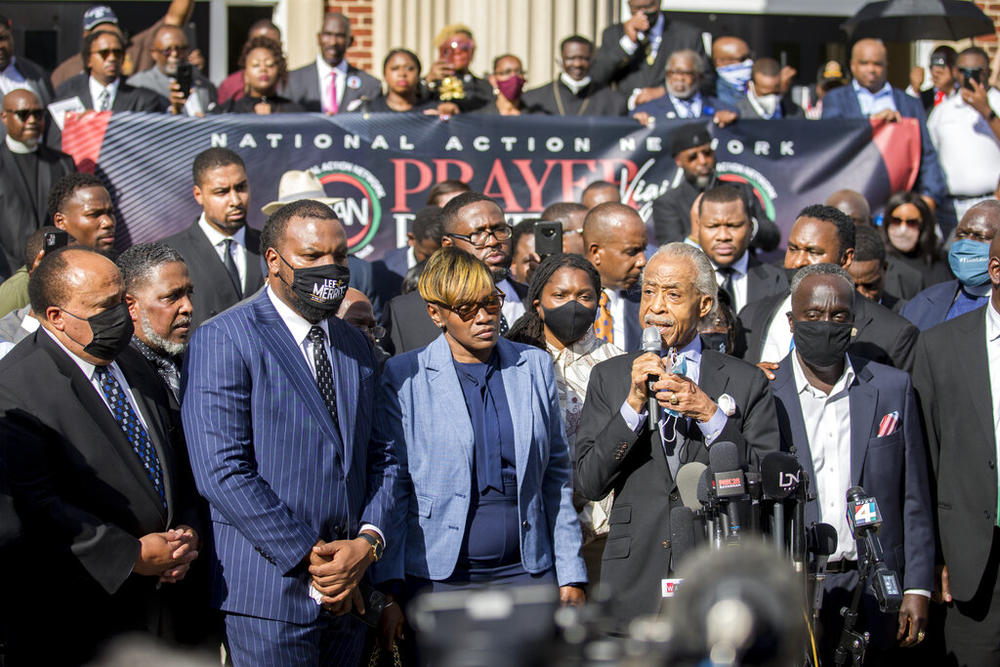
Black pastors rally outside trial over Arbery’s killing

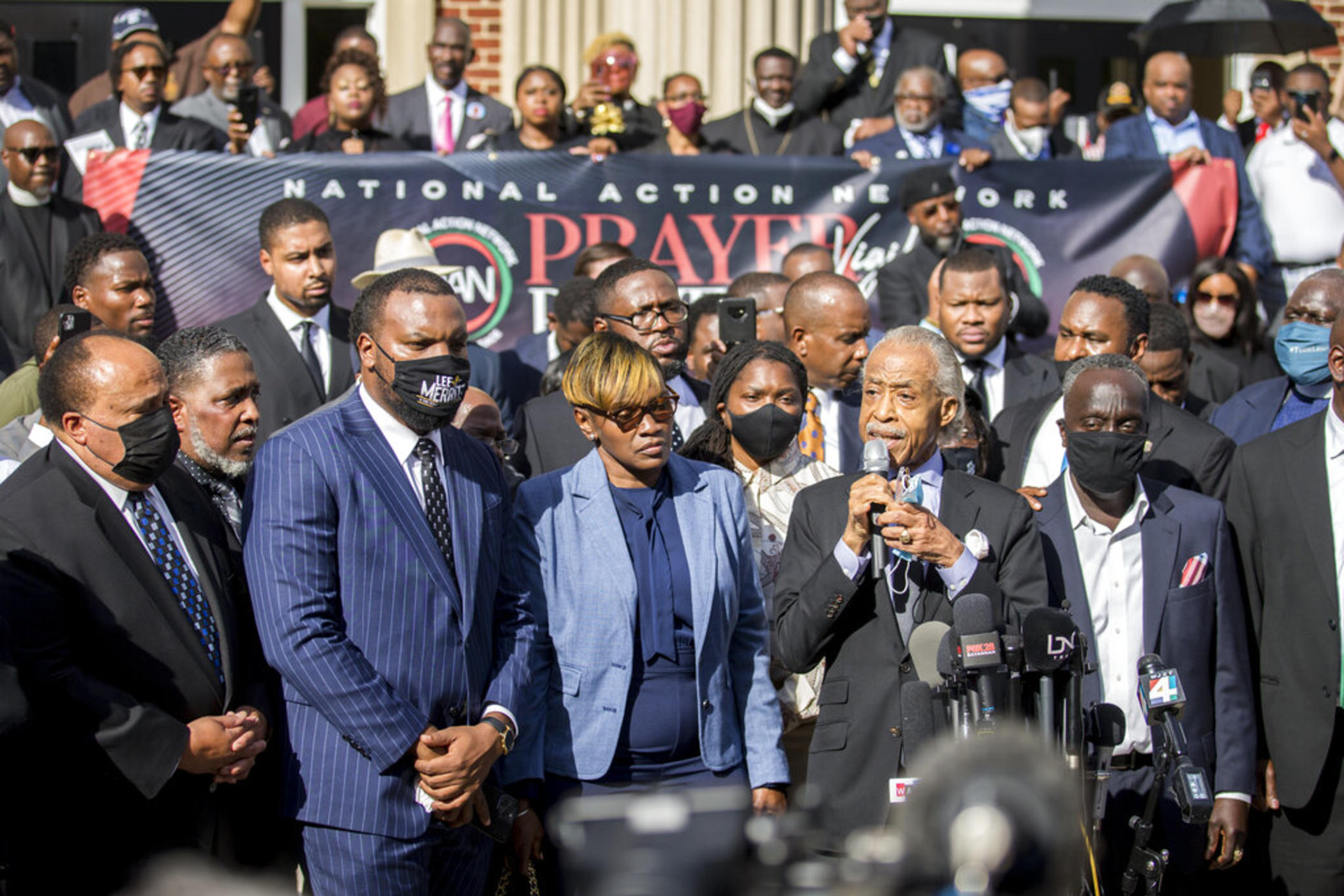
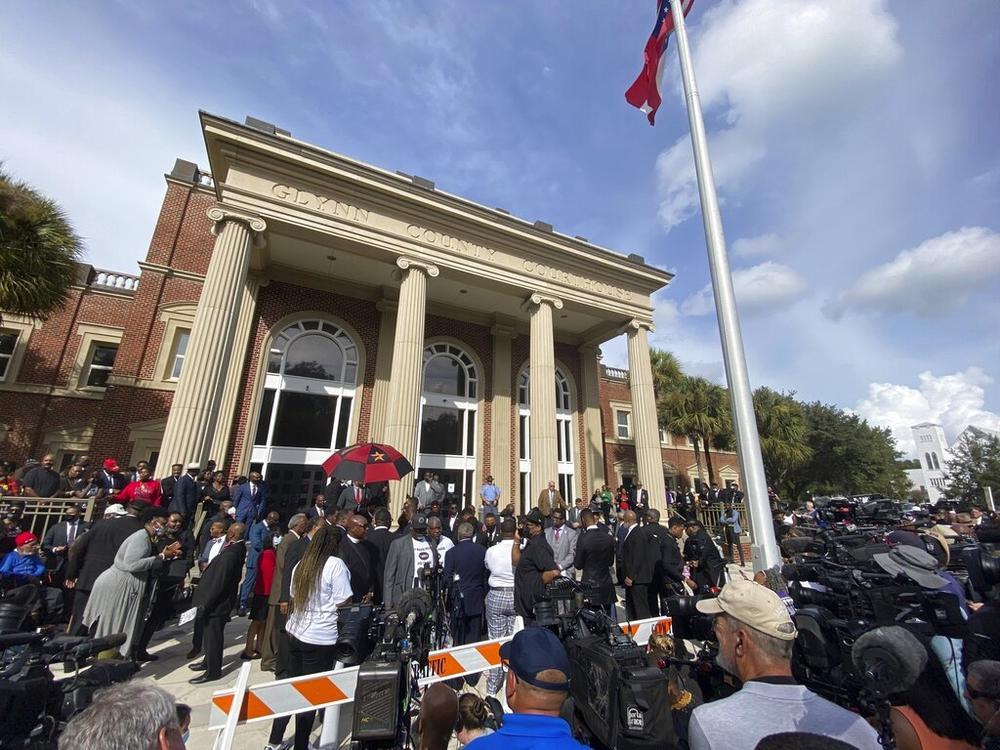
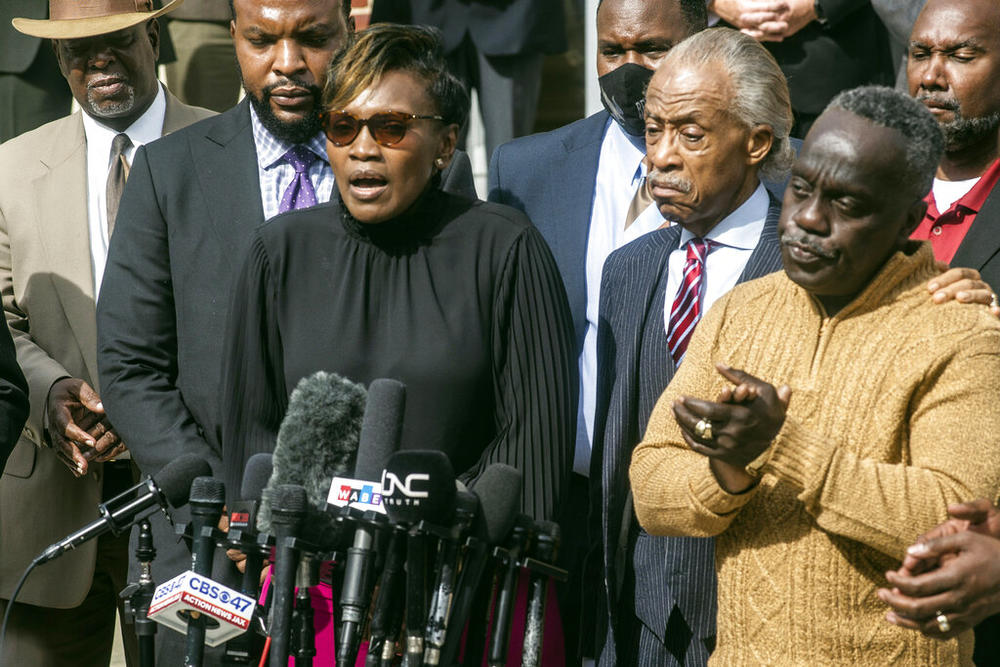
The Rev. Al Sharpton, second from right, flanked by Ahmaud Arbery's parents, Wanda Cooper-Jones, left, and Marcus Arbery, right, speaks to over nearly 750 pastors, supporters and family of Ahmaud Arbery gathered outside the Glynn County Courthouse during a Wall of Prayer event, Thursday, Nov. 18, 2021, in Brunswick, Ga. Last week Sharpton's attendance in the trial of Greg McMichael and his son, Travis McMichael, and a neighbor, William "Roddie" Bryan prompted defense attorney Kevin Gough to object to his presence and other Black pastors in court. (AP Photo/Stephen B. Morton)

Hundreds of pastors both rallied and prayed Thursday at the Georgia courthouse where three white men are on trial in the killing of Ahmaud Arbery, gathering in response to a defense lawyer’s bid to keep Black ministers out of the courtroom.

As testimony resumed inside the Glynn County courthouse, with its four huge columns, arched windows and shaded lawn, a group of mostly Black ministers gathered outside — a sea of dark suits and white collars.

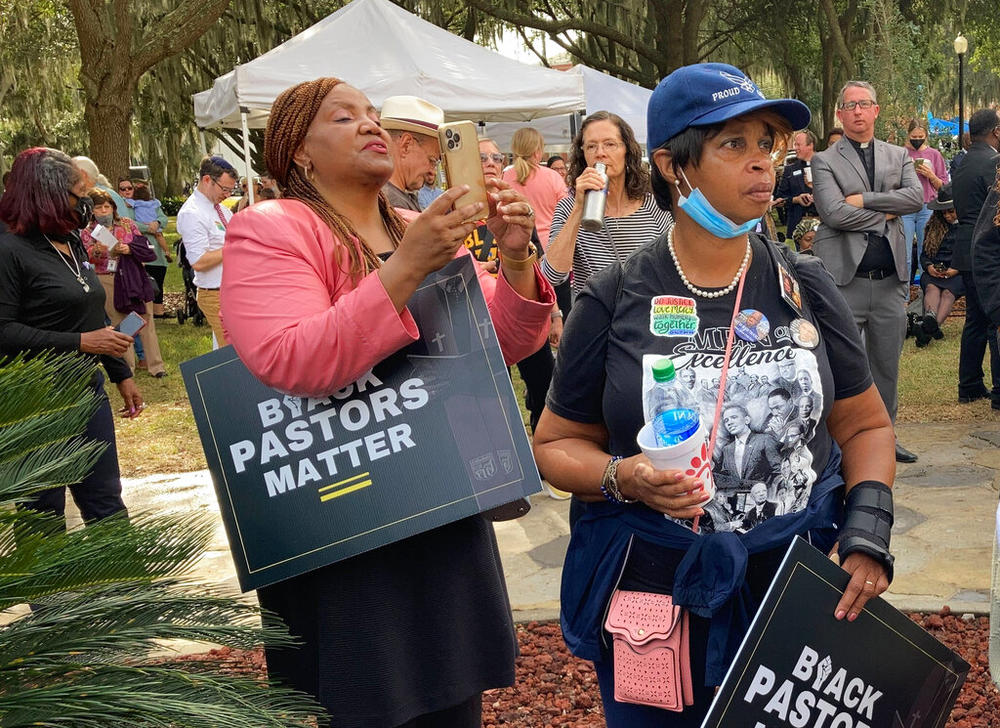
Protesters stand outside the Glynn County Courthouse on Thursday, Nov. 18, 2021 in Brunswick, Ga., during the trial of Greg McMichael and his son, Travis McMichael, and a neighbor, William "Roddie" Bryan. The three are charged with the February 2020 slaying of 25-year-old Ahmaud Arbery.
Protesters stand outside the Glynn County Courthouse on Thursday, Nov. 18, 2021 in Brunswick, Ga., during the trial of Greg McMichael and his son, Travis McMichael, and a neighbor, William “Roddie” Bryan. The three are charged with the February 2020 slaying of 25-year-old Ahmaud Arbery. (AP Photo/Jeffrey Collins)

Many carried signs reading, “Black pastors matter,” and some wore buttons with Arbery’s picture and the hashtag they were using for the case, “#JusticeForAhmaud.” A vendor sold T-shirts under one tent while a woman under another offered water and snacks and asked people to put donations in a pickle jar.

The Rev. Al Sharpton announced the rally after a defense attorney intensified frustrations in the coastal Georgia community of Brunswick when he said he didn’t want “any more Black pastors” sitting in the courtroom with Arbery’s family.

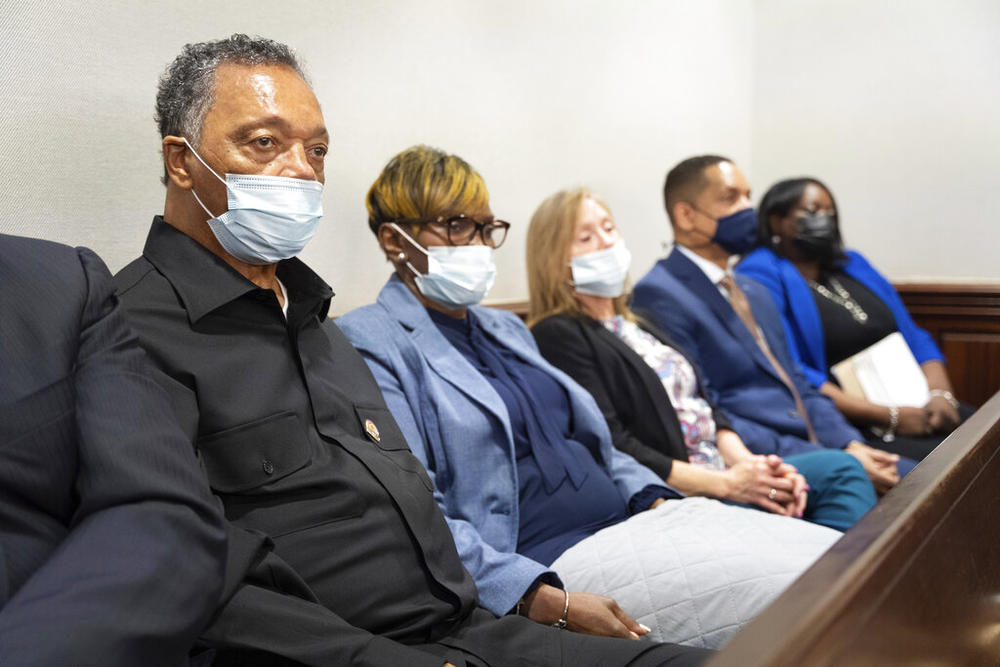
As the crowd grew outside, the Rev. Jesse Jackson once again joined Arbery’s family in the courtroom.

Rev. Jesse Jackson, left, sits with Wanda Cooper-Jones, mother of Ahmaud Arbery, during the trial of Arbery at the Glynn County Courthouse on Thursday, Nov. 18, 2021 in Brunswick, Ga. Travis McMichael, his father Greg McMichael, and a neighbor William "Roddie" Bryan are charged charged with the February 2020 slaying of 25-year-old Ahmaud Arbery.
Rev. Jesse Jackson, left, sits with Wanda Cooper-Jones, mother of Ahmaud Arbery, during the trial of Arbery at the Glynn County Courthouse on Thursday, Nov. 18, 2021 in Brunswick, Ga. Travis McMichael, his father Greg McMichael, and a neighbor William “Roddie” Bryan are charged charged with the February 2020 slaying of 25-year-old Ahmaud Arbery. (Sean Rayford/Pool Photo via AP)

The Rev. Gregory Edwards was broadcasting a Facebook Live video back to his friends in Allentown, Pennsylvania, where he is pastor of the Resurrected Life Community Church, United Church of Christ. As soon as the call for pastors to come to Brunswick went out, Edwards said, he rearranged his schedule to fly down.

“I would have walked,” said Edwards, who also runs a multifaith, multiracial community organizing group. Edwards said he cried when he saw the video of the 25-year-old Black man’s shooting death and thought of his three Black adult sons.

“Through technology we have been forced to bear witness to the public executions of our Black brothers and sisters,” Edwards said.

Hundreds of pastors rally during the trial of Greg McMichael and his son, Travis McMichael, and a neighbor, William "Roddie" Bryan outside the Glynn County Courthouse, Thursday, Nov. 18, 2021, in Brunswick, Ga. The three are charged with the February 2020 slaying of 25-year-old Ahmaud Arbery.
Hundreds of pastors rally during the trial of Greg McMichael and his son, Travis McMichael, and a neighbor, William “Roddie” Bryan outside the Glynn County Courthouse, Thursday, Nov. 18, 2021, in Brunswick, Ga. The three are charged with the February 2020 slaying of 25-year-old Ahmaud Arbery. (AP Photo/Stephen B. Morton)

A group of businesses in Brunswick and surrounding Glynn County joined together to provide a lunch of free barbecue sandwiches, shrimp and side dishes before the pastors rallied. Organizer Mike Mally said the group wanted to show that the community was united, not divided by race.

“We figured this was a good thing to do with all these visitors,” Mally said.

Cellphone video of Arbery’s death on Feb. 23, 2020, leaked online about two months later, deepening a national outcry over racial injustice. The defense contends Arbery was killed in self-defense.

The man who shot Arbery, Travis McMichael, testified on Thursday that Arbery did not speak, show a weapon or threaten him in any way before he raised his shotgun and pointed it at him.

This article appears on Now Habersham through a news partnership with GPB News

Joint congressional map slated for Senate vote

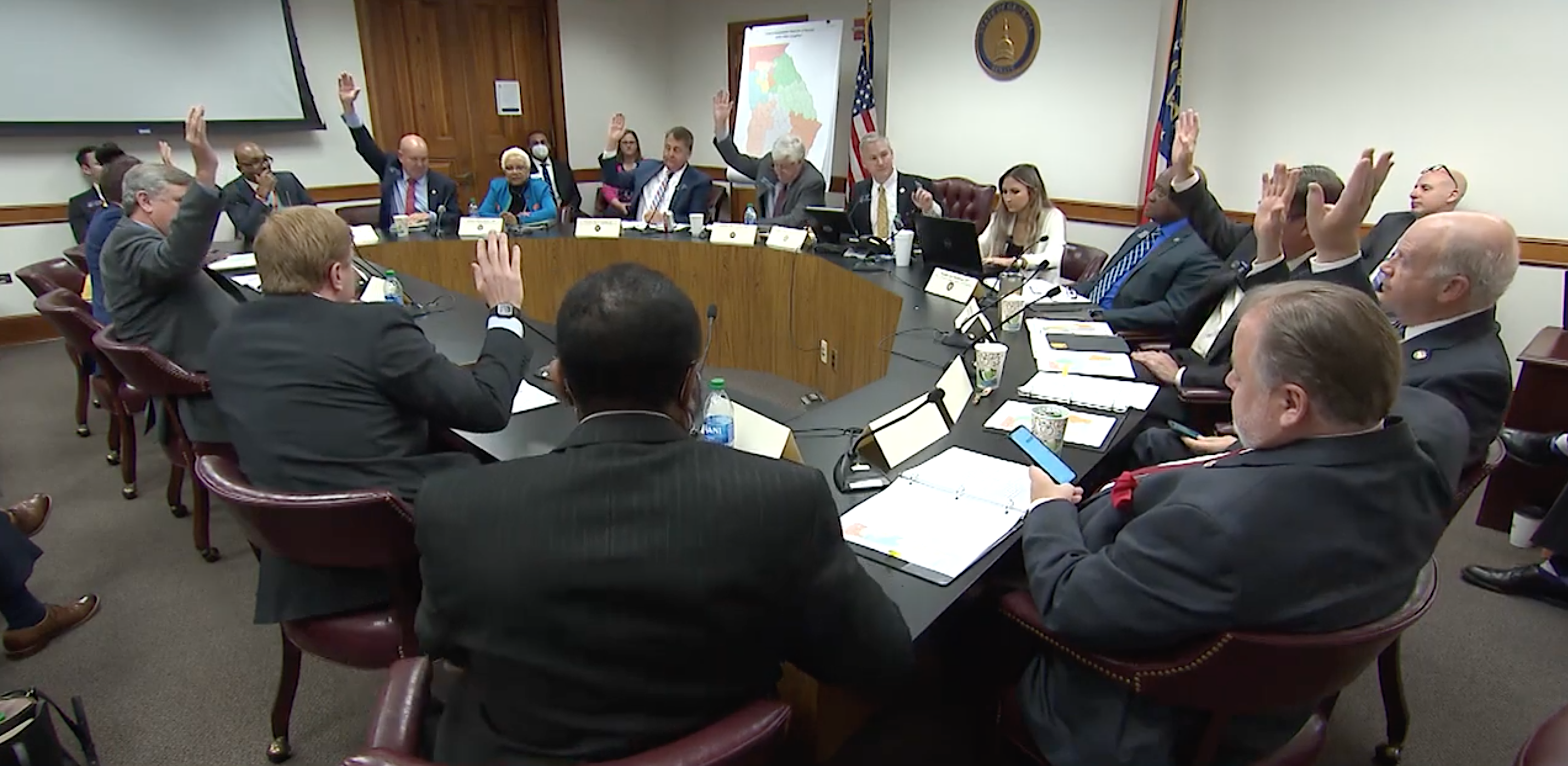
Republican members of the Senate Reapportionment and Redistricting Committee vote down a congressional map proposed by Democrats, 9-5. The GOP map passed by the same margin. (screenshot Lawmakers GPB)

The joint congressional map heads to the floor of the Senate for a vote tomorrow. After gaining approval from the Reapportionment and Redistricting Committee, it moved forward by a vote of 9-5 along party lines.

Before the committee vote, Senate Minority Leader Sen. Gloria Butler (D-Stone Mountain) presented the map by the Democratic Caucus first released Oct. 21. The Democrats contend their map more evenly represents the state’s electorate, especially when it comes to minorities.

“Georgia’s growth has been entirely the growth of minority residents,” Butler said. “The number of white residents has declined.”

After Butler’s presentation, speakers focused mainly on how the Republican map splits Cobb County into four districts — stretching the 6th District into strong Republican-learning counties.

“This makes it unlikely that people of color will be able to elect a candidate of choice such as Black congresswoman Lucy McBath,” said David Garcia with the GALAO Impact Fund, which advocates for the Latino community across Georgia.

At the House hearing, several speakers complained about south Cobb’s redistricting.

“The citizens of Austell and Powder Springs would currently be in Congressional District 14, which is Marjorie Taylor Greene[‘s],” Rep. Erica Grove (D-Austell) said. “This is not what the citizens of my district deserve.”

The House redistricting committee will not meet Friday but hold a virtual hearing on Saturday morning.

This article appears on Now Habersham through a news partnership with GPB News

Fire leaves Rabun County family homeless: ‘All we’ve got left is the clothes on our backs’

(photo submitted)

As Carrie Watts stood with her husband and children watching their house burn, she shared her anguish online.

“At my lowest point of my entire life,” she wrote on Facebook. “I have lost everything I have worked hard for my entire life. My chest is so tight.”

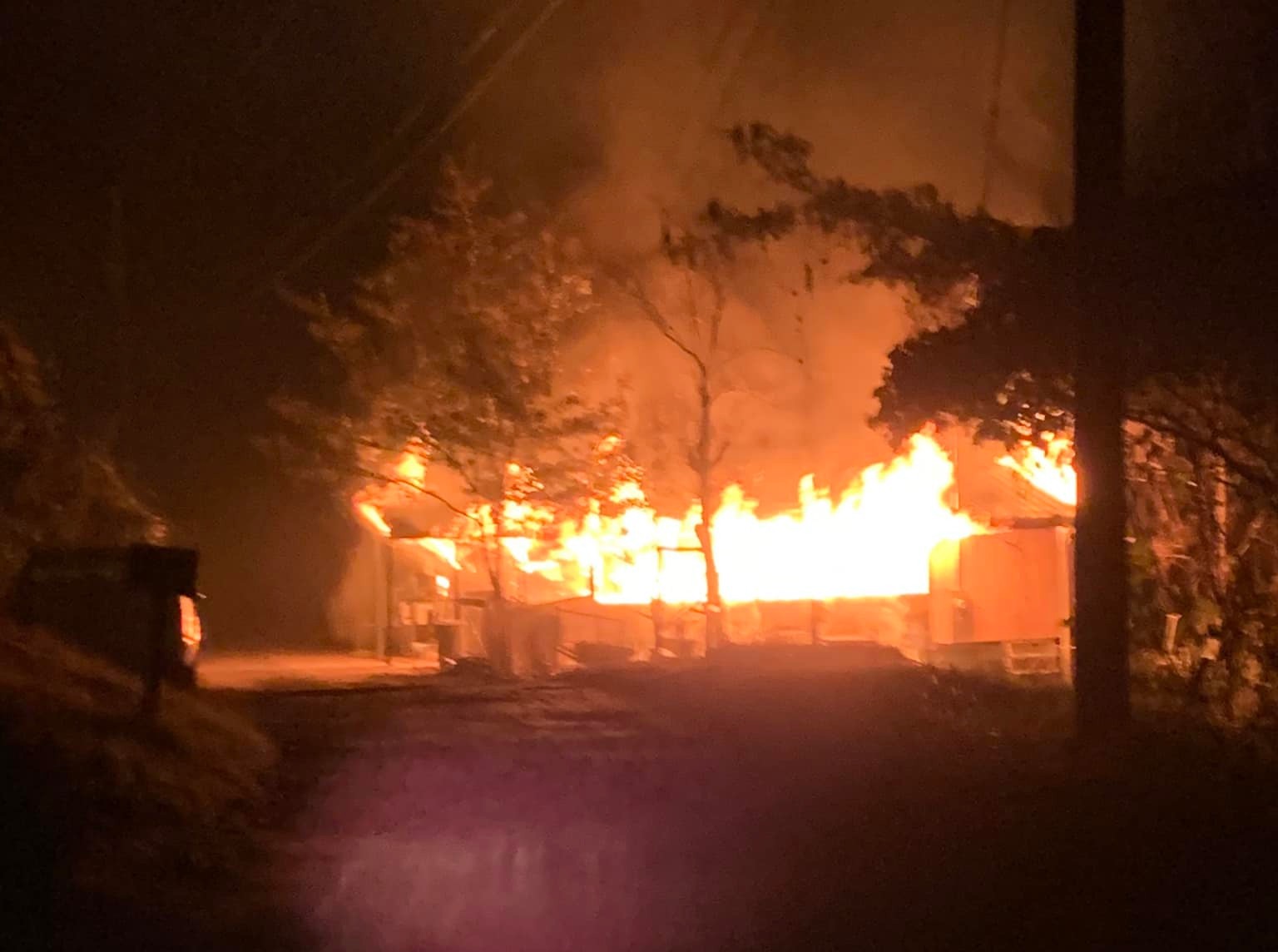
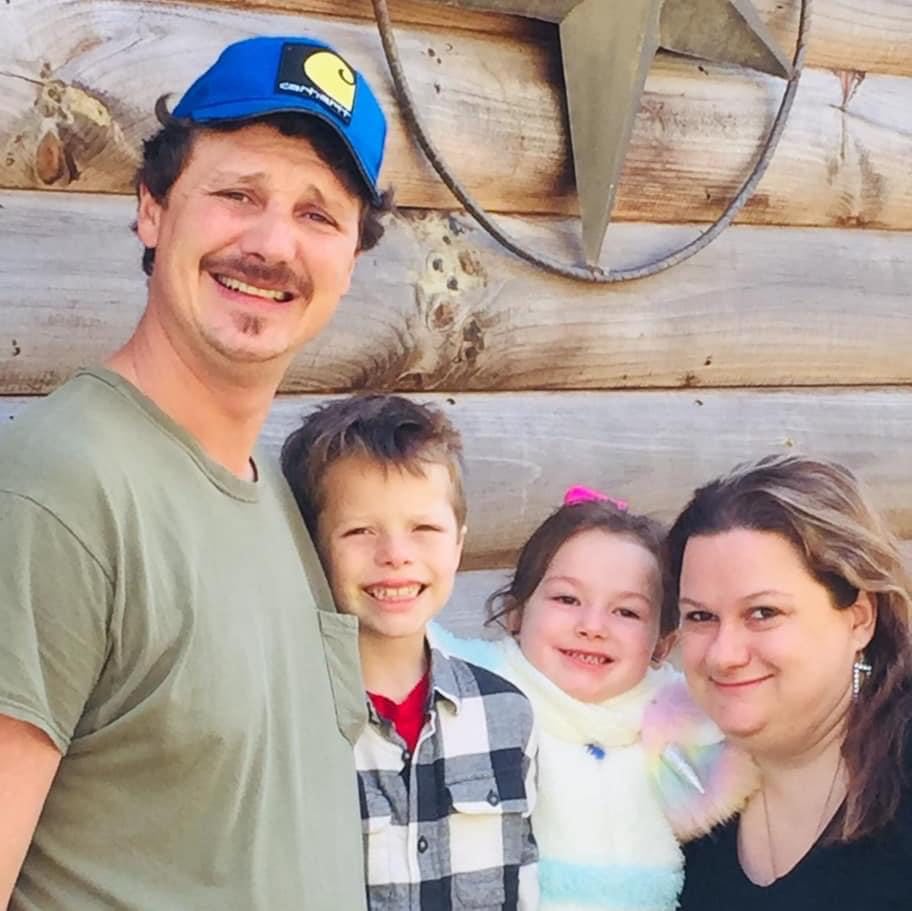
When the fire broke out inside their Rabun County home late Wednesday night, Watts, her husband, Cam, and their two children, Mason and Maleigha, escaped with just the clothes on their backs.

Firefighters responded to the blaze at 144 JB and Fred Lane in Clayton at 8:25 p.m. on November 17. When they arrived, the approximately 1,000 square foot single-family home had fire “showing from all sides,” says Rabun County Assistant Fire Chief Justin Upchurch. Firefighters kept the fire from spreading but were unable to save the home. It was a total loss.

The Watts family, from left, Cam, Mason, Maleigha, and Carrie. (photo submitted)

“Please pray please pray,” Watts desperately pleaded, asking, “Where do we go from here?”

The immediate answer to that is to family. Loved ones took in the now homeless young family of four and gave them a place to stay overnight. Officials notified the Red Cross to assist them. Friends and strangers are helping out too.

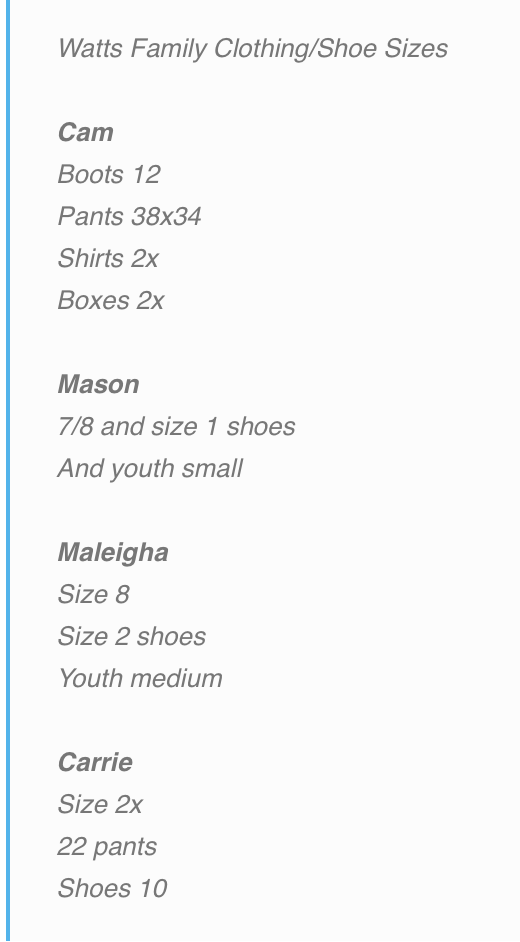
Beyond shelter and food, the family’s most immediate needs are clothes, shoes, and personal hygiene supplies. They’re also accepting cash donations through Venmo @carrieann1987.

Friends have set up donation collection sites in Lakemont at 7247 Old Highway 441 South and 6524 Highway 441 South.

Watts says fire officials think the blaze may have started in their home’s wiring, but no official cause has been released.

“The cause of the fire is unknown at this time,” says Upchurch.

This is the third time in less than a week that fire has displaced an area family. Two families in Habersham were forced from their homes in fires in Mount Airy and Demorest.

This article has been updated with additional information from Rabun County Fire Services

Infant critically injured in fatal wreck recovering, leaves ICU

(Jessica Burgess/Facebook)

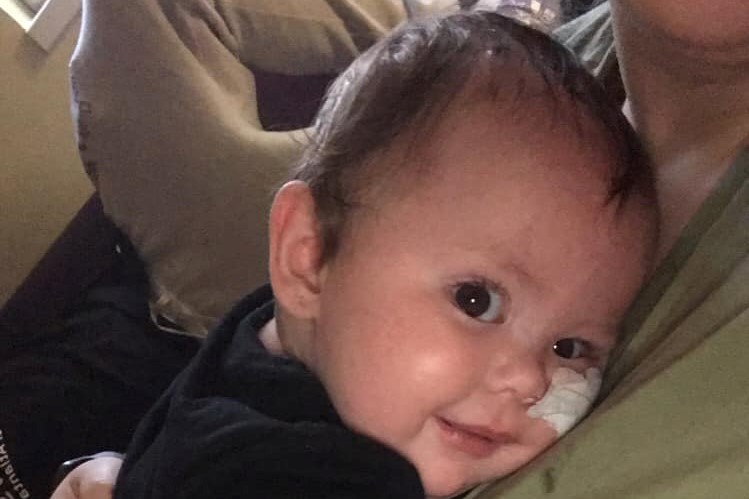
The infant boy critically injured in the Oct. 29 wreck at Mt. Zion Road and GA-365 that claimed the lives of two is on the road to recovery.

The wreck on the night of Oct. 29 took the lives of 5-year-old Lincoln Burgess and his aunt Cynthia Wade when their vehicle was hit by a van headed Southbound on 365. Lincoln’s mother and Wade’s sister, Jessica Burgess, her infant son Hudson Burgess and cousin Denise Wade survived the crash.

(Jessica Burgess/Facebook)

Hudson was critically injured in the wreck. He has spent the past three weeks in the Children’s Hospital of Atlanta’s Intensive Care Unit, where he has received a blood transfusion, been in a medically induced coma, on an oxygen tube, feeding tube, received treatment for brain swelling, fractured bones and countless other treatments to save his life.

RELATED: Family that lost aunt, nephew in fatal wreck needs community’s support

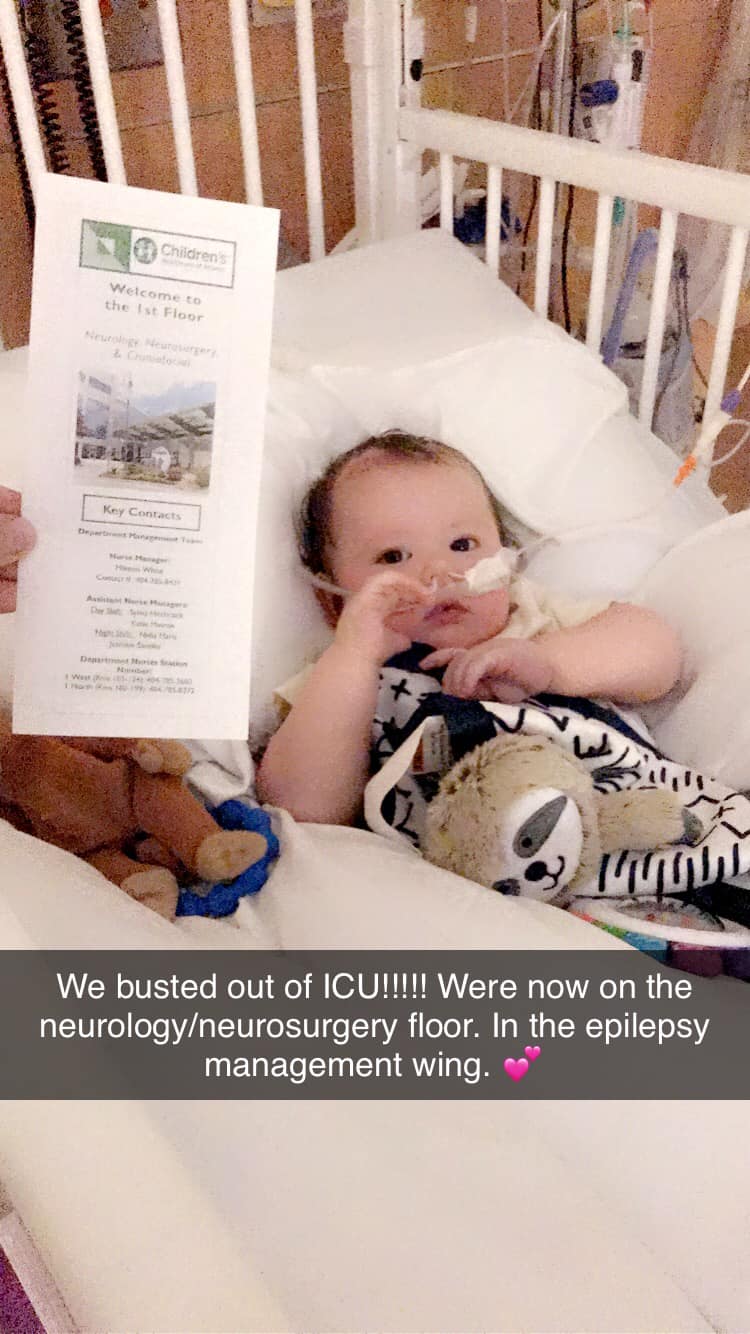
As of yesterday at 3:30 a.m., Hudson is now out of CHOA’s ICU and is no longer on oxygen. Hudson’s recovery is continuing in the Epilepsy Management Wing of the hospital, where his doctors are helping him with physical and occupational therapy.

“He did great with physical therapy,” Burgess writes in a Facebook update. “He’s not got the best control but he will be sitting unassisted again in no time!”

Mother Jessica Burgess says that due to his brain injuries, healthcare workers at CHOA advised her that Hudson will likely have to “start from scratch,” and he may be delayed developmentally long-term. She says that a delay is something they can get through, with her son Lincoln having been on the Autism spectrum.

Hudson is growing stronger each day, and was able to sit up unassisted for 15 minutes while playing and singing with his mother just before he left the ICU.


“I could not be more on top of the world than I am right this moment,” Burgess says in a Facebook post. “So proud of the warriors I raised! Not one, but both of my boys are pure strength.”

Burgess asks her community for continued prayers of healing for Hudson, comfort for her grieving family and financial support from insurance.

“We honestly could not have made it through without the outreach and support of family and community,” Burgess tells Now Habersham. “We are forever grateful and thankful! God’s mercy is with us all of this way!”

If you would like to donate to the family, you can do so through their GoFundMe page.

Baldwin’s “Shop With a Hero” provides clothes, toys for area children

Shop with a Hero (previously Shop with a Cop) began in Baldwin in 2014. Since then, police officers and firefighters, like these pictured in 2019, have raised money and donated their time annually to spread Christmas cheer. (Daniel Purcell/Now Habersham)

The City of Baldwin’s annual “Shop With a Hero” provided 20 children in need with toys and clothing in time for the holiday season on Wednesday.

For many children across the United States and in Habersham County, financial hardship is a reality that takes away from holiday fun, but Baldwin’s Fire and Police Departments made sure that children in need would have clothes to keep them warm and toys under the Christmas tree this winter.

The program began in 2014 when the Baldwin Police Department started the “Shop with a Cop” program, but as department heads changed over time, the police and fire departments are now both involved in the once-a-year event. Funds to take area children shopping come from raffles and donations that begin during the summer.


This year, the charity event raised more than $6,000 to disperse among a group of 20 children, the most the city has raised in its seven years.

“All children involved had a wonderful time and also got much-needed clothing,” Baldwin Fire Cheif Joe Roy says. The children were able to buy $150 worth of clothing and $150 worth of toys.

Seven Baldwin firefighters and two police officers, alongside Baldwin City Councilman Larry Lewallen, attended the event to help kids shop at Walmart in Cornelia. Baldwin’s public safety departments were also able to purchase car seats for two children that didn’t have them.

“I would like to thank the whole community for helping us in the fundraisers that we do for this program,” Roy said. “Without them, we would not be able to do this.”

Defense rests after shooter testifies Ahmaud Arbery never threatened him

Defendant Travis McMichael testifies during his trial for the killing of Ahmaud Arbery at the Glynn County Courthouse on Thursday, Nov. 18, 2021 in Brunswick, Ga. Travis McMichael, his father Greg McMichael, and a neighbor William "Roddie" Bryan are charged charged with the February 2020 slaying of 25-year-old Ahmaud Arbery. (Sean Rayford/Pool Photo via AP)

Defense attorneys for the three men accused of killing Ahmaud Arbery rested Thursday after calling a total of seven witnesses.

The people who testified in the men’s defense included the man who fatally shot Arbery, Travis McMichael. Six neighbors testified about their concerns regarding crime in the neighborhood.

Closing arguments are scheduled for Monday at 9 a.m.

The man who killed Ahmaud Arbery testified Thursday that Arbery did not speak, show a weapon or threaten him in any way before he raised his shotgun and pointed it at the 25-year-old Black man.

Travis McMichael was among only seven total defense witnesses called to the witness stand before attorneys for all three of the white defendants rested Thursday afternoon. Superior Court Judge Timothy Walmsley scheduled closing arguments in the trial for Monday.

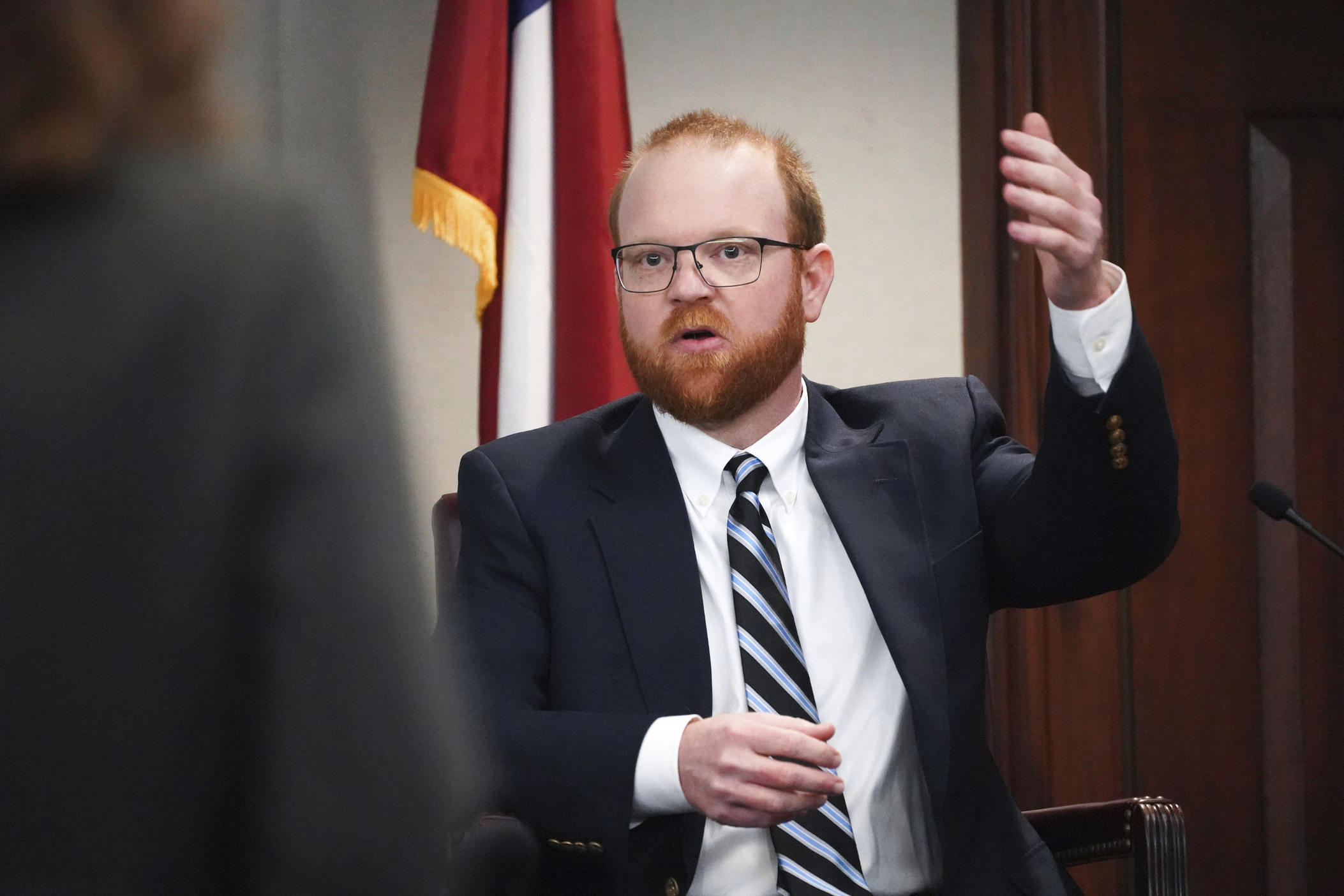
Under cross-examination by the prosecution on his second day of testimony, McMichael said he was “under the impression” that Arbery could be a threat because he was running straight at him and he had seen Arbery trying to get into the truck of a neighbor who had joined in a pursuit of Arbery in their coastal Georgia neighborhood.

“All he’s done is run away from you,” prosecutor Linda Dunikoski said. “And you pulled out a shotgun and pointed it at him.”

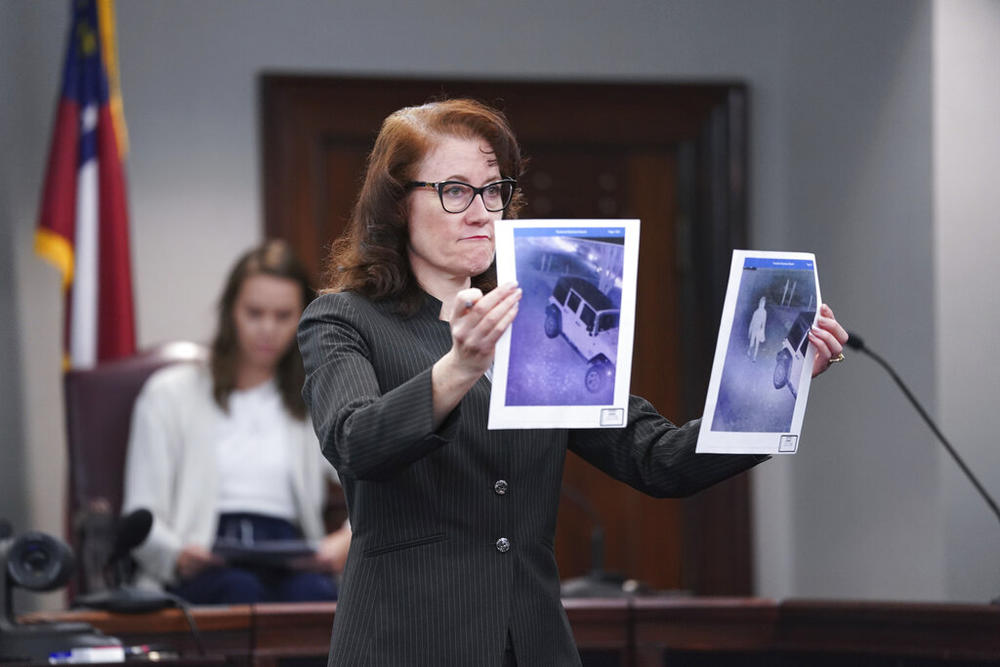
Prosecutor Linda Dunikoski shares evidence during the trial of the killers of Ahmaud Arbery at the Glynn County Courthouse on Thursday, Nov. 18, 2021, in Brunswick, Ga.
Prosecutor Linda Dunikoski shares evidence during the trial of the killers of Ahmaud Arbery at the Glynn County Courthouse on Thursday, Nov. 18, 2021, in Brunswick, Ga. (Credit: Pool photo)
Cellphone video from the Feb. 23, 2020, shooting — replayed in court Thursday — shows Arbery running around the back of McMichael’s pickup truck after McMichael first points the shotgun while standing next to the open driver’s side door. Arbery then runs around the passenger side as McMichael moves to the front and the two come face to face. The truck blocks any view of them until the first gunshot sounds.
McMichael’s testimony Wednesday marked the first time any of the three men charged with murder in Arbery’s death has spoken publicly about the killing. He said that Arbery forced him to make a split-second “life-or-death” decision by attacking him and grabbing his shotgun.
Dunikoski noted Thursday that’s not what McMichael told police in an interview about two hours after the shooting occurred.

“So you didn’t shoot him because he grabbed the barrel of your shotgun,” Dunikoski said. “You shot him because he came around that corner and you were right there and you just pulled the trigger immediately.”

“No, I was struck,” McMichael replied. “We were face to face, I’m being struck and that’s when I shot.”

McMichael said he had approached Arbery because neighbors indicated something had happened down the road and he wanted to ask Arbery about it. Arbery was running in the Brunswick neighborhood at the time. He said Arbery stopped, then took off running when McMichael told him police were on the way.

Asked how many times he had previously pulled up behind strangers in the neighborhood to ask them what they were doing there, McMichael said never.

“You know that no one has to talk to anyone they don’t want to talk to, right?” Dunikoski said.

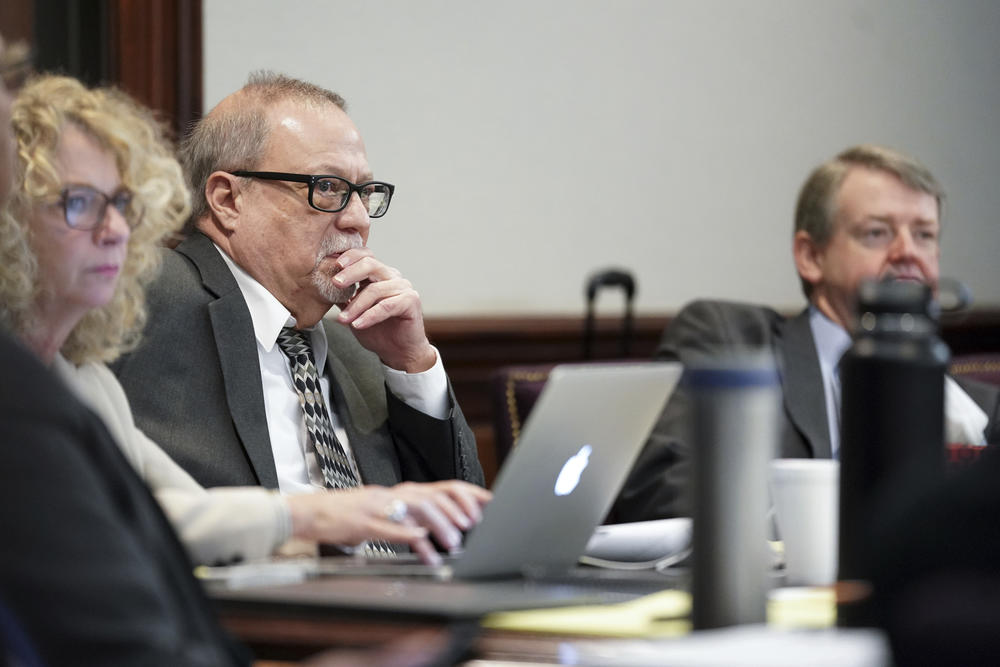
Defendant Greg McMichael listens to testimony during his trial for the killing of Ahmaud Arbery at the Glynn County Courthouse on Thursday, Nov. 18, 2021, in Brunswick, Ga.
Defendant Greg McMichael listens to testimony during his trial for the killing of Ahmaud Arbery at the Glynn County Courthouse on Thursday, Nov. 18, 2021, in Brunswick, Ga. (Credit: Pool photo)
The prosecutor also pressed McMichael on why he didn’t include some details of his testimony Wednesday in his written statement to police, namely the part about his telling Arbery police were on the way.


McMichael said he was “under stress, nervous, scared” at the time of his police interview and “probably being choppy.”

“What were you nervous about?” Dunikoski asked.

“I just killed a man,” McMichael responded. “I had blood on myself. It was the most traumatic event of my life.”

“You were nervous because you thought you were going to jail, right?” Dunikoski asked.

“No. I gave them a statement,” McMichael said.

McMichael and his father, Greg McMichael, armed themselves and pursued Arbery in a pickup truck after he ran past their home from the house under construction. A neighbor, William “Roddie” Bryan, joined the chase in his own truck and recorded cellphone video. Arbery’s killing deepened a national outcry over racial injustice after the video of his death leaked online.

Outside the Glynn County courthouse Thursday, hundreds of pastors gathered in response to a defense lawyer’s bid to keep Black ministers out of the courtroom.

The Rev. Al Sharpton, second from right, flanked by Ahmaud Arbery's parents, Wanda Cooper-Jones, left, and Marcus Arbery, right, speaks to over nearly 750 pastors, supporters and family of Ahmaud Arbery gathered outside the Glynn County Courthouse during a Wall of Prayer event, Thursday, Nov. 18, 2021, in Brunswick, Ga.
The Rev. Al Sharpton, second from right, flanked by Ahmaud Arbery’s parents, Wanda Cooper-Jones, left, and Marcus Arbery, right, speaks to over nearly 750 pastors, supporters and family of Ahmaud Arbery gathered outside the Glynn County Courthouse during a Wall of Prayer event, Thursday, Nov. 18, 2021, in Brunswick, Ga. (Credit: AP Photo/Stephen B. Morton)
The Rev. Jesse Jackson again joined Arbery’s family in the courtroom, even as Bryan attorney Kevin Gough renewed his request to keep pastors like Jackson out. The issue was brought up outside the jury’s presence, and Judge Walmsley declined to take it up again, noting he’d already rejected the same motion twice.

“The court’s position is already in the record,” Walmsley said.

Gough first asked the judge last week to remove the Rev. Al Sharpton from the court, saying the civil rights activist was trying to influence the jury, which is disproportionately white. The judge later called Gough’s remarks “reprehensible.”

Prosecutors contend there was no justification for McMichael and his father to arm themselves and chase Arbery when he ran past their Georgia home. The McMichaels told police they suspected Arbery was a burglar because security cameras had recorded him several times in the unfinished house on their street.

Prosecutors say the men chased Arbery for five minutes and used their trucks to prevent him from fleeing their neighborhood before Travis McMichael shot him. They say there’s no evidence that Arbery — who had enrolled at a technical college to study to become an electrician like his uncles — had committed any crimes.

Arbery’s shooter testifies he was not under any threat; Black pastors rally

Travis McMichael reacts to questions during his testimony in the trial of he and his father Greg McMichael and neighbor William "Roddie" Bryan in the Glynn County Courthouse, Wednesday, Nov. 17, 2021, in Brunswick, Ga. The three are charged with the February 2020 slaying of 25-year-old Ahmaud Arbery. (AP Photo/Stephen B. Morton, Pool)

The man who fatally shot Ahmaud Arbery testified Thursday that the 25-year-old Black man’s demeanor struck as him as suspicious when he pulled up beside him in his pickup truck to ask him what he was doing in a coastal Georgia neighborhood.

Travis McMichael said neighbors indicated that something had happened down the road and he wanted to ask Arbery about it, but when he told Arbery the police were on the way Arbery began to run.

Testifying under cross-examination, McMichael acknowledged that Arbery didn’t pull out a weapon or threaten him in any way and indicated several times that he didn’t want to talk to him.

Asked how many times he had previously pulled up behind strangers in the neighborhood to ask them what they were doing there, McMichael said never.

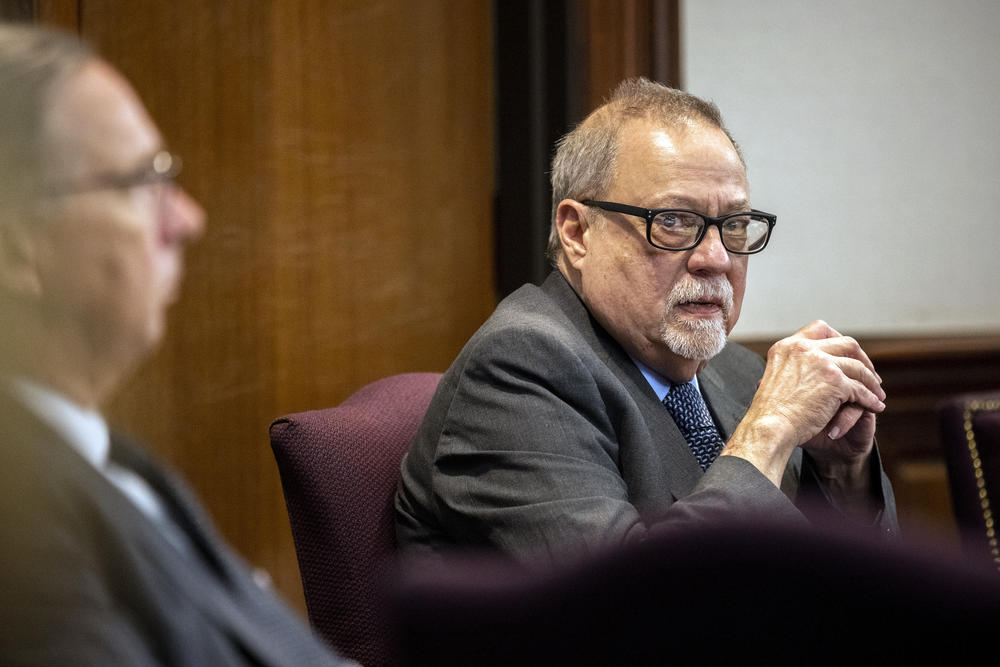
Greg McMichael looks at the gallery during the testimony of his son, Travis McMichael's in the trial of he, his son and William "Roddie" Bryan in the Glynn County Courthouse, Tuesday, Nov. 16, 2021, in Brunswick, Ga.
Greg McMichael looks at the gallery during the testimony of his son, Travis McMichael’s in the trial of he, his son and William “Roddie” Bryan in the Glynn County Courthouse, Tuesday, Nov. 16, 2021, in Brunswick, Ga. (Pool photo)

Prosecutor Linda Dunikoski pressed McMichael on why he didn’t include some details of his testimony Wednesday in his written statement to police, namely the part about his telling Arbery police were on the way.

Travis said he was “under stress, nervous, scared” at the time of his police interview and “probably being choppy.”

“What were you nervous about?” Dunikoski asked.

“I just killed a man,” McMichael responded. “I had blood on myself. It was the most traumatic event of my life.”

“You were nervous because you thought you were going to jail, right?” Dunikoski asked.

“No. I gave them a statement,” McMichael said.

“So you don’t think you’re going to jail?” Dunikoski asked.

Meanwhile, the Rev. Al Sharpton planned to return Thursday for a rally with a large group of Black ministers, after a defense attorney intensified frustrations in the coastal Georgia community of Brunswick when he said he didn’t want “any more Black pastors” sitting in the Glynn County courtroom with Arbery’s family.

Marcus Arbery, right, applauds as his former wife Wanda Cooper speaks about the slaying of their son Ahmaud Arbery as Civil rights leader Rev. Al Sharpton stands between them outside the Glynn County courthouse, Wednesday, Nov. 10, 2021, in Brunswick, Ga. Rev. Sharpton led a prayer and spoke out against injustice during the noon break in the trial of three men charged with murder in Ahmaud Arbery's shooting death.
Marcus Arbery, right, applauds as his former wife Wanda Cooper speaks about the slaying of their son Ahmaud Arbery as Civil rights leader Rev. Al Sharpton stands between them outside the Glynn County courthouse, Wednesday, Nov. 10, 2021, in Brunswick, Ga. Rev. Sharpton led a prayer and spoke out against injustice during the noon break in the trial of three men charged with murder in Ahmaud Arbery’s shooting death. (Terry Dickson/The Brunswick News via AP)

Attorney Kevin Gough asked the judge last week to remove Sharpton from the court, saying the civil rights activist was trying to influence the jury, which is disproportionately white. The judge refused, and later called Gough’s remarks “reprehensible.”

Gough, who represents William “Roddie” Bryan, pointed out on Thursday morning that the Rev. Jesse Jackson was in the courtroom again with Arbery’s family.

He also said he saw someone wearing an “I support Black Pastors” T-shirt during the break. Cheers broke out in the overflow room next door, where several Black pastors are seated, according to the AJC.

The Feb. 23, 2020, shooting deepened a national outcry over racial injustice after cellphone video of Arbery’s death leaked online two months later.

McMichael and his father, Greg McMichael, armed themselves and pursued Arbery in a pickup truck after he ran past their home from a nearby house under construction. A neighbor, William “Roddie” Bryan, joined the chase in his own truck and recorded the video.

The McMichaels told police they suspected Arbery was a burglar because security cameras had recorded him several times in the unfinished house on their street.

Prosecutors say the men chased Arbery for five minutes and used their trucks to prevent him from fleeing their neighborhood before Travis McMichael shot him. They say there’s no evidence that Arbery — who had enrolled at a technical college to study to become an electrician like his uncles — had committed any crimes.

This article appears on Now Habersham through a news partnership with GPB News

Lawmaker to revive protester bill critics say could infringe on 1st Amendment rights

A bill aimed at curtailing violent protesters is poised for a return engagement at the Gold Dome early next year when lawmakers convene for their 2022 legislative session.

In a committee hearing Tuesday, Democrats and civil rights groups said the measure could chill free speech.

The bill’s author, Republican Sen. Randy Robertson of Cataula, said the measure will protect the right to peaceful protest and punish only those who break the law by engaging in violence, destroying property or blocking roads.

“When this legislation was first brought forward last year, and as the author of this legislation, I take full responsibility for that, there was some miscommunication as to what the intent of the legislation was,” Robertson said. “And what the intent of this legislation is is fairly simple. It is to protect peaceful and lawful assembly. What it is to push back against is unlawful assembly, violent assembly and situations where citizens who may want to come out and exercise their rights are not intimidated or pushed back or infiltrated by individuals who are there to disrupt their right to peacefully assemble.”

Under the proposed law, protesters who break the law would face increased penalties. Participating in a protest with seven or more people and committing violence against a person or property or blocking a highway during a protest could both land Georgians with a felony charge and a fine of between $1,000 and $5,000 or up to five years imprisonment. Defiling a publicly owned monument, cemetery or structure comes with even steeper punishments – a fine of up to $15,000 or up to 15 years behind bars.

It would also require cities and counties to establish a process for granting permits for all protests on public property, regardless of size, and governments that fail to provide “reasonable law enforcement protections” for protests that become violent could be made to pay damages for injuries or property damage.

Robertson gave the example of last summer’s violent racial justice protests and the Jan. 6 U.S. Capitol riot as the type of events the bill is intended to target. The Georgia Capitol has added increased security measures including a perimeter fence after protests over police brutality rocked Atlanta last year.

The bill also offers a legal shield for those who cause injury or death while fleeing such a protest if they do so “under the reasonable belief that fleeing was necessary to prevent or terminate an attack upon the accused’s property or person.”

Sen. Elena Parent, an Atlanta Democrat, questioned whether that last part would allow motorists to simply run protesters over.

“It seems like it’s like a license or escape hatch for individuals who would kind of run people over with their cars,” she said. “It just seems to really kind of almost, if not encourage, give license to that type of behavior.”

Robertson said his intent was to provide that defense only in desperate situations.

“I would attribute it to almost the castle doctrine, where an individual is securely in their vehicle and there’s a threat by someone, to impede their free movement to the point where that individual felt unduly threatened and prevented from leaving, someone may be trapped in their vehicle in these situations.”

Robertson gave the example of Los Angeles truck driver Reginald Denny, who was pulled from his truck and severely beaten by four men in the riots that followed the acquittals in the Rodney King trial in 1992.

Vasu Abhiraman, deputy political director and senior policy counsel for the American Civil Liberties Union, said the law already protects people who cause injury in self-defense and outlined several other problems the ACLU has with the legislation.

Among them, Abhiraman said the bill would provide local officials an incentive to crack down on peaceful protests rather than risk them getting out of hand and risk liability.

“The incentives go further than, for example, avoiding gross negligence,” he said. “They go towards avoiding any lawsuit established for that cause of action, and as municipalities have certain budgets for defending themselves against a suit like this, as they establish their standard operating procedure, we’re very concerned that that standard operating procedure will be anti-First Amendment, anti-peaceful assembly.”

As the Senators discussed the measure, deliberations were underway in the trial of Kyle Rittenhouse, who shot three men, killing two of them, during a protest in Kenosha, Wisconsin. Rittenhouse argued he fired in self defense.

If this bill becomes law, more people could be inspired to take justice into their own hands, potentially escalating dangerous situations, Abhiraman said.

“Unfortunately, there’s a case going on now involving somebody who thought they were volunteering to protect businesses, and it ended really, really poorly, and we can all see that,” he said. “Do we want to invite more actions like that into our communities in Georgia, the cradle of the Civil Rights Movement?”

Robertson’s bill did not receive a vote and will not advance during the current special session, but the Legislature is likely to revive it when they return in January.