Home Blog Page 1572

New Baldwin water tower to significantly increase city’s water supply

A new water tower will join the City of Baldwin’s expanding infrastructure this summer.

The new water tower will replace the old silo-type tower on Light Road in Baldwin, and will increase the amount of water available to the city. The tower is on schedule to be completed by July, according to Fletcher Holliday of Engineering Management Incorporated (EMI). Holliday addressed the Baldwin City Council about the water tower project during the Council’s meeting Monday night.

(Source: Google Maps)

“The tower itself … is going to change the landscape and sometimes water towers make the landscape kind of attractive,” Mayor Joe Elam said. “I hope that that’s what we see. It’ll match the other tank, but from a perspective of better water pressures and things like that, I hope the public recognizes that sometimes you have to have these things hanging in the air to provide that kind of service.”

EMI President Fletcher Holliday updates the Baldwin City Council on the water tower project at their Monday meeting. (Hadley Cottingham/Now Habersham)

This new tower will also allow the city’s other tower to reach full capacity, so in addition to the 500,000 gallons of water the new tower will provide, the other tower will be able to fill to maintain an additional 30,000-50,000 gallons of water.

Elam says the water infrastructure that the city has is decades old, and new infrastructure, like this water tank and improvements coming to their water pipeline, are needed to provide Baldwin water customers with the service they need.

“The reality is the region as a whole needs to really improve [water] storage in order for this community to be a drought protected,” Elam says. “And we need to have a lot of storage, and this is just one of those components.”

The project overall will cost the city $1,088,715.

Cleveland residents arrested on drug charges

A drug bust at a local gas station landed two Cleveland residents in jail. Deputies arrested Jeremy Keith May and Samantha Dawn Kinsey on February 23 at the Clipper gas station on South Main Street in Cleveland.

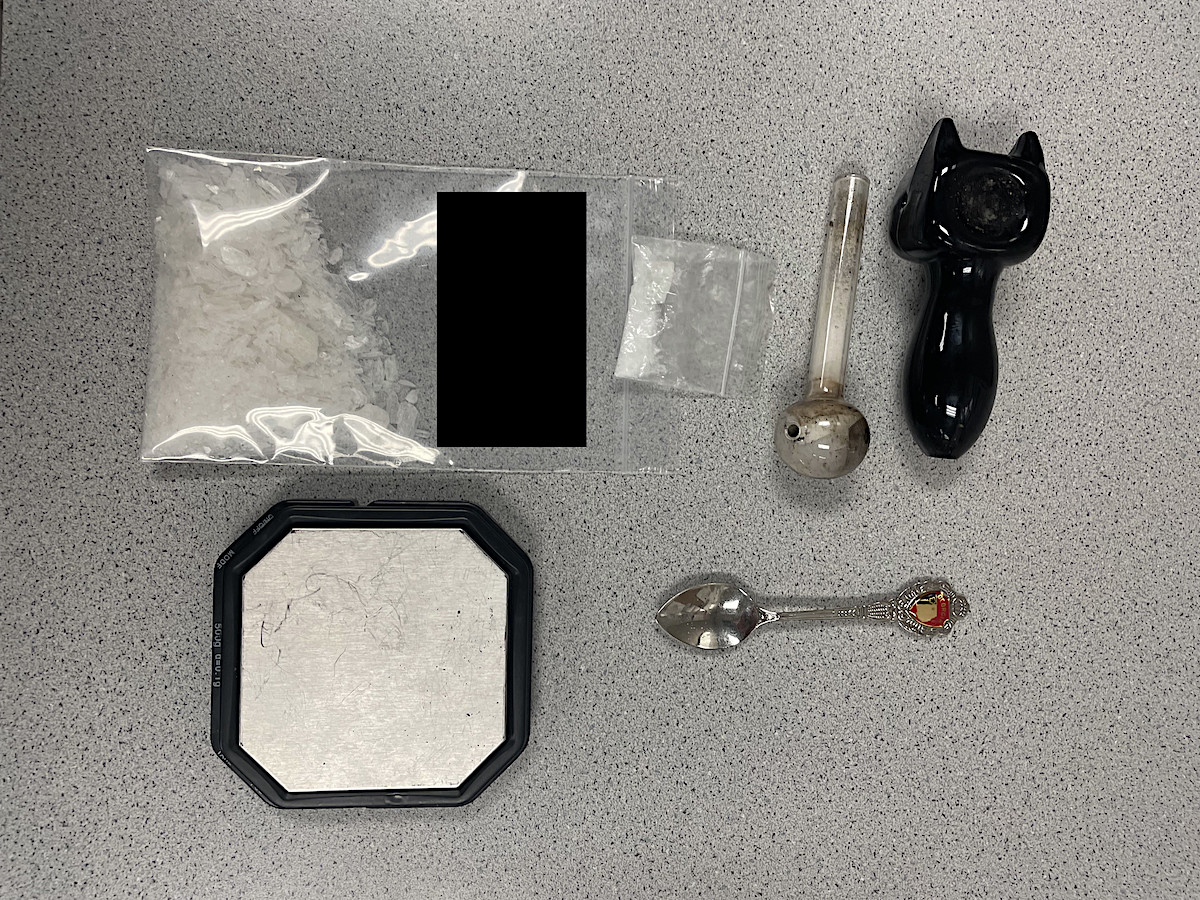
Drugs and drug paraphernalia deputies say they seized from a vehicle parked at the Clipper gas station in Cleveland on Feb. 23, 2022. (WCSO)

According to the White County Sheriff’s Office, one of its deputies was at the station fueling his patrol car. He walked by a parked vehicle at the store and noticed a strong smell of marijuana coming from inside the vehicle.

“The deputy made contact with the driver and passenger. Upon further investigation, deputies located over 35 grams of methamphetamine inside the vehicle,” says White County Sheriff Rick Kelley.

Deputies arrested the 31-year-old May and 33-year-old Kinsey. Officers charged May with trafficking methamphetamine and possession of drug-related objects; they charged Kinsey with possession of a Schedule II controlled substance and possession of drug-related objects.

The suspects were both booked into the White County Detention Center. Kinsey was released February 24 on a $3,500 bond. May, whose online jail record shows previous meth-related arrests in 2016 and 2021, remains in jail without bond.

There have been multiple drug arrests made in counties and towns across Northeast Georgia in recent days. On February 23, eight people were arrested in Habersham and Lumpkin counties in unrelated cases, and on February 24, police arrested five people on drug charges in Toccoa. Each of the arrests involved at least one suspect being charged with trafficking meth.

More pushback against Sen. Hatchett’s ‘divisive concepts’ bill

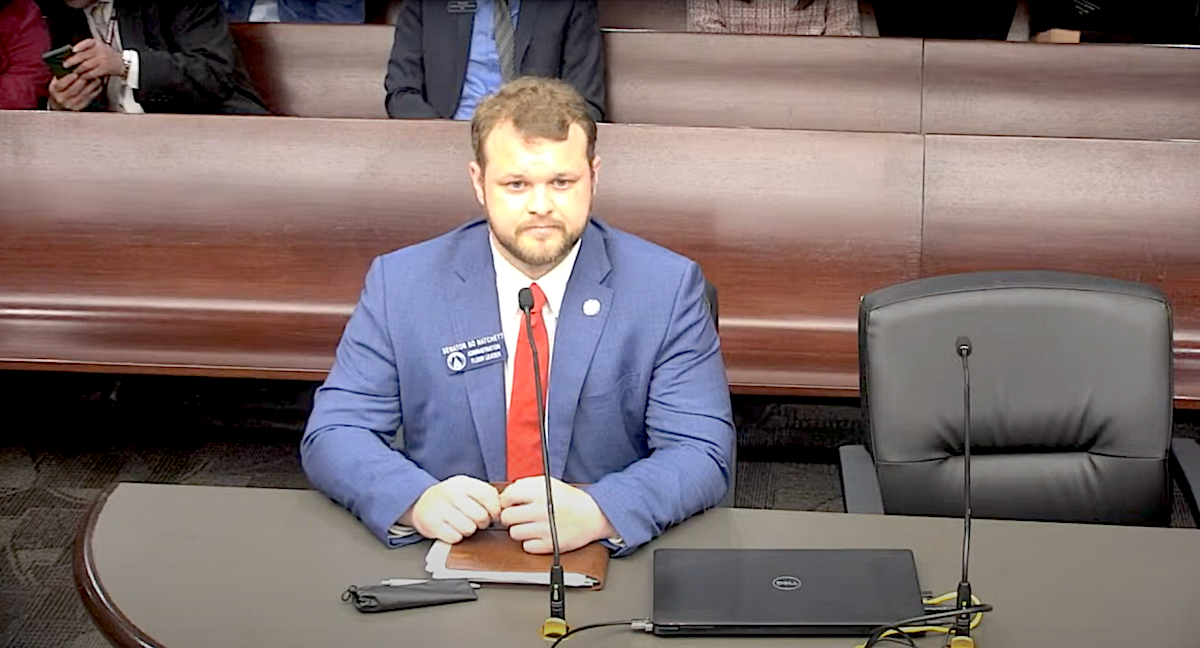
Sen. Bo Hatchett (R-Cornelia) says his proposed bill won't "prevent a teacher from teaching the facts of history." (GA Senate livestream)

The Georgia Senate Education and Youth Committee heard more than an hour of public comment on a controversial education bill Monday.

Senate Bill 377, sponsored by Sen. Bo Hatchett (R-Cornelia), had its third hearing where it met criticism from educators and students. The bill would limit schools’ ability to teach “divisive concepts.”

Georgia Association of Educators President Lisa Morgan speaks out against SB 377 during a hearing before the Senate Committee on Education and Youth on Feb. 28, 2022. (GA Senate livestream)

Lisa Morgan, a teacher and president of the Georgia Association of Educators, was one of several educators who spoke out against the bill. She said it sent a message to teachers that they are not trusted and could hinder their planned curriculum.

“Will the teacher who had planned to use literature discussing Plessy v. Ferguson to teach argumentative essays be told ‘You might want to find a different essay?’” she said.

“It’s not so much the actual history lessons that will change,” she continued. “It’s the other lessons that interweave history.”

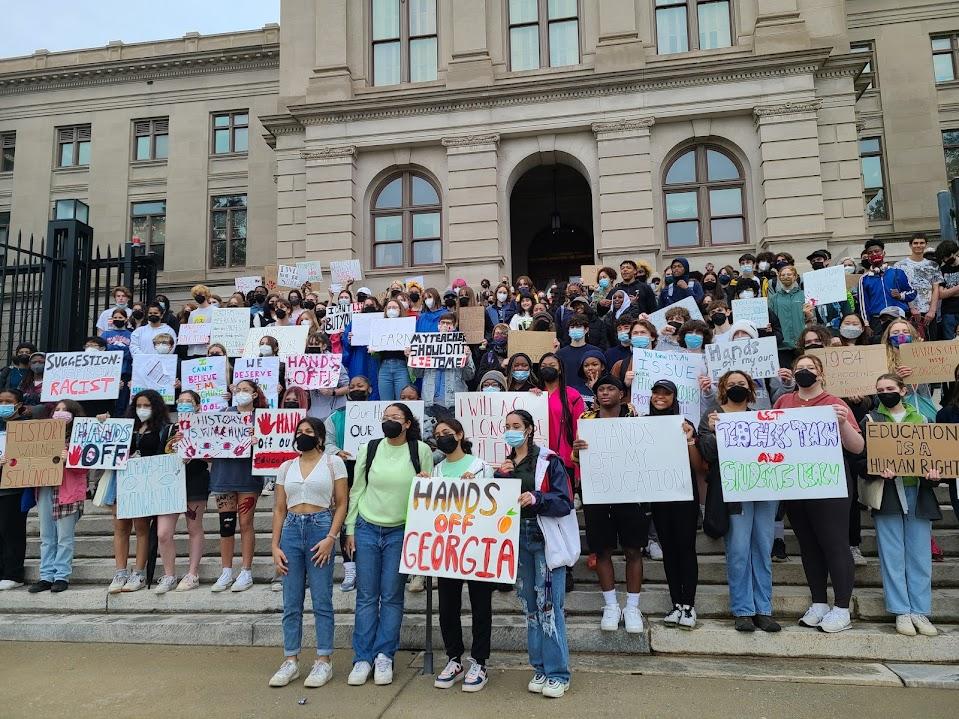
Students also gathered at the Georgia Capitol on Friday morning in protest over two bills dealing with the teaching of race and racism. Students deem the bills prohibitive and unhelpful in their quest to become citizens.

Students gathered at the Georgia Capitol on Feb. 25, 2022, to protest legislation limiting what schools can teach about systemic racism.
(Amanda Andrews/GPB News)

Hatchett said in an earlier meeting that banned topics included teaching that the U.S. is fundamentally racist, that one race is superior, that individuals should feel responsible for the actions of other people of the same race, and that individuals are consciously or unconsciously racist because of their ethnicity.

SB 377 is one of several Republican bills to address school curriculum regarding race and history.

Hatchett says he is writing a substitute to the bill based on public comment, and it could be available as early as next week.

Biden OKs release of 30 million barrels of oil from Strategic Petroleum Reserve

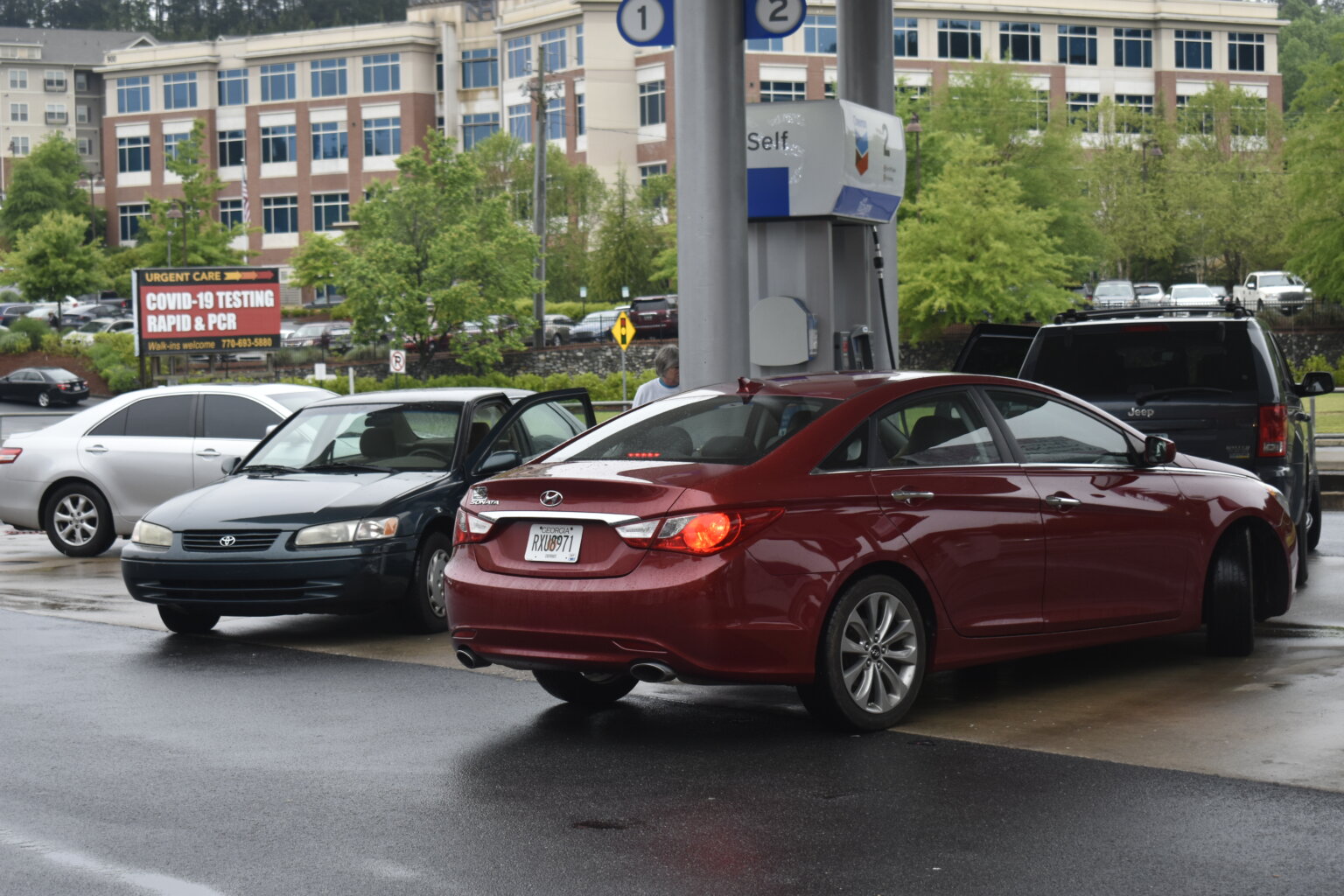
The Biden administration Tuesday announced the release of 30 million gallons of oil from the country’s strategic reserves in anticipation that the price of gasoline could continue to spike as Russians sanctions ramp up. File 2021 (Ross Williams/Georgia Recorder)

President Joe Biden on Tuesday authorized the release of 30 million barrels of oil from the Strategic Petroleum Reserve, part of an international boost to the global oil supply that has been disrupted by Russia’s invasion of Ukraine.

The reserve is a complex of four sites with deep underground storage caverns in salt domes along the Louisiana and Texas Gulf Coasts.

The U.S. contribution will make up half of the reserve oil that the International Energy Alliance, a collection of 31 mostly European countries that also includes the United States, agreed to collectively release, White House press secretary Jen Psaki said in a statement.

The release is meant to counteract Russian President Vladimir Putin’s “weaponization of oil and gas,” Psaki said.

“Today’s announcement is another example of partners around the world condemning Russia’s unprovoked and unjustified invasion of Ukraine and working together to address the impact of President Putin’s war of choice,” Psaki said.

Russia’s oil and gas sector is the most significant piece of its economy that the U.S. has not sanctioned after Russia invaded Ukraine last week.

Since the fighting began, Biden has often repeated he is seeking to minimize the impact to U.S. consumers, including curbing any rise in prices at gas pumps.

The war has already led to a disruption of the global energy market, Biden said in a memorandum authorizing the release.

“Russia’s actions in Ukraine have resulted in energy supply shortages of significant scope and duration and have already caused a substantial increase in oil prices worldwide,” the memo reads.

Energy Secretary Jennifer L. Granholm said the administration may draw down more from the reserve if the conflict persists.

“We stand prepared to take additional measures if conditions warrant,” she said in a statement.

The Energy Department reported the reserve held about 588 million barrels as of the end of January.

Releasing oil from the Strategic Petroleum Reserve is one of only a few options policymakers have to contain the price of energy supplies, Patrick De Haan, the head of petroleum analysis for the gas price-tracking company GasBuddy, said in an interview last week.

But a one-time release is not particularly effective at keeping prices in check, De Haan said, and it’s also not the actual purpose of the reserve.

“Unless there’s an actual physical disruption, the SPR should be used for its intended purpose,” he said. “It’s the strategic petroleum reserve, not the price reduction reserve.”

Judge rules Georgia’s new redistricting maps will be used in 2022 elections

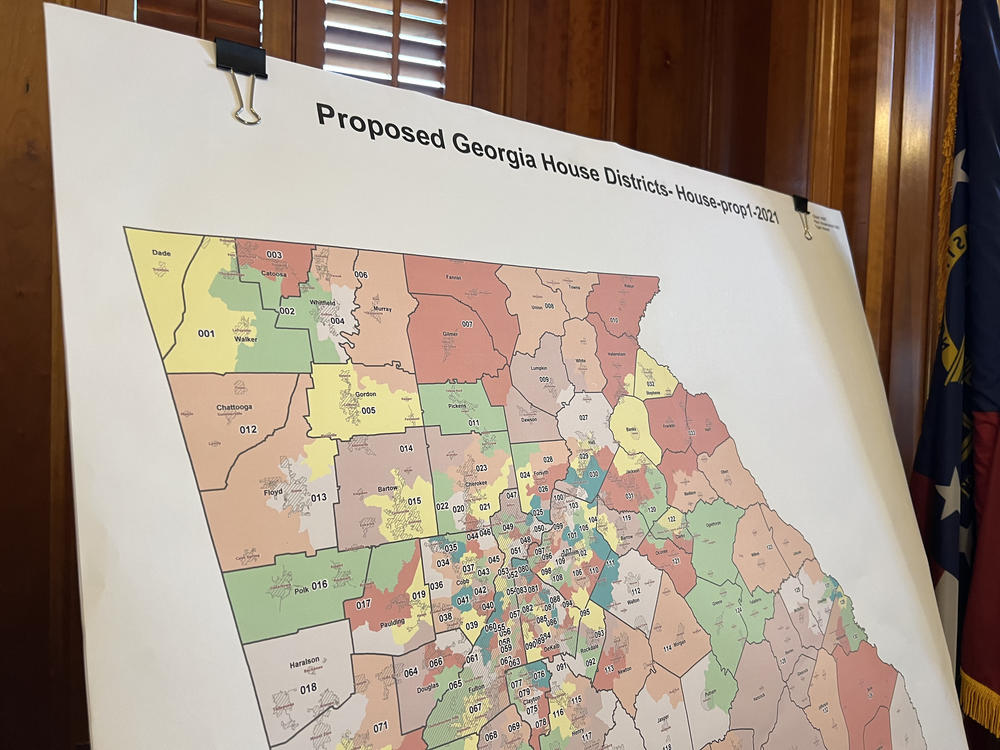
A proposed map of Georgia's 180 state House districts sits outside the chamber before lawmakers approved it on a mostly-party line vote. (Stephen Fowler/GPB News)

A federal judge has ruled that Georgia’s new legislative and congressional maps can be used for the 2022 elections but also that they likely contain districts that violate the Voting Rights Act.

Judge Steve Jones issued a 238-page order Monday that denied a request to block new boundary lines that give Republicans an additional U.S. House seat and shrink their margins in the General Assembly because making changes while preparations for the May 24 primary election are underway could result in “significant upheaval and voter confusion.”

“Changes to the redistricting map at this point in the 2022 election schedule are likely to substantially disrupt the election process,” Jones wrote.

The ruling comes in a case that combines three lawsuits that allege the redistricting process violated Section 2 of the Voting Rights Act by failing to include enough majority-minority districts that would give Black voters the opportunity to elect candidates of their choice.

Much of Georgia’s population growth over the last decade has been spurred by an influx of Black residents to metro Atlanta, and the lawsuits argue lawmakers neglected to account for that growth when redrawing political maps.

While the state of Georgia contends its maps are not unconstitutional, elections officials also testified that the months-long preparation process for the May primary would be disrupted if the court-ordered any changes to maps or election dates.

“With candidate qualifying for the State of Georgia set to begin in six days, any change now would be considered late in the process,” Jones wrote. “Applying the Purcell principle, the United States Supreme Court ‘has also repeatedly emphasized that lower federal courts should ordinarily not alter the election rules on the eve of an election.'”

County elections officials have to assign Georgia’s more than 7.5 million voters into their new districts for federal, state and local races and mail out new precinct cards notifying them of changes. After candidate qualifying ends next week, the state creates drafts of more than 2,000 ballot styles with combinations of races specific to each precinct that must be checked before absentee ballots are printed and mailed to voters beginning in April. Jones also acknowledged that counties could have difficulty securing polling places if the election date were moved.

The normal local redistricting timeline was already compressed due to delayed results from the U.S. Census.

Jones also took note of a similar redistricting case out of Alabama where the U.S. Supreme Court ruled the state’s primary could continue under maps that a lower court found unconstitutional.

“This a clear victory for common sense and order over liberals’ attempted partisan power grab,” Republican Secretary of State Brad Raffensperger said. “Georgia’s maps are fair and adhere to traditional principles of redistricting, and I look forward to defending them through this case and in the Court of Appeals and Supreme Court.”

While Jones allowed the maps to be used for the current election cycle, he also found all three plaintiffs were likely to succeed with at least some of their claims of districts that violate the law.

One set of plaintiffs argued that Georgia’s 14 House districts should have included a majority-Black seat based in the western part of metro Atlanta, spanning from Cobb to Fayette counties. The current maps drastically overhaul the competitive, currently Democratic 6th and 7th Districts in metro Atlanta to give Republicans a safe seat in the 6th while making the 7th safe for Democrats.

The ruling also found that the other sets of plaintiffs challenging state legislative maps are likely to succeed in showing two majority-minority state Senate districts and two state House districts could be drawn in the south metro Atlanta area and another majority-minority state House district could be drawn near Albany.

While the maps will be in place for now, the larger lawsuit over the legality of the maps will continue.

“Having determined that a preliminary injunction should not issue, the Court cautions that this is an interim, non-final ruling that should not be viewed as an indication of how the Court will ultimately rule on the merits at trial,” Jones wrote. “Under the specific circumstances of this case, the Court finds that proceeding with the Enacted Maps for the 2022 election cycle is the right decision. But it is a difficult decision. And it is a decision the Court did not make lightly.”

An appeal is expected.

This article appears on NH through a news partnership with GPB News

Piedmont photography exhibit spotlights Appalachia’s Black communities

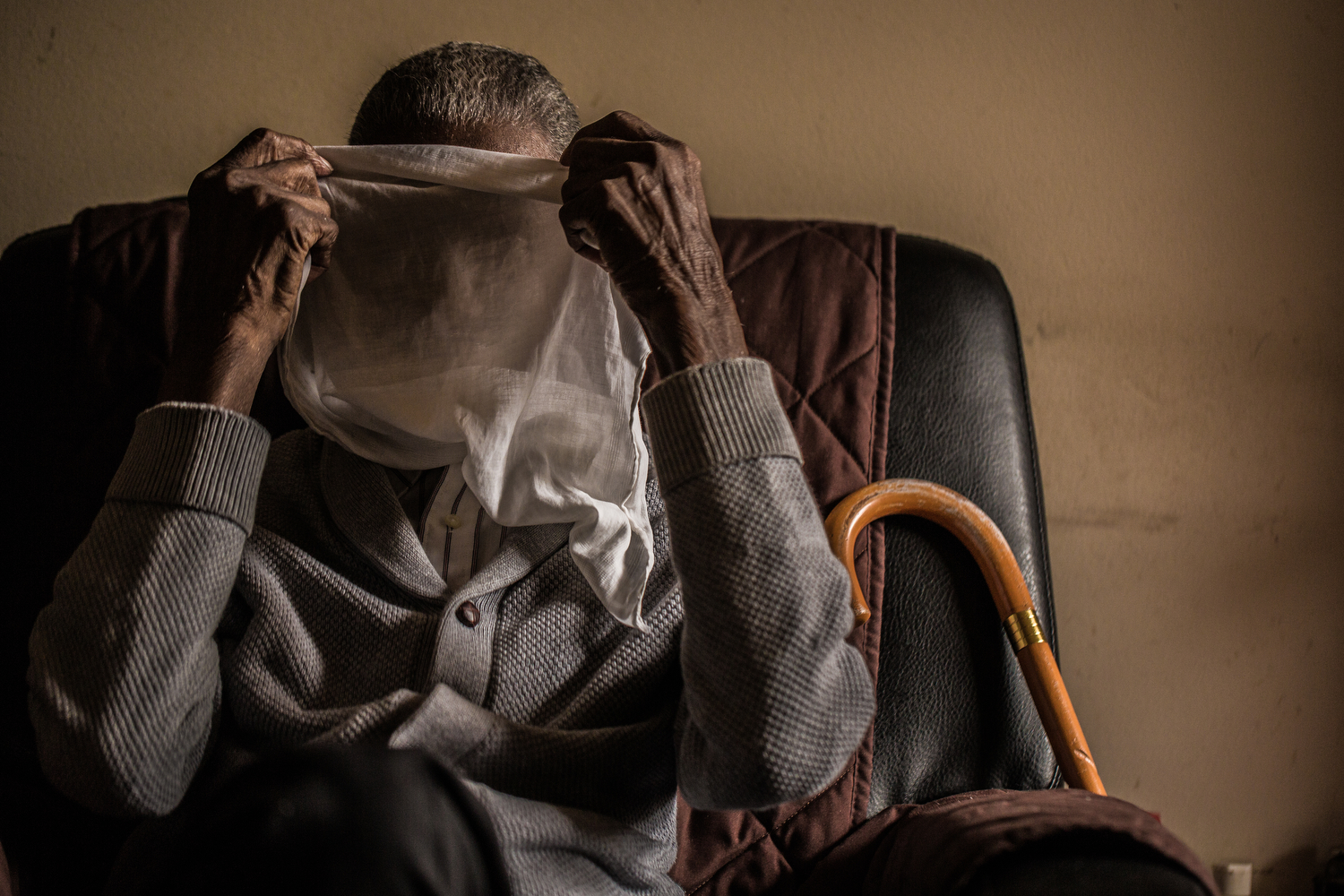
Affrilachian culture and history have been hidden from mainstream media for centuries— photographer Chris Aluka Berry wants to change that. This photo features Deacon B.C. Mance, 103, who has lived in Stephens County his entire life. (Photo by Chris Aluka Berry)

Chris Aluka Berry is a South Carolina native and an Atlanta-based photojournalist with a heart for telling stories. Berry took on a new project six years ago, documenting Black culture and history in the Appalachian region. Today, his work is on display at the Piedmont University Mason-Scharfenstein Museum of Art.

“Affrilachia: The Remnant that Remains,” follows alongside the lives of Black Americans living in the Appalachian region, and documents the moments that define their communities. His hope is to immortalize these moments in a disappearing, and often undocumented, history.

In another of Berry’s photos, he captures William “Tank” Coward, 77, walking by Keener Cemetery in Sylva, N.C. Fifty years ago, there was a thriving African-American community surrounding the cemetery. Now, Coward is the last African-Americans to live in the area. (Photo by Chris Aluka Berry)

“When most people think about Appalachia they kind of think it’s a homogeneous society where it’s predominantly white folks,” Berry tells Now Habersham. “The deeper I went with this story, the more I just found out about how that’s just very far from the truth. There’s a lot of diversity in the mountains.”

He says that there’s rich Black history in the Appalachian region, from many of the region’s buildings and railroads, as well as silver and gold mining industries being built by enslaved people, to mountainside Black communities that disappeared from Appalachia’s history.

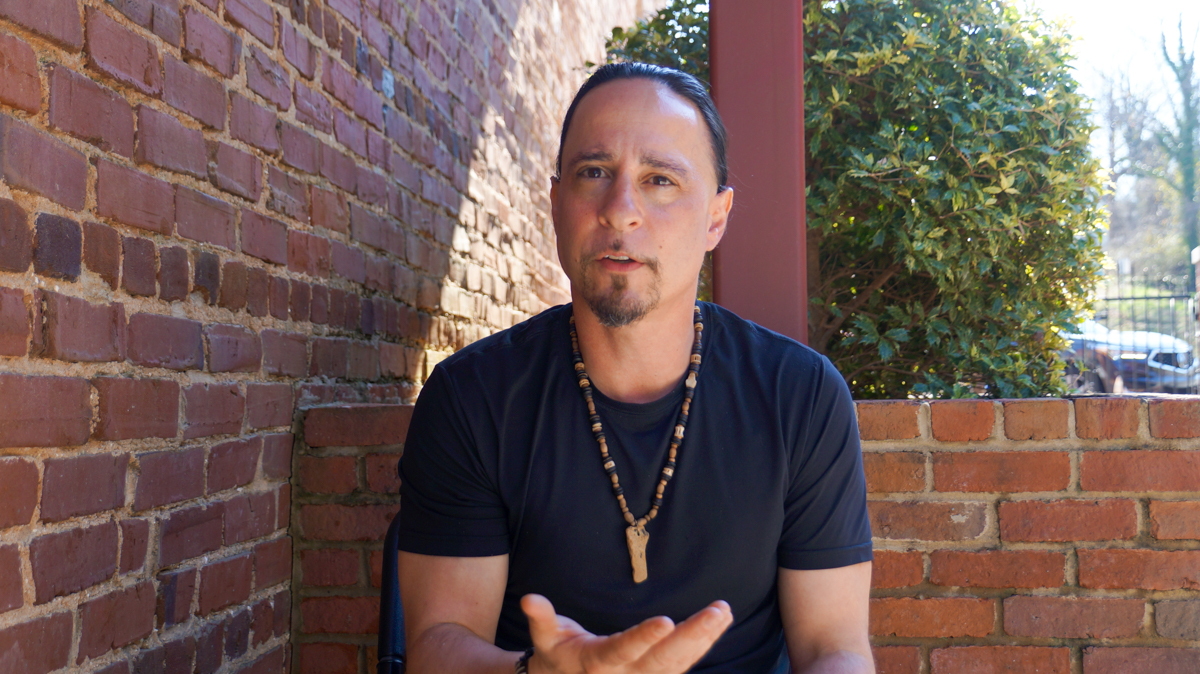
Chris Aluka Berry began his photojournalism career 20 years ago, his current project “Affrilachia: The Remnant that Remains,” may be the one he works on for the rest of his career. (Hadley Cottingham/Now Habersham)

“I read stories about people buying their freedom with the gold that they found,” Berry said. “There were even, here in White County, entire mountainsides that were owned by Black folks at one time and entire communities, where there was a school and there was a church … and stores, and now you drive by and you just see the forest, and you have no idea [it was there].”

He says that during his travels where he worked on photojournalism projects for news outlets and hiked through the Appalachian mountains, he found his passion for documenting Appalachia’s Black history.

“I’ve been camping, hiking in the mountains for years, and I never knew that there were people of color in the mountains,” he says. “It seemed like it was a history that was never really documented and would be forgotten if somebody didn’t like make a visual document of it.”

Now, it’s Berry’s ongoing project, one he says he may work on for the rest of his career.

Discovering Affrilachia

In her 2021 exhibit that highlighted Affrilachian culture in the COVID-19 pandemic, Cochran dedicated the exhibit to her uncle who was killed by a teenage driver in 2020. (Photo by Marie Cochran)

During his time in northeast Georgia, he learned about “Affrilachia,” a term coined by Frank X Walker of Kentucky, from Toccoa artist and activist Marie Cochran. The term recognizes the culture of the African-American people living in the Appalachian region and their impacts in building the communities over 25 million people live in today.

He says that as a biracial man and native of the south, being able to not only see parts of his community that he wasn’t aware of, but to feel like part of a family he didn’t know he had has been essential to the project.

“Now I’m kind of like family with a lot of the folks [in the project],” Berry says. “I have people that call me and invite me to photograph birthday parties and funerals and graduations, and people kind of know what I’m doing, and some people realize that it’s important. This is just as much a documentary project as it is like a preservation project.”

Berry’s photos capture the everyday moments of Affrilachian culture, finding the striking cultural beauty in moments. (Hadley Cottingham/Now Habersham)

Annie Sutton and Tim Jenkins have both been featured in Berry’s photography of the northeast Georgia Appalachian region and attended the MSMA’s reception for his exhibit.

“It’s really great that somebody is perserving history, because I’m a history buff, and I think every young person needs to know their roots,” Sutton said.

She recalled her childhood days at the camp meetings Berry photographed, as Jenkins talked about Berry’s dedication to helping him rediscover parts of his own history, like lost photos of his uncle.

“Chris and I became real, real good friends,” Jenkins said. “He slept on my couch a few nights, too, and he has helped me look for a lot of stuff … any old history and stuff like that to me is just exciting to me.”

Berry donated three photographs from the collection to become part of the MSMA’s permanent collection of art, which Museum Director Rebecca Brantley hopes is the start of bringing in more art that resonated with the northeast Georgia community.

“[These] will help us build up work that reflects our community and our region a little bit better,” Brantley said. “It’s the start of an exciting new chapter for us.”

Berry’s exhibit will be on display at the MSMA until March 24; museum hours are from 12-5 p.m., Tuesday through Saturday.

Somsy Nifong

Somsy Nifong, age 87, of Cornelia passed away Monday, February 28, 2022.

Funeral Services are scheduled for 2:00 p.m., Saturday, March 5, 2022, at the Whitfield Funeral Home, South Chapel.

The family will receive friends from 12:00 p.m. to 2:00 p.m., Saturday, March 5, 2022, at the funeral home prior to the service.

Arrangements have been entrusted to Whitfield Funeral Homes & Crematory, South Chapel at 1370 Industrial Boulevard, Baldwin, Georgia 30511. Telephone: 706-778-7123

Woman dies from her injuries following Athens wreck

(NowGeorgia.com)

A woman suffered life-threatening injuries in a single-vehicle crash Sunday in Athens, police say. Just days later, the Athens-Clarke County Police reports that she died.

Sandra Kelley, age 50, of Athens, died as a result of her injuries.

ACCPD responded to the crash on Atlanta Highway at Dakota Drive around 10:48 a.m. on February 27. The initial investigation indicates that a Ford Explorer was traveling west on Atlanta Highway when the vehicle exited the roadway and struck an embankment, causing the vehicle to overturn.

EMS transported Kelley to a local hospital with life-threatening injuries, where she later died. Five other passengers in the vehicle were not injured.

This is the second fatal crash in Athens this year.

The investigation into the crash is ongoing. Anyone with information is asked to contact the ACCPD at 762-400-7087.

The Piedmont powerhouse: Health system’s expansion reaches Augusta

Piedmont Healthcare has added Augusta to its expanding hospital footprint.

The Atlanta-based nonprofit system now contains 19 hospitals, with the announcement Tuesday that it has taken over University Health Care System, which includes University Hospital in Augusta.

Other hospitals in the agreement are smaller facilities: University Hospital Summerville and University Hospital McDuffie. The two systems had announced in May that they had signed a letter of intent to seek an affiliation.

Piedmont last year acquired four hospitals from HCA for $950 million: Cartersville Medical Center, Eastside Medical Center in Snellville and Coliseum Medical Centers and Coliseum Northside, both in Macon.

Through these takeovers, Piedmont has greatly surpassed the number of hospitals held by other systems in Georgia, including Emory Healthcare and Wellstar Health System.

“They are going to be a force throughout Georgia,’’ said Dave Smith, a consultant with Kearny Street Management, who added that Piedmont may want to get even bigger.

Piedmont, when asked about plans for future growth, said in statement later Thursday, “We will continue to develop our network of care options to ensure that Georgians have access to high-quality, cost-effective care close to home.”

By its expansion, Piedmont is consolidating its power to reach contracts with insurers.

Contract negotiations between health systems and insurers used to be routinely resolved before prior agreements expired, even if the bargaining was contentious. But in recent years, an increasing number of these disputes have not settled in time, severing network relationships and leaving patients caught in the middle.

Wellstar, based in Marietta, has been out of network with UnitedHealthcare since October, while Anthem Blue Cross Blue Shield and Northside Hospital have not been able to reach a contract deal, despite a Fulton County court’s intervention.

“I think Piedmont feels they have leverage’’ in such contract battles, Smith said. “They’ve done a great job positioning themselves for a showdown” with insurers.

Still, Piedmont will face a challenge in managing 19 hospitals, Smith said.

A bigger hospital system, though, can save money in purchasing medical supplies, experts say.

University Health Care System serves the greater Augusta region, anchored by University Hospital, founded in 1818 as City Hospital. The system includes University Hospital Summerville, also in downtown Augusta, and University Hospital McDuffie in rural Thomson.

“Piedmont’s model is to provide comprehensive care close to home, and we are excited that a great system like University Health Care, which has been doing that for more 200 years, is joining with us,” Kevin Brown, Piedmont president and CEO, said in a statement Tuesday.

“Our focus is always on changing health care, making it easier, more seamless and removing the hassle, which is what we will bring to this partnership.”

University also operates two skilled nursing and rehabilitation centers, and serves ambulatory patients with physician practices and Prompt Care centers in downtown Augusta, Evans, South Richmond County and Grovetown in Georgia, and in Aiken and North Augusta in South Carolina.

The agreement will include an infusion of $1 billion in capital to modernize and update facilities and grow the Heart and Vascular Institute tower at the newly named Piedmont Augusta Hospital, the Augusta Chronicle reported. The affiliation also includes $2 million a year for 10 years to address community health care needs, such as supporting clinics and other initiatives, the newspaper reported.

“Today, we celebrate the beginning of a new chapter in the history of University Health Care System,” James Davis, president and CEO of Piedmont Augusta and Piedmont McDuffie, said in a statement. “We are excited about the many possibilities and new opportunities the partnership with Piedmont will bring to our patients, employees, physicians and the community. Becoming Piedmont ensures we secure high-quality care in our community into the future. This has been our commitment for 204 years, and we’re excited the tradition of excellence will continue.”

Yarixa Oakes named new head volleyball coach at White County High

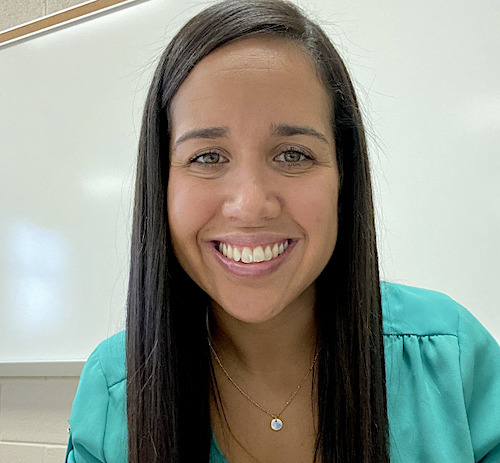
Yarixa Oakes

White County Schools has announced the hiring of Yarixa Oakes as the new Head Volleyball Coach at White County High School.

The announcement was made Tuesday following a called meeting of the White County Board of Education.

Lloyd Collins, Athletic Director at White County High School said in a news release, behalf of the White County Board of Education, Superintendent Laurie Burkett, and Principal Mary Anne Collier, “I am pleased to announce that Yarixa Oakes has accepted the offer to become the new head volleyball coach at White County High School.”

Coach Oakes has 9 years of high school coaching experience in Georgia and Florida. She has been the varsity assistant coach for the past three years at the high school.

The release said during Coach Oakes’ time as the varsity assistant coach, she helped lead the volleyball team to three GHSA state tournament appearances, including an Elite 8 appearance in 2019, and a Sweet 16 appearance in 2020. Prior to coaching at WCHS, Coach Oakes was a coach at Sickles High School in Florida, as well as serving many years as a club volleyball coach both in Florida and Georgia.

“Coach Oakes has been a member of our coaching staff for four years and I am looking forward to watching Coach Oakes take our program to the next level. Coach Oakes is familiar with our program and athletes and will be able to step right in and begin working with her team,” Collins said.

“We are excited to have Coach Oakes as the new Head Volleyball Coach,” said Collier. “She has a passion for the game and our students and we are looking forward to seeing the great things that come out of our volleyball program.”

Legislative update: safety, women’s healthcare and classroom technology

Editor’s Note: The following legislative update is from Rep. Victor Anderson (R-Cornelia) who represents the 10th State House District of Georgia. The District includes portions of Habersham and White counties. Anderson presently serves on the House Energy, Utilities & Telecommunications Committee, Governmental Affairs Committee, and State Planning & Community Affairs Committee. He also chairs the study committee on annexation and cityhood issues. You may contact him at victor.anderson@house.ga.gov

Greetings from the Gold Dome!

Thursday, February 24, brought to a close legislative day 20 of 40. This means we have successfully completed half of this year’s legislative session. With 20 days down and 20 to go, we expect the pace to quicken as we all work to ensure our respective bills make it through the process in time to receive passage from both the House and Senate chambers prior to our last day deadline. Below, please see my latest update covering our House action.

As always, I will be updating you weekly on all happenings concerning your government at work. If you have concerns or questions regarding legislation, I ask that you reach out to our office directly. Thank you for allowing me the honor and privilege of serving our home under the Gold Dome. May God bless you, and may He continue to bless the great state of Georgia.

Public Safety

To hold to our promise of a safer Georgia, the House has prioritized arming our law enforcement officials with new, cutting-edge tools to combat the war on gang crime which has been an ongoing issue in recent years. The passage of House Bill 1134 would allow the state’s attorney general to collaborate with local district attorneys to prosecute certain gang-related crimes across the state. Additionally, HB 1134 would allow the attorney general to employ peace officers for investigative purposes. This bill would also work in tandem with the governor’s plan to create the Gang Prosecution Unit within the attorney general’s office. HB 1134 is now in the Senate to receive further consideration.

Wildlife/Environmental Protection

In order to ensure that we continue our efforts in protecting our state’s natural resources, we successfully passed House Bill 893. This bill works to extend the collection of hazardous waste fees, which are crucial to supporting the Hazardous Waste Trust Fund and its work to restore Georgia’s environment. This fund was established to collect fees from hazardous waste generators, solid waste tipping fees, and violation fines to help fund the cleanup of hazardous waste sites. Without this fund, it would be challenging for the Georgia Environmental Protection Division to continue its critical missions to remediate contaminated sites, and our local governments would be left with an unfunded mandate to fund the cleanup of leaking landfills, abandoned and contaminated properties. Originally set to expire this summer, HB 893 extends the sunset date of this Fund to July 1, 2027.

We have always been dedicated to the continued preservation of Georgia’s unique wildlife.  Those efforts were enhanced through the passage of House Bill 1147. This bill builds off the current framework used to protect various species such as turkeys, ground-nesting birds as well as year-round protection of our loggerhead turtle population. HB 1147 would allow property owners to hunt and trap raccoons and opossums year-round thus removing bag limits for these animals as they are known predators to some of Georgia’s most endangered species, most specifically, ground-nesting birds.

Healthcare

We also passed House Bill 1092, also known as the Georgia Women’s Child Care Alternatives, Resources, and Education Act. This bill would allow eligible pregnant women, sentenced to a period of confinement in a penal institution to have their sentences deferred for the duration of their pregnancies until six weeks postpartum. If deferment is accepted, the offender will be required to maintain perinatal health care, treatment and assessments, as well as participate in education and resource programs. The bill also requires that every female offender who is not released on bond within 72 hours of an arrest to be given the option to submit to a urine pregnancy test. Further, deferment of one’s sentence does not count towards “time served.” We are hopeful that more perinatal care and resources to these pregnant women will yield better health outcomes for both the unborn child and the mother.

Education

To keep up with ever-evolving technology trends, regarding education, we successfully passed House Bill 1217, or the Student Technology Protection Act. This measure works to promote the safe and appropriate use of school-issued technology. The Student Technology Protection Act requires the following:

  • Local education authorities would be required to adopt an acceptable-use policy to better prevent any school computer or network from accessing obscene materials deemed harmful to minors.
  • The requirement to update school technology to better block or filter access to these explicit materials online. The Georgia Department of Education would provide local school systems with guidance and technical assistance to develop guidelines for training school personnel.
  • The State Board of Education is given the power to withhold a portion of state funding allotted for that school if that school has not implemented the practices outlined above.

We are hopeful that as technology continues to evolve, this bill would ensure that Georgia’s public schools have these policies in place and are equipped with the resources needed to protect children from harmful online content.

Bills of Interest

  • House Bill 963 would provide the annual update of provisions of the Controlled Substance Act for Schedule I and Schedule IV controlled substances;
  • House Bill 969 would update reporting requirements for insurance holding companies to include information on their financial profile and group capital calculation;
  • House Bill 500 would allow a second round of funding of $100 million to the  Georgia Agribusiness and Rural Jobs Act program for capital investments, increase the program’s application fee from $5,000 to $25,000, establish an annual maintenance fee of $7,500 for all rural funds and update the program’s reporting requirements;
  • House Bill 896 would update a homestead exemption for counties that had populations between 23,500 and 23,675 on the 2010 U.S. Census with counties that had populations between 25,400 and 25,500 on the 2020 U.S. Census;
  • House Bill 1008 would amend the operations and composition of the Georgia Higher Education Savings Plan (GHSP) board of directors, dissolve the Georgia Achieving a Better Life Experience program and transfer this program’s authority and trust to the GHSP, as well as remove the board of directors’ authority to require and collect fees to cover administrative costs and impose withdrawal penalties;
  • House Bill 1059 would provide exclusions to unfair trade practices and unlawful inducements by allowing insurance companies to provide loss-mitigation safety products to consumers;
  • House Bill 1086 would lower the age at which hospitals would be required to offer an inpatient the influenza vaccine prior to discharge from 65 to 50 years of age;
  • House Bill 1088 would authorize non-judicial foreclosures of time-share estates by an owners’ association and would update notice of sale requirements for these foreclosures;
  • House Bill 1146 would require that vehicles driven by officers enforcing traffic laws be equipped with flashing blue lights and would allow the Georgia State Patrol to have vehicles without such exterior-mounted roof lights;
  • House Bill 1148 would prohibit individuals from bringing a cervid carcass, such as a deer carcass, from outside Georgia into the state if any part of the carcass contains a portion of the nervous system, and this bill would provide exceptions for antlers, skulls, skull plates, teeth or jawbones that have soft tissue attached;
  • House Bill 1186 would expand the eligibility for individuals who can have a non-diagnostic electro-physiologic screening done by a non-licensed audiologist from ages three and under to birth through 22 years of age;
  • House Bill 1195, which would update the reporting options for interlocal risk management agencies within local governments to include statutory accounting principles;
  • House Bill 1215 would allow students to withdraw from their local school and enroll in a charter school with available classroom space without penalty and would require local education boards to adopt a universal, streamlined transfer process, as well as clarify how local revenue allocations would be collected and calculated for charter schools;
  • House Bill 1233 would revise the effective date of rules and regulations promulgated by the Georgia Board of Natural Resources to January 1, 2022, consolidate various species of black bass, update requirements for shotguns used for hunting migratory game birds and create the umbrella term “migratory game birds;”
  • House Bill 1276 would require the Georgia Department of Community Health to post detailed statistical reports with data for administered state health plans on its website biannually;
  • House Bill 1307 would require excavators to make an emergency 911 call to alert emergency services if they strike or damage a utility facility that carries gas or a hazardous liquid;
  • House Bill 132 would update the state’s definition of “Internal Revenue Code” to include the provisions of the federal Infrastructure Investment and Jobs Act, such as changing which bonds qualify as tax-exempt bond financing, extending interest-rate smoothing for defined benefit plans and expanding certain non-taxable contributions for government water or sewage disposal services;
  • House Bill 1361 would require that if a General Assembly act is alleged to be unconstitutional or invalid in an action, the attorney general would be served with a notice and would be entitled to be heard in defense of the act.

Georgia Senate passes permitless carry handgun bill

Georgia Republican senators on Monday passed a gun rights bill lobbyists are branding as the constitutional carry act, designed to spare handgun owners the trouble of getting a carry permit.

ATLANTA (GA Recorder) — Georgia Republicans legislators moved a step closer to ending concealed carry license requirements after rejecting Democrats’ requests to expand background checks on Monday.

The “Constitutional Carry of Act 2021” now heads to the House chamber after advancing in the Senate on Monday with a 31-22 vote following more than an hour of debate among GOP lawmakers who argued for less government control while Democrats contended lax laws are already contributing to gun violence in the state.

Senate Bill 319’s sponsor, Dallas Sen. Jason Anavitarte, said permit-less carry eliminates the need for law-abiding Georgians to go through a review in local probate courts to obtain a license and pay a fee.

“If you’re going to tell young moms, families in the suburbs of Atlanta or the city of Atlanta, or in West Georgia, or Valdosta, Augusta or Savannah that they’re extremists because they want to protect their families in this day and age, then maybe you need to rethink your priorities of what we’re doing for Georgia families in the Capitol,” Anavitarte said.

The permit-less gun bill passed after Senate Republicans voted down an amendment from Johns Creek Democratic Sen. Michelle Au calling for mandatory state background checks for all firearm purchases, not just at retailers.

Federal law requires licensed gun dealers to perform a background check on prospective purchasers in order to determine if they can legally purchase a firearm. Unlicensed dealers, however, such as those selling guns at gun shows, online, or privately, are not required to perform the same background checks.

As a result of loopholes in gun laws, Senate Democrats argued, more people with felony convictions and domestic violence protective orders can avoid having their criminal histories checked by dealers.

Atlanta Democrat Sen. Elena Parent cited a Council of Superior Court Judges of Georgia report that at least 5,200 weapons carry permits were denied over a year period, mostly because of prior criminal convictions.

Sen. Elena Parent (Ross Williams/Georgia Recorder) 

“With this bill, the immediate effect is that we make it easier for criminals to have guns, make it easier for there to be bad guys with guns,” said Parent. “And this whole good guy with a gun thing is so infuriating because don’t forget everyone is a good guy with a gun before they commit their first crime.”

Sen. Nan Orrock, a Democrat from Atlanta, said Republican officials are trying to appease an extreme wing of their constituency during this election year. The National Rifle Association and GA2A, a statewide organization, support concealed carry.

“It’s true, is it not, that gun violence in Georgia is through the roof,” Orrock said.

Senators also passed Senate Bill 479, which adds a separate criminal charge for each firearm possessed by convicted felons. And Senate Bill 259 legislation prohibits courts and law enforcement agencies from sharing gun permit databases with outside organizations.

Republican Gov. Brian Kemp emphasized permit-less licenses as his priority for the 2022 session in early January.

Gun legislation was a dominant theme at the State Capitol on Monday with the Senate passing three bills and a House subcommittee holding hearings on a House version of permit-less carry and a bill allowing firearms in churches and other places of worship.

House Bill 1378 would remove the gun ban in places of worship so that churches and other religious institutions can set their own firearms policies.

At Monday’s House Public Safety subcommittee hearing, GA2A vice-president John Monroe said Georgia is one of six states that criminalize bringing firearms into churches or other places of worship. The law has been in place since 1871.

The Georgia Baptist Mission Board, which represents 3,000 churches, is also in favor of letting churches decide if weapons can be kept on their property, according to lobbyist Mike Griffin.

“We have worked hard in making sure that the safety issues and security issues are dealt with in our church,” Griffin said.

And Rep. Mandi Ballinger, a Canton Republican and sponsor of permitless carry legislation H.B. 1358, told committee members Monday that giving all legal gun owners the same rights won’t change the types of places where guns aren’t allowed by law, such as college dorms.

“The idea being that you shouldn’t have to have a card from the government to exercise your Second Amendment rights,” she said.