Coquilla Welborn Bryan, age 83 of Hull, Georgia, went home to be with the Lord on Thursday, February 17, 2022.
Born in Clarkesville, Georgia, on June 26, 1938, she was a daughter of the late Andrew and Fannie Jones Welborn. Coquilla was a secretary for the Department of Public Health where she retired with over 35 years of dedicated service. In her spare time, she enjoyed flower gardening, working in her yard, and spending time with her family, especially her grandbabies. Coquilla was an avid fan of NASCAR racing, the Georgia Bulldogs, and the Atlanta Braves. She was of the Baptist faith.
In addition to her parents, she was preceded in death by her son, Keith Bryan and granddaughter, Morgan Bryan.
Survivors include her granddaughters, Whitney Bryan of Hartwell, GA, and Katie Bryan of Hull, GA; great-grandchildren, Piper Bryan, Mia, Lilah, and Zaiden Hudson; sister, Janet Franklin of McDonough, GA; niece, Tammie Franklin and great-niece, Tiffany Franklin of Stockbridge, GA; former daughter-in-law, Wendy Bryan Miller of Hartwell, GA; as well as other extended relatives and friends.
The family will receive friends at the funeral home from 3:00 p.m. until 3:45 p.m. on Friday, March 04, 2022.
Graveside services are scheduled for 4:00 p.m. Friday, March 04, 2022, at Bethlehem Baptist Church Cemetery with Rev. Terry Rice officiating.
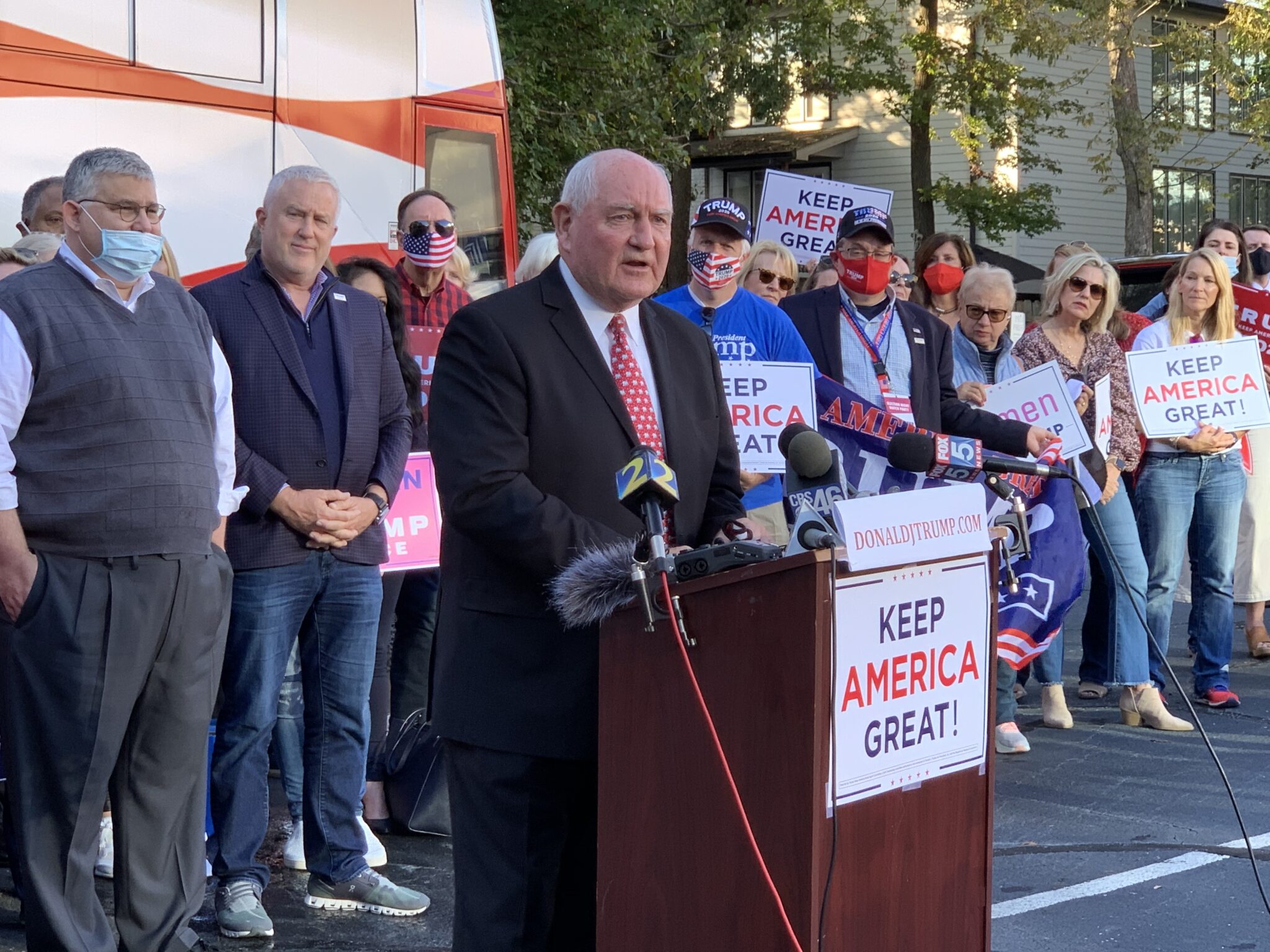
U.S. Secretary of Agriculture Sonny Perdue is set to become the next leader of the University System of Georgia. (Jill Nolin/Georgia Recorder)
(GA Recorder) — Former U.S. Secretary of Agriculture and two-term Georgia Gov. Sonny Perdue Tuesday was officially tapped to be the next leader of the University System of Georgia’s 26 public colleges and universities.
In a controversial but widely expected move, the Georgia Board of Regents approved Perdue with a unanimous vote at a virtual meeting in which Perdue did not participate. Perdue’s own appointees to the board spoke in his favor.
“I appreciate the Board’s confidence in me and look forward to working together with them, our campus leadership and faculties, our elected representatives and most importantly, our students, to provide opportunities for students, faculty and staff to be successful and to produce even more outstanding results,” Perdue said in a statement after the vote. “This may be the most important job yet. I can’t think of a better way to make a difference than to help prepare the next generation – educating them for prosperity, themselves, their families and ultimately our state. I’m excited to get started.”
Perdue is set to get started April 1, replacing acting Chancellor Teresa MacCartney, who has been serving since former Chancellor Steve Wrigley’s retirement in July. MacCartney will return to her previous role as executive vice chancellor for administration.
The decision caps off a long and fraught process that saw a search firm tasked with finding a candidate quit and a warning from the Southern Association of Colleges and Schools Commission on Colleges on undue political interference.
Perdue was reportedly the top choice of Gov. Brian Kemp, in spite of Perdue’s cousin former Sen. David Perdue’s GOP primary challenge for Kemp’s job. Sonny Perdue reportedly helped Kemp secure the endorsement of then-President Donald Trump in 2018, helping him win the Republican nomination for governor, but the relationship goes back even further, said University of Georgia political science professor Charles Bullock.
“Sonny and Brian go back quite a ways,” he said. “The way that Brian originally became secretary of state was Sonny appointed him. There was a vacancy there. So when Brian first met the electorate, he was running as the incumbent rather than one of several people looking for an open seat.”
Kemp may also believe he is removing a powerful piece from David Perdue’s chessboard, Bullock added.
“By having Sonny (at) the Board of Regents, it probably takes him out of the mix for the gubernatorial election,” he said. “He’ll have his hands full, I assume setting policy, overseeing activities for the Board of Regents, therefore less likely to be out campaigning with his cousin, and Sonny is a far, far better retail politician than David is.”
Kemp congratulated Perdue with a tweet after the vote.
“He has a long track record of success working for the people of our state and its students. He will bring the benefit of his decades of leadership to our top-ranked university system.”
Regents at the meeting were similarly effusive in their praise for the former governor, some praising their past experience working with him.
“Previously, as you all know, I worked for Gov. Perdue as services policy director, and I specifically advised him on education policy issues,” said Regent Erin Hames. “Over four and a half years in that role, I really saw firsthand his character, his work ethic and his deep love for the state of Georgia. I saw his passion for the future of Georgia.”
The Georgia Board of Regents votes to confirm former Gov. Sonny Perdue as the next chancellor of the University System of Georgia during a virtual hearing. Ross Williams/Georgia Recorder.
“Sonny appointed me in 2010, and my service on the Board of Regents for the last 12 years has been one of the highlights of the things I’ve done in state,” said Regent C. Thomas Hopkins. “I deeply appreciate what he did putting me on this board, and I look forward to working with him for the future and moving the university system forward.”
Multiple regents praised Perdue’s executive and professional experience. In addition to his public service, he holds a doctorate in veterinary medicine from the University of Georgia. He lives in Bonaire, where he has found success in agribusiness, trucking and land development.
But Perdue might not receive such a sunny reception from all students or faculty.
His nomination triggered charges of political patronage as well as student protests.
The university system saw bitter divides over mask rules during the pandemic, and some professors are raising alarms over proposed changes to the post-tenure review process, which they say will harm their academic freedom and job security.
Perdue critics say he lacks experience in the higher education system.
“Perdue obviously has a great resume for being a governor, but he has zero resume for being the head of universities and colleges,” said Matthew Boedy, Georgia chapter president of the American Association of University Professors. “I don’t know what academic means to them, but four out of the five last chancellors have had experience working in the university system, working in university administration. So, either they’re knocking those people or telling us the job has radically changed.”
Some also worry that his past conservative positions will clash with a more left-leaning campus culture.
Perdue campaigned for governor on restoring the old state flag which included a Confederate symbol, and his tenure in the agriculture department brought charges that he dismissed climate change and suppressing research that demonstrated its effects.
“The chancellor historically has not been a personal political officer,” Boedy said. “We just don’t know what he’s going to do. And his record on funding higher education and supporting higher education is not there, outside of his love for the University of Georgia sports teams. So, the chancellor’s job isn’t to kill research or to promote one issue over the other, so if he starts to do that, that would be very bad for the university system.”
Boedy said he has concerns about the transparency of the selection process, but for now, students and faculty will just have to wait and see what happens.
“That’s where we are now. We have a new chancellor, and we’ll just have to see what he does.”
A motorcycle crash in Athens claimed the life of a 23-year-old man. Police say the man was thrown from his motorcycle after crashing into a trailer being towed by a pickup truck. He is the second person to die on Athens area roads in three days.
This most recent fatal crash happened around 6:36 p.m. on March 1 at College Station Road and University Circle, just south of the downtown district.
According to Athens-Clarke County police, the initial investigation indicates that a Ford F250 towing a landscape trailer was in the process of turning onto University Circle. The motorcycle was traveling south on College Station Road when it collided with the trailer. The motorcycle operator was ejected from the bike and died as a result of his injuries. Officials are withholding his name pending notification of next of kin.
This is the third fatal motor vehicle crash in Athens-Clarke County this year.
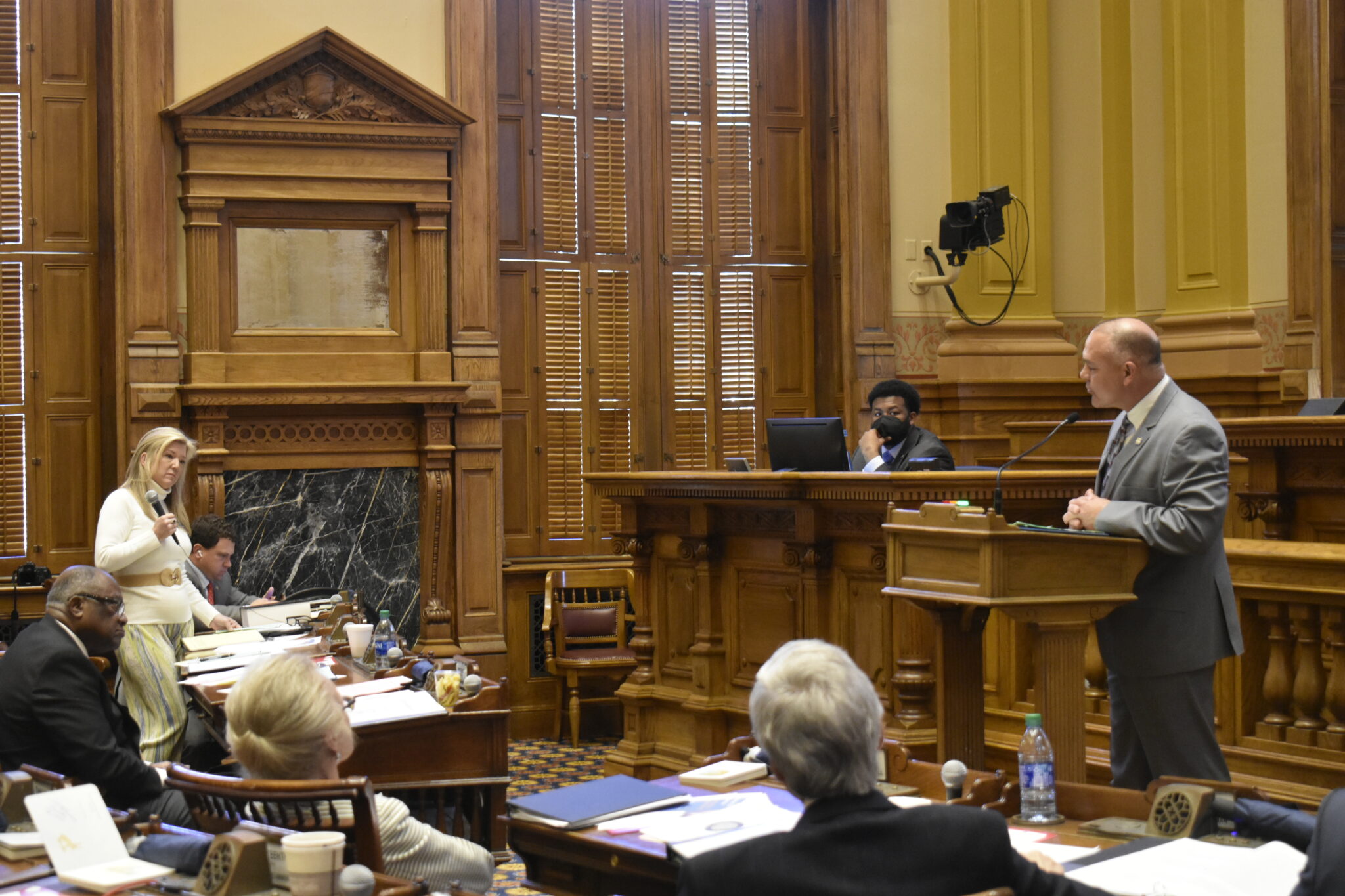
From left, Sen. Jen Jordan and Sen. Bruce Thompson debate his bill that would ban mail-order abortion pills. (Ross Williams/Georgia Recorder.)
(GA Recorder) — The Georgia Senate passed a bill Tuesday aimed at preventing Georgia women from accessing abortion pills by mail.
If the bill passes the House and receives Gov. Brian Kemp’s signature, doctors will be required to conduct an in-person exam before they can prescribe the drugs as well as schedule a follow-up appointment one to two weeks afterward. The bill applies to medicine taken after conception to end a pregnancy, but not contraceptive pills like Plan B designed to prevent pregnancy.
The bill’s sponsor, Sen. Bruce Thompson, a Republican from White who is running for state labor commissioner, says it will undo a rule change by the Biden administration that loosened restricted access to the pills during the pandemic. Democrats called the measure a backhanded means to restrict abortion access ahead of an expected overhaul to Roe v. Wade this summer.
Thompson characterized the drugs as potentially dangerous, pointing to guidelines posted by one of the companies that make the drugs, warning of side effects and requiring that they be administered by a medical professional.
“The manufacturers of these drugs understand the risks associated with taking these pills, and they also outline the importance of a post-treatment assessment between day seven and 14,” he said. “So you can see that their prescriber agreement form is very, very clear.”
Thompson said 26 deaths have been reported in connection with the pills. He did not specify the time frame for the deaths or the size of the population in which they occurred.
Savannah Republican Sen. Ben Watson, a physician who chairs the Senate Health and Human Services Committee, said drugs for treating ailments ranging from acne to rheumatoid arthritis require in-person visits, which makes good medical sense.
“During the pandemic, the rules were suspended, and patients were allowed to get this medicine via telemedicine,” he said. “The FDA’s website has not changed, the medicine has not changed, and the need to see a physician has not changed. Other aspects relating to a follow-up visit is very important when you’re prescribing medicines. Does the patient need to have a birth control discussion? Is there follow-up with any complications related to the medicine? And their initial visit also, do you need an ultrasound to see if this is an ectopic pregnancy? Is it a cervical pregnancy? Is there already some type of miscarriage going on? There are many things that need to be evaluated. Simply put, this puts it back to the pre-pandemic situation that we were in before and I think encourages good health care.”
Another physician lawmaker, Sen. Michele Au, a Johns Creek Democrat, disagreed.
Seeing patients face-to-face is always best, Au said, but many women do not have the ability, including those who cannot afford to see a doctor or who live in rural counties unlikely to have a practicing OB/GYN.
A Supreme Court ruling out of Mississippi expected this summer could limit abortions to the first 15 weeks of pregnancy, and Au said Thompson’s bill would further strip away access to what she characterized as a safe medical procedure.
“This is why this bill matters in this current environment,” she said. “And because of how narrow this window is about to become, you need to leave healthcare providers as many options as possible in order to allow us to care for the patients who need us. The Legislature should not be in the practice of dictating how we can, and should, safely practice medicine.”
Sen. Jen Jordan, an Atlanta Democrat running for attorney general, accused the bill’s Republican sponsors of playing politics.
“Y’all know that term gaslighting?” she said. “You’re going to gaslight women up and down. You’re gonna come up here and you’re gonna tell me that the only reason you want to pass this law is because you want to protect vulnerable women. You’re going to do everything you can to protect women. ‘Highest standard of care that women deserve.’ And yet you won’t even expand Medicaid. Y’all talk about protecting the cherished doctor-patient relationship. And you know what you do? You basically take that away, and you tell the doctor what to do.”
Jordan characterized the requirements for doctors to prescribe the pills as overburdensome and intended to make it harder to obtain an abortion. She expressed particular disgust with a portion of the bill requiring a doctor to inform a patient that “she may see the remains of her unborn child in the process of completing the abortion.”
The bill also states that doctors may, but are not required to, inform women that it might be possible to reverse the abortion process if they change their mind, a claim medical experts described as dubious during a committee hearing.
“Let’s be clear, this has nothing to do (with) protecting women,” Jordan said. “Nothing. It’s about an agenda that’s being pushed. It is about the fact that the Supreme Court of the United States is about to overturn Roe v. Wade. It is about narrowing whatever access actually may be available, especially to women that are poor, that live in rural areas and that are women of color.”
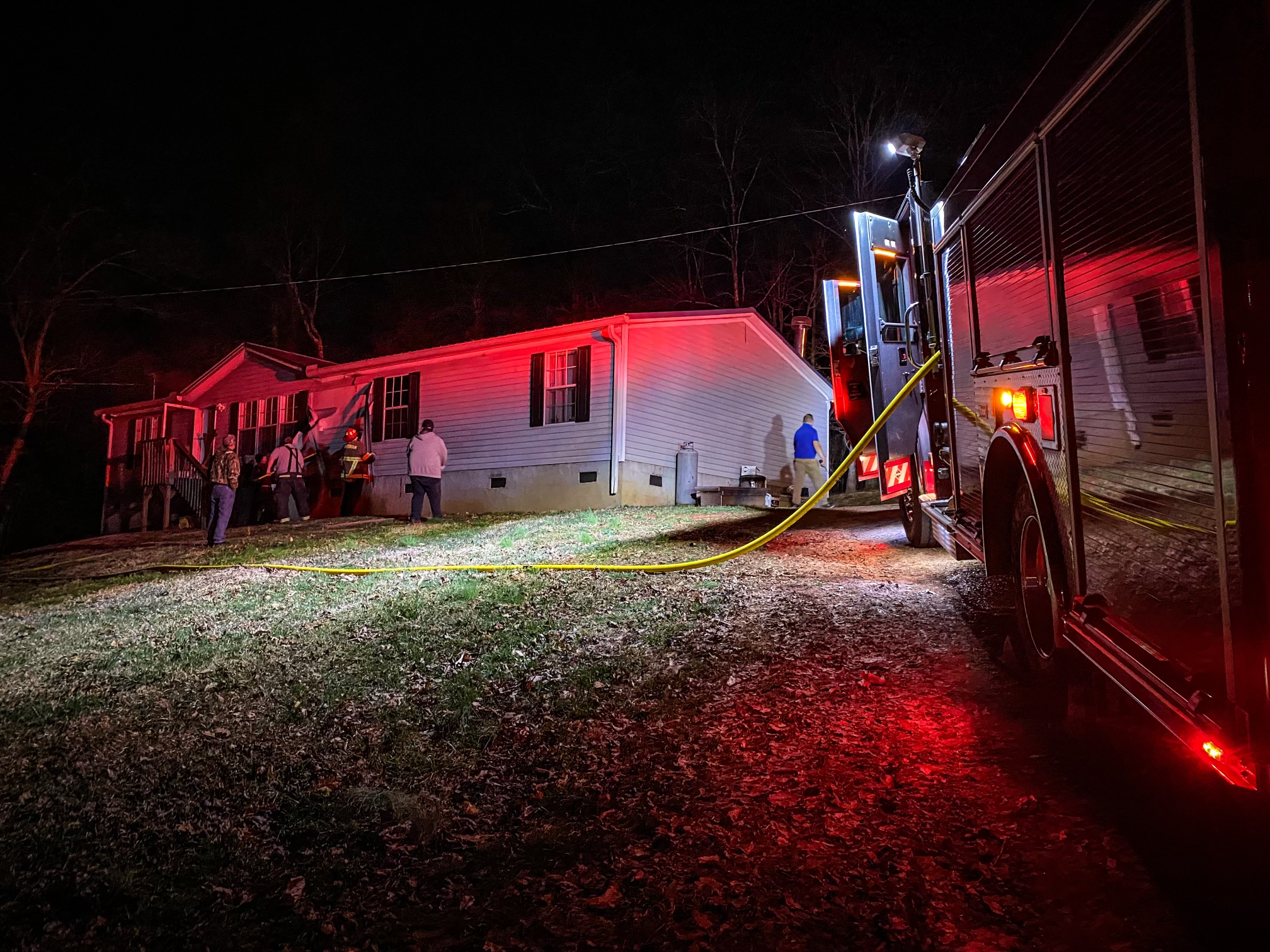
A small fire broke out inside this mobile home on Diamond Avenue in Clarkesville Tuesday evening, March 1, 2022. (Red Bird Media)
An electrical fire forced a Clarkesville family from their mobile home Tuesday night. The fire was called into Habersham 911 shortly after 7 p.m. on March 1.
Firefighters found flames around a bedroom outlet and extinguished them, saving the mobile home from serious damage. (Red Bird Media)
Firefighters from Clarkesville, Habersham County and Lee Arrendale fire departments responded to the scene at 355 Diamond Avenue off Wall Bridge Road.
Units arrived on the scene within ten minutes to find the 1500 square foot structure with light smoke showing.
“Upon investigation, crews found a burned spot on the exterior of the home,” says Habersham County Fire Capt. Matt Ruark.
Firefighters disconnected the electricity, checked inside, and found a fire around a bedroom outlet. Crews extinguished the flames and checked the rest of the home for any signs of burning.
They advised the homeowners to keep the power off until an electrician could inspect the wiring in the home, Ruark says. Fire units cleared the scene shortly before 8 p.m.
The #8-ranked Lady Indians took on #5-ranked Galloway at home in the Elite 8, and despite holding a comfortable early lead, they dropped the 55-43 final to end their season on Tuesday night.
TFS held the lead for much of the first half, going up by as many as 8 points before Galloway cut the deficit to one going into the break. Veronaye Charlton had the first 4 points for the Lady Indians, and later in the first, she and Denika Lightbourne had back-to-back baskets to take a 10-6 lead. Galloway charged back to tie the game at 12.
Charlton notched a layup and Haygen James a jumper to push it back up to 16-12, as Charlton finished with 8 points in the first quarter. TFS led 16-13 heading into the second. Molly Mitchell had 5 points in the quarter, including an early 3-pointer as part of a game-high 8-point lead for Tallulah. A 5-0 run for TFS go them ahead, though slowly Galloway inched back. A long scoring drought for the Lady Indians was finally ended on Mitchell’s bucket. TFS took a slim 27-26 lead into the break.
Right out of the break, Galloway came out with a different level of energy. An immediate 3-pointer game them a 28-27 lead, and though Lightbourne hit a trifecta to tie the game at 32 moments later, Galloway used a 19-2 run that spanned into the final quarter to take control of the game. By the end of the third, Galloway held a 49-34 lead after outscoring TFS 24-7 in the third.
Lightbourne and Charlton had a pair of quick back-to-back buckets in the fourth to pull it within 12, and the Lady Indians once got back to within 10 before Galloway put the game away. Lightbourne scored 13 of the Lady Indians’ 16 second half points. She closed with 21 points, giving her now 973 career points heading into her senior year.
Charlton closed with 13 points, 10 of which came in the first half. Mitchell had 5 points, and Kailyn Neal and James had 2 apiece. The Lady Indians finish the season with a 15-5 record and the school’s first-ever Elite 8 run.
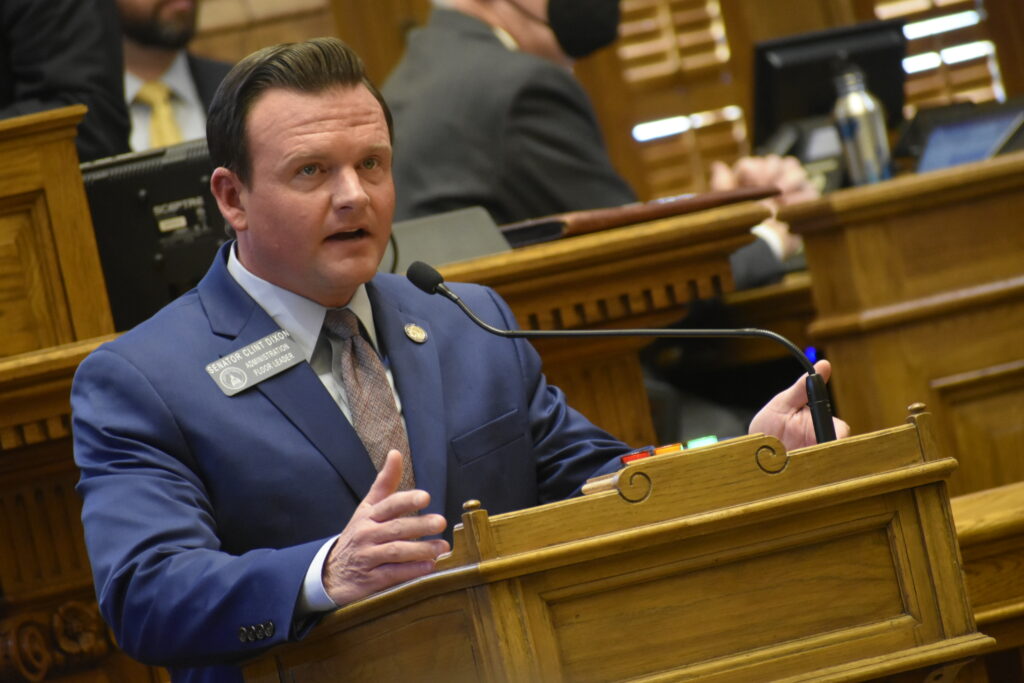
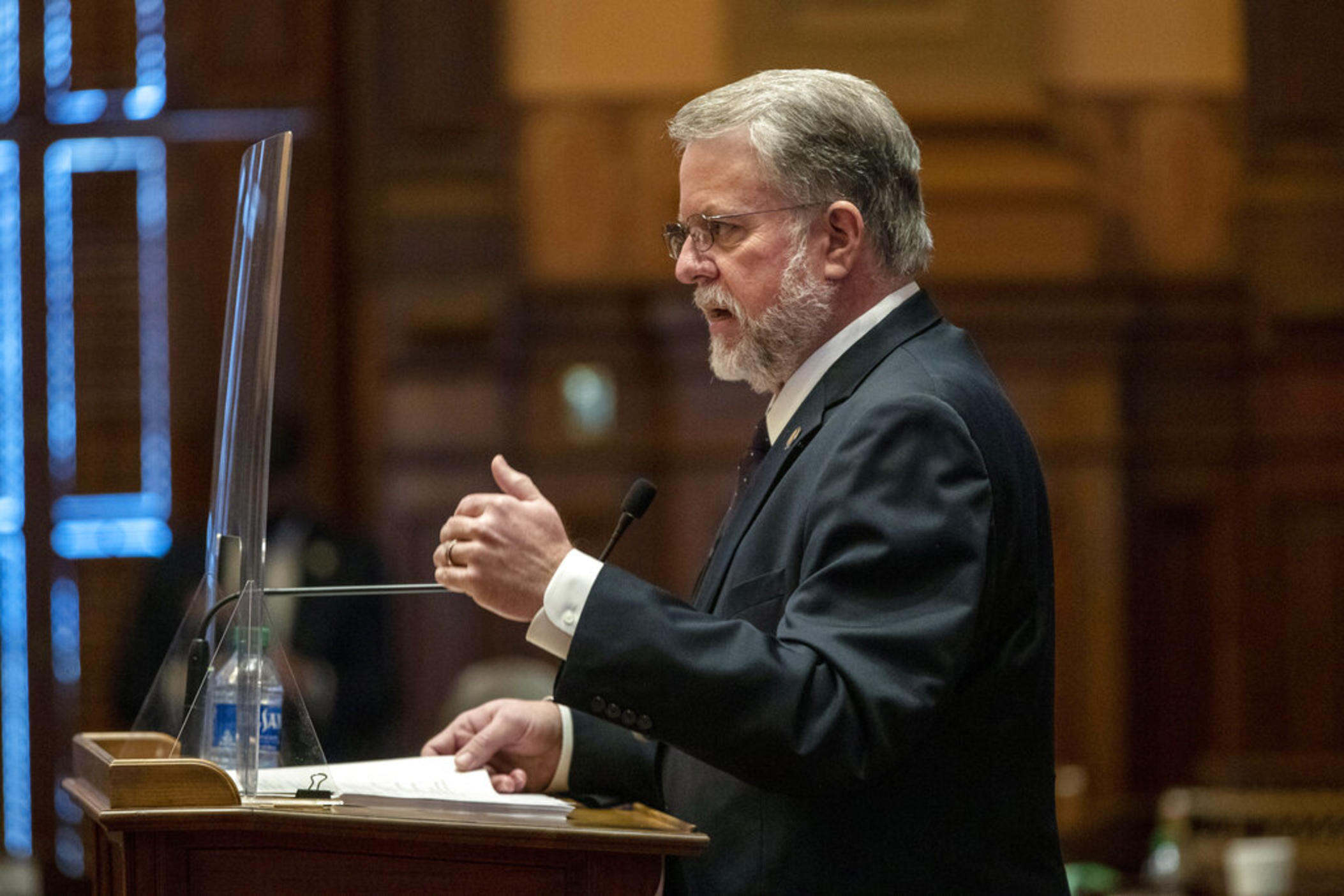
Republican Sen. Clint Dixon presented Gov. Brian Kemp’s bill on Tuesday, which the Gwinnett legislator said would give parents more control over the “misguided politics” of public school mask mandates. The bill allows parents to opt their children out of mask requirements for the next five years. (Ross Williams/Georgia Recorder)
(GA Recorder) — The Georgia Senate signed off Tuesday on Gov. Brian Kemp’s plan to allow parents of public school students to opt-out of mask requirements, as Republican legislators complained that local mandates in dozens of districts are an overreach.
Kemp’s “Unmask Georgia Students Act,” supporters say the measure protects parents’ rights to make decisions about their children’s health and education. The bill is now set to head over to the House, where its chamber’s GOP legislators are also expected to usher the controversial bill to the governor’s desk where he seems sure to sign it.
The legislation moved forward just days after the Centers for Disease Control and Prevention relaxed its guidelines for masks in schools and other public buildings based on the level of risk the virus poses to hospitals. More than 40 Georgia school districts enforce some form of mask requirement. Some are already rolling back their policies, including Atlanta Public Schools, which made face coverings optional on Tuesday for the first time since in-person classes resumed in the COVID-19 era.
The bill that intends to allow parents to opt-out of mask requirements was amended Tuesday to remain in effect until June 2027, an extension beyond the prior 2023 sunset. Parents would be able to opt their children out of mask mandates or rules set by local school boards, state charter schools, school superintendents, and other governing bodies if the legislation makes it into law. Kemp’s Senate floor leader, Gwinnett County GOP Sen. Clint Dixon, said the bill does not interfere with a student being able to wear a face-covering but gives parents the option to reject the “misguided politics” of the mandate.
“Masking prevents students and teachers from hearing each other, masks hinder instruction and student progress, masks slow the development of social skills in early grades,” Dixon said. “Masks further a sense of disconnect and masks do not provide the quality of protection we were initially led to believe.”
Democratic lawmakers said the bill would undermine local school boards’ ability to enforce mandates that can prevent the spread of viruses that could temporarily shut down schools.
Sen. Donzella James, a retired teacher and Democrat from Atlanta, says she’s still dealing with health complications a year after being hospitalized due to COVID-19 and believes SB 514 fails to recognize the importance of masks to protect students, teachers, and other staff.
“We need it more than ever now because it still exists,” James said. “So don’t let the numbers escalate again, because that’s the body bags going out of these hospitals.”
The CDC now says that more than 70% of U.S. residents live in lower-risk communities that don’t require masks indoors. In others, where risks are higher, the organization recommends that students continue to wear face coverings.
A CDC map from Feb. 24 lists about 50 Georgia counties as high risk, with the largest clusters around north and south Georgia.
Mask skeptics said Tuesday that public health organizations have different guidelines regarding the appropriate ages for mask use and whether they might hinder learning and psychological development.
“We have gone overboard in the masking of children who are statistically at little to no risk of death from COVID,” Cumming Republican Sen. Greg Dolezal said.
Democrats contend that the bill stems from misinformation about mask effectiveness dating back to the onset of the pandemic two years ago. The bill would limit local school officials’ authority to enforce policies for the next five years, Stone Mountain Democratic Sen. Kim Jackson said.
“Can you guarantee me that we will not have another global pandemic that is transmitted from breathing, a respiratory pandemic that will not begin before your sunset period ends,” she said.
Republican Sen. Ben Watson, a physician from Savannah, countered that federal and state emergency declarations can override the bill if it’s considered necessary to protect the public.
House Appropriations Committee Chairman Rep. Terry England, R-Auburn, speaks to the House in Atlanta on Friday, March 5, 2021. England’s committee on Thursday, Feb. 10, 2022, passed a revised budget for the current year that includes higher pay for state employees and teachers and state income tax rebates. (Alyssa Pointer/Atlanta Journal-Constitution via AP)
Georgia state senators want prison guards and school nurses to get larger raises and want to set aside a big chunk of money to cover the state’s share of an upcoming federal transportation program.
Those are among the changes the Senate Appropriations Committee made Monday as it passed a revised budget for the year ending June 30. House Bill 910 moves to the state Senate for more debate.
The bill already includes $5,000 pay boosts for university and state agency employees, $2,000 bonuses to teachers and $1,000 bonuses to other K-12 workers including school bus drivers, part-time employees and cafeteria workers. It also restores $383 million to the state’s K-12 funding formula that had been cut when lawmakers feared revenue decreases at the beginning of the COVID-19 pandemic.
Beyond the spending, the document also earmarks $1.6 billion for state income tax rebates. A separate bill to actually pay those rebates is pending in the House.
On top of the $5,000 raise for state employees, the Senate plan would add another $4,000 in raises for guards in the state’s prisons and juvenile justice detention centers. The additional amount would cost nearly $8 million and would take effect April 1, like the underlying raise for all employees.
Senate Appropriations Committee Chairman Blake Tillery, a Vidalia Republican, said prison and juvenile justice employees would not get a chunk of the money as a bonus, unlike the plan for the $5,000 base raise. There, state and university employees who have been on the payroll since July 1 will get a $3,750 bonus for time worked through March 30, and a $1,250 pay raise over the remaining three months of the year.
Senators also added $2 million to give school nurses $2,000 bonus payments, instead of the $1,000 bonus payment proposed by the governor and the House. Tillery said senators wanted to maintain pay parity between nurses and teachers.
Using money it saved elsewhere in the budget, the Senate would set aside nearly $190 million to cover the 20% state match for the federal Infrastructure Investment and Jobs Act. Tillery said state lawmakers are not sure when the state will need the money, but said it makes sense to set aside funds now when the state has plenty of money.
This year is seeing a huge burst of spending even as Kemp and lawmakers face reelection later this year, thanks to bountiful state tax collections. A $2.35 billion surplus was left at the end of the 2021 budget even after filling the state’s savings account to its legal limit of $4.3 billion. That led the House to agree with Kemp’s plan to give $1.6 billion in tax rebates in April — $250 to every single person filing state income taxes, $375 to every single person heading a household and $500 to married people filing jointly.
The Senate would spend $37 million more on Medicaid and the PeachCare program for children to pay more for positive health care outcomes.
The Senate plans also continues a trend that began in the House of spending cash on construction projects and equipment purchases that the state would normally finance through borrowing. The Senate would spend $20 million for rural downtown development grants and direct universities to spend $30 million of their own money on building projects instead of using state money.
This article appears on NH through a news partnership with GPB News
A new water tower will join the City of Baldwin’s expanding infrastructure this summer.
The new water tower will replace the old silo-type tower on Light Road in Baldwin, and will increase the amount of water available to the city. The tower is on schedule to be completed by July, according to Fletcher Holliday of Engineering Management Incorporated (EMI). Holliday addressed the Baldwin City Council about the water tower project during the Council’s meeting Monday night.
(Source: Google Maps)
“The tower itself … is going to change the landscape and sometimes water towers make the landscape kind of attractive,” Mayor Joe Elam said. “I hope that that’s what we see. It’ll match the other tank, but from a perspective of better water pressures and things like that, I hope the public recognizes that sometimes you have to have these things hanging in the air to provide that kind of service.”
EMI President Fletcher Holliday updates the Baldwin City Council on the water tower project at their Monday meeting. (Hadley Cottingham/Now Habersham)
This new tower will also allow the city’s other tower to reach full capacity, so in addition to the 500,000 gallons of water the new tower will provide, the other tower will be able to fill to maintain an additional 30,000-50,000 gallons of water.
Elam says the water infrastructure that the city has is decades old, and new infrastructure, like this water tank and improvements coming to their water pipeline, are needed to provide Baldwin water customers with the service they need.
“The reality is the region as a whole needs to really improve [water] storage in order for this community to be a drought protected,” Elam says. “And we need to have a lot of storage, and this is just one of those components.”
The project overall will cost the city $1,088,715.
A drug bust at a local gas station landed two Cleveland residents in jail. Deputies arrested Jeremy Keith May and Samantha Dawn Kinsey on February 23 at the Clipper gas station on South Main Street in Cleveland.
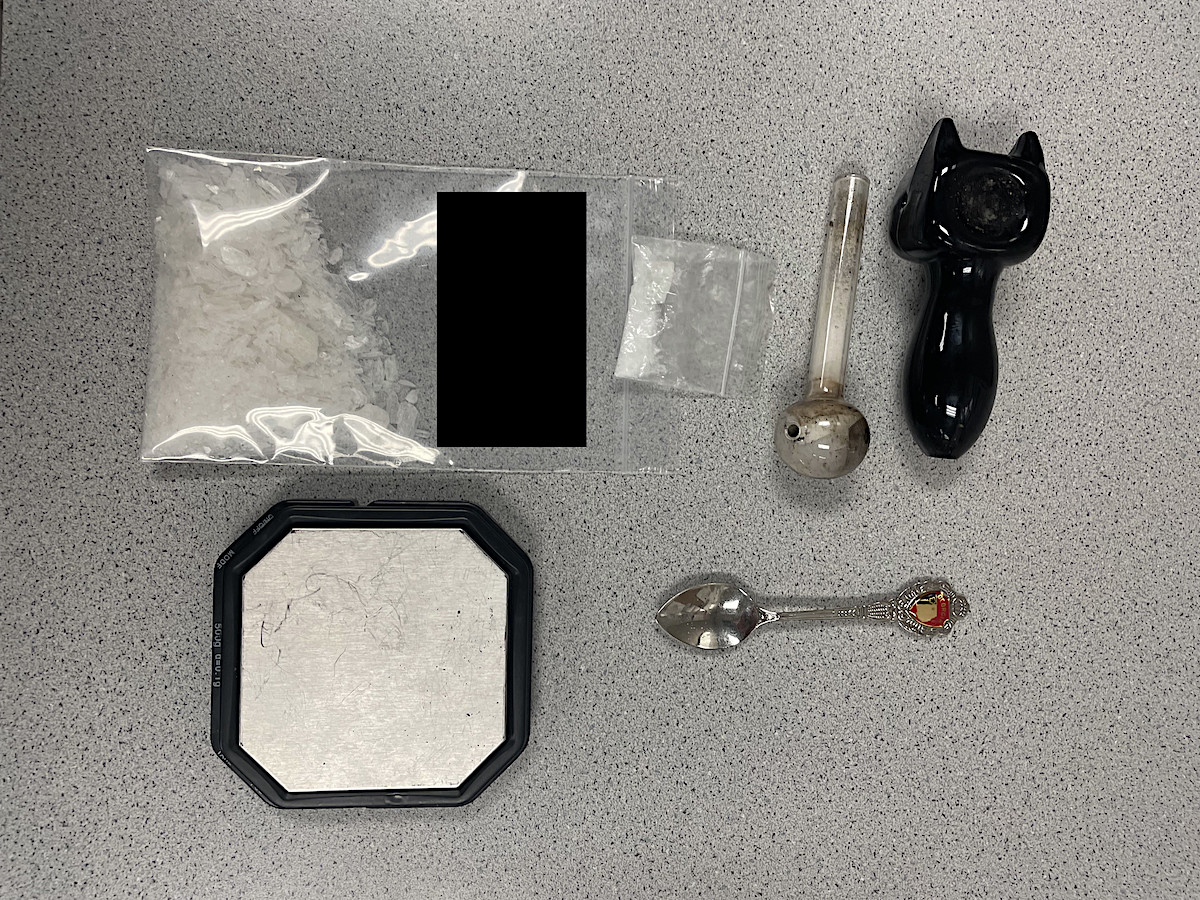
Drugs and drug paraphernalia deputies say they seized from a vehicle parked at the Clipper gas station in Cleveland on Feb. 23, 2022. (WCSO)
According to the White County Sheriff’s Office, one of its deputies was at the station fueling his patrol car. He walked by a parked vehicle at the store and noticed a strong smell of marijuana coming from inside the vehicle.
“The deputy made contact with the driver and passenger. Upon further investigation, deputies located over 35 grams of methamphetamine inside the vehicle,” says White County Sheriff Rick Kelley.
Deputies arrested the 31-year-old May and 33-year-old Kinsey. Officers charged May with trafficking methamphetamine and possession of drug-related objects; they charged Kinsey with possession of a Schedule II controlled substance and possession of drug-related objects.
The suspects were both booked into the White County Detention Center. Kinsey was released February 24 on a $3,500 bond. May, whose online jail record shows previous meth-related arrests in 2016 and 2021, remains in jail without bond.
There have been multiple drug arrests made in counties and towns across Northeast Georgia in recent days. On February 23, eight people were arrested in Habersham and Lumpkin counties in unrelated cases, and on February 24, police arrested five people on drug charges in Toccoa. Each of the arrests involved at least one suspect being charged with trafficking meth.
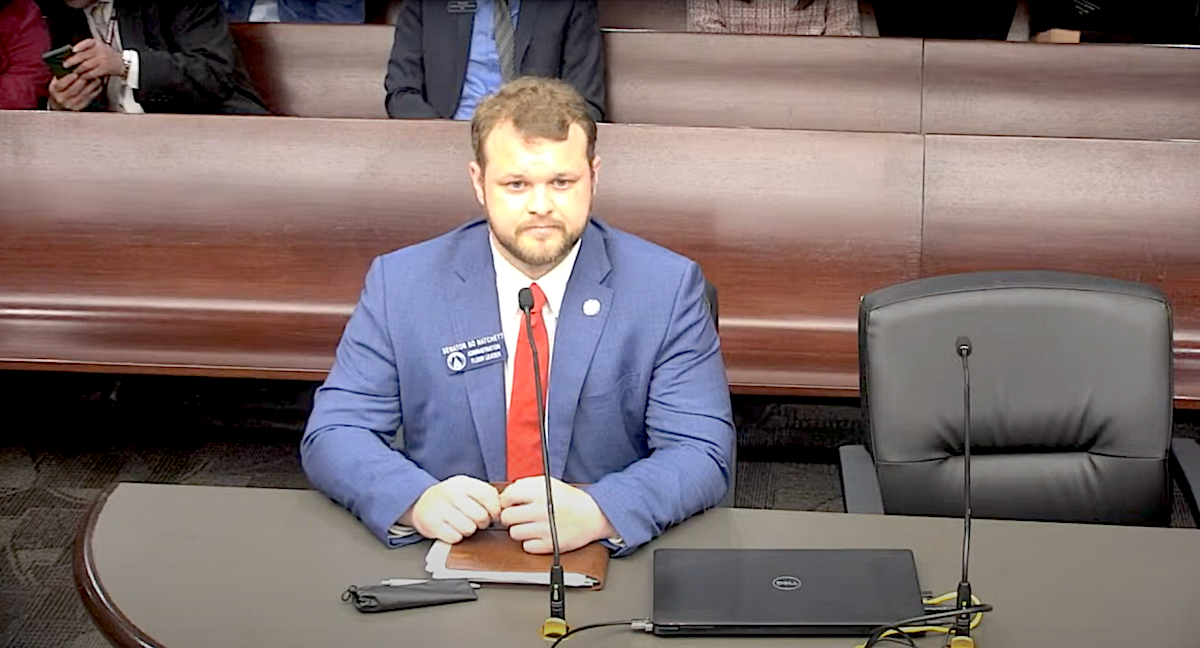
Sen. Bo Hatchett (R-Cornelia) says his proposed bill won't "prevent a teacher from teaching the facts of history." (GA Senate livestream)
The Georgia Senate Education and Youth Committee heard more than an hour of public comment on a controversial education bill Monday.
Senate Bill 377, sponsored by Sen. Bo Hatchett (R-Cornelia), had its third hearing where it met criticism from educators and students. The bill would limit schools’ ability to teach “divisive concepts.”
Georgia Association of Educators President Lisa Morgan speaks out against SB 377 during a hearing before the Senate Committee on Education and Youth on Feb. 28, 2022. (GA Senate livestream)
Lisa Morgan, a teacher and president of the Georgia Association of Educators, was one of several educators who spoke out against the bill. She said it sent a message to teachers that they are not trusted and could hinder their planned curriculum.
“Will the teacher who had planned to use literature discussing Plessy v. Ferguson to teach argumentative essays be told ‘You might want to find a different essay?’” she said.
“It’s not so much the actual history lessons that will change,” she continued. “It’s the other lessons that interweave history.”
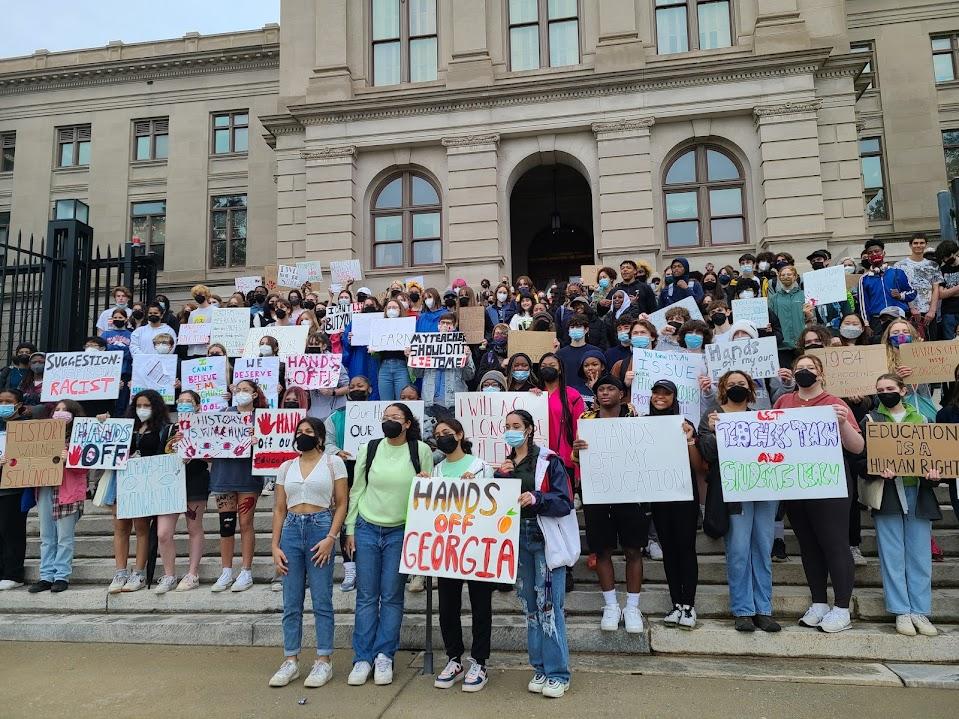
Students gathered at the Georgia Capitol on Feb. 25, 2022, to protest legislation limiting what schools can teach about systemic racism. (Amanda Andrews/GPB News)
Hatchett said in an earlier meeting that banned topics included teaching that the U.S. is fundamentally racist, that one race is superior, that individuals should feel responsible for the actions of other people of the same race, and that individuals are consciously or unconsciously racist because of their ethnicity.
SB 377 is one of several Republican bills to address school curriculum regarding race and history.
Hatchett says he is writing a substitute to the bill based on public comment, and it could be available as early as next week.
The Biden administration Tuesday announced the release of 30 million gallons of oil from the country’s strategic reserves in anticipation that the price of gasoline could continue to spike as Russians sanctions ramp up. File 2021 (Ross Williams/Georgia Recorder)
President Joe Biden on Tuesday authorized the release of 30 million barrels of oil from the Strategic Petroleum Reserve, part of an international boost to the global oil supply that has been disrupted by Russia’s invasion of Ukraine.
The reserve is a complex of four sites with deep underground storage caverns in salt domes along the Louisiana and Texas Gulf Coasts.
The U.S. contribution will make up half of the reserve oil that the International Energy Alliance, a collection of 31 mostly European countries that also includes the United States, agreed to collectively release, White House press secretary Jen Psaki said in a statement.
The release is meant to counteract Russian President Vladimir Putin’s “weaponization of oil and gas,” Psaki said.
“Today’s announcement is another example of partners around the world condemning Russia’s unprovoked and unjustified invasion of Ukraine and working together to address the impact of President Putin’s war of choice,” Psaki said.
Russia’s oil and gas sector is the most significant piece of its economy that the U.S. has not sanctioned after Russia invaded Ukraine last week.
Since the fighting began, Biden has often repeated he is seeking to minimize the impact to U.S. consumers, including curbing any rise in prices at gas pumps.
The war has already led to a disruption of the global energy market, Biden said in a memorandum authorizing the release.
“Russia’s actions in Ukraine have resulted in energy supply shortages of significant scope and duration and have already caused a substantial increase in oil prices worldwide,” the memo reads.
Energy Secretary Jennifer L. Granholm said the administration may draw down more from the reserve if the conflict persists.
“We stand prepared to take additional measures if conditions warrant,” she said in a statement.
The Energy Department reported the reserve held about 588 million barrels as of the end of January.
Releasing oil from the Strategic Petroleum Reserve is one of only a few options policymakers have to contain the price of energy supplies, Patrick De Haan, the head of petroleum analysis for the gas price-tracking company GasBuddy, said in an interview last week.
But a one-time release is not particularly effective at keeping prices in check, De Haan said, and it’s also not the actual purpose of the reserve.
“Unless there’s an actual physical disruption, the SPR should be used for its intended purpose,” he said. “It’s the strategic petroleum reserve, not the price reduction reserve.”