

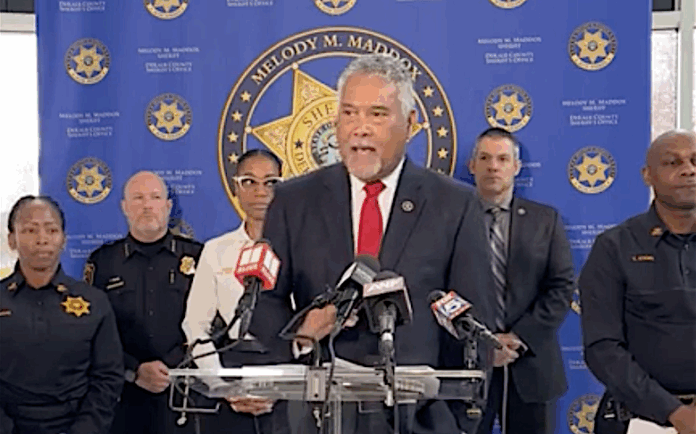
ATLANTA (AP) — Three inmates who escaped from a jail east of Atlanta, including a murder suspect, commandeered a terrified Lyft driver’s car to reach south Florida before she was rescued and they were captured, according to details revealed in court records.
The driver told FBI agents that the men used a fake name to order the ride, put a rope around her neck from behind her, dragged her into the backseat and threatened to kill her, according to a court affidavit filed late Tuesday and obtained by The Associated Press.
The inmates were able to “compromise” a portion of a cell inside the DeKalb County Jail to make their escape, said DeKalb County Chief Deputy Temetris Atkins. He didn’t provide more specifics because jailers don’t want other inmates to know the facility’s weaknesses.
“We repaired the area that was compromised, and we’re looking at other areas that are similar to that to fortify them to make sure that they are not compromised in the same manner,” Atkins said at a Tuesday news conference.
DeKalb County Sheriff Melody Maddox described the jail as an “aging facility that’s deteriorating right before our eyes.” The jail is in Decatur, about 10 miles east of downtown Atlanta.
The escape was discovered early Monday during a routine security check, authorities said. After jailers realized the three were gone, investigators listened to recordings of conversations they’d had on recorded phone lines. They learned that one of the inmates had contacted people on the outside who helped them evade capture after the escape, U.S. Marshal Thomas Brown said.
The inmates were picked up by an unnamed man and taken to one of their girlfriends’ homes, Brown said. Then, a Lyft ride was ordered using a fake, female name.
Officers tracked the car as it traveled to south Florida with the aid of license plate readers, devices that can alert law enforcement to the locations of wanted vehicles. When they caught up with the car and tried to stop it, one of the inmates jumped out and ran but was arrested along with a second inmate, according to a court affidavit.
Investigators also learned that the men used the Lyft driver’s credit card for a short-term rental of a home in Miramar, Florida, where officers apprehended the third inmate and rescued the driver, court records state.
The driver told investigators that she was held in the car for six to 10 hours as they tried to gain access to her phone and online banking records. After trying to escape once, she endured “increased threats of being shot, raped, and tortured,” an FBI agent wrote in an affidavit.
“As you can imagine, the Lyft driver is very traumatized by this,” Brown said.
All three inmates were charged with kidnapping as well as the escape, according to criminal complaints.
A lawyer with the Federal Public Defender’s Office in Fort Lauderdale appointed to represent one of the men, 24-year-old Stevenson Charles, did not immediately respond to messages seeking comment Tuesday evening, nor did a Miami attorney representing a second, Naod Yohannes, 25. There was no lawyer listed in court records for the third, Yusuf Minor, 31.
Charles was being held before the escape on charges including murder and armed robbery. The other two faced charges including armed robbery and arson.
The sheriff’s office had warned that the men might be armed and were considered dangerous after their escape.
Before they were captured, federal authorities had issued particularly strong warnings advising the citizens to be wary of Charles, who has had several run-ins with law officers in Georgia and Florida. He had been sentenced to life in prison after pleading guilty to multiple counts of kidnapping and bank robbery, a federal agent wrote in a Monday affidavit regarding the recent jail escape.
After being sentenced, the agent wrote, Charles was turned over to DeKalb County authorities on Dec. 5 to face the murder charge, details of which were not immediately available.
In one of multiple cases involving Charles in South Florida, he is accused of meeting a man through the Grindr online dating application and then pulling a gun on him when they met in person at a Miami residence in 2022. Charles then drove the man to various Miami area banks, withdrawing money from the victim’s accounts, court records show.
By Jeff Martin



















Bookman: Republicans are fighting a losing battle on health care
In politics, as in war, victory often depends on your choice of battlefield.
Here in Georgia, U.S. Sen. Jon Ossoff has chosen health care and the economy as the grounds on which he will defend his Senate seat in next year’s election. His Republican opponents have chosen loyalty to Donald Trump and, I guess, “wokeness.”
Good luck with that.
So far, an estimated 190,000 Georgians have been forced to drop their health insurance for next year because Republicans in Washington refused to extend subsidies to make the insurance affordable. That’s just the first wave. Overall, experts predict more than 400,000 Georgians will be forced to go uninsured under the ACA next year because they just can’t afford a doubling or tripling of their premiums.
(That’s not counting the hundreds of thousands of additional Georgians who will lose coverage due to cutbacks in Medicaid approved by Republicans in Congress, including two GOP congressmen who are running to oppose Ossoff.)
The political impact of all that will likely be significant, but as Ossoff points out, so will the impact on human beings.
“I heard just a few days ago from one of my constituents, a single mother with four children who gets her insurance through the Affordable Care Act exchange, and her medication costs $20,000 per dose,” he said on the Senate floor earlier this month. “She needs four doses per year. Her premiums are about to go up by 500%.
“I heard from another constituent a few days ago, a woman in her early 60s who waits tables for a living, who’s fighting breast cancer. She needs chemo monthly. Her premiums are now going to be $500 per month. She can’t afford it. She’s going to have to give up her insurance in the middle of chemotherapy while she’s fighting breast cancer.
“What are people supposed to do when they lose health insurance in the middle of a cancer battle?”
Theoretically, you could make an argument that a country with an exploding deficit can’t afford to keep funding Medicaid and ObamaCare subsidies. In the coming campaign, Republicans will no doubt try to do so. But if we, the richest nation in the world with an economy that Trump describes as the best ever, can’t afford to help a working mom and her four kids buy health insurance, if we can’t cover a cancer patient who would die without treatment, then surely we also can’t afford trillion-dollar tax cuts for the very wealthy, right?
Wrong, according to Republicans, because that’s exactly what they’ve done in their “big, beautiful bill,” the legislation that they tout as their crowning achievement of the past year. Budgets reflect priorities, and based on their actions the priority for national Republicans is to further enrich the already rich, while pushing sick Americans onto ice floes and wishing them well.
The political problem for Republicans runs even deeper than that: Because they have never accepted the argument that Americans have a right to health care, they have never shown interest in how that right might best be protected. Trump, for example, has been promising to offer a better, cheaper version of Obamacare since 2015, but in the decade since has failed to produce anything akin to an actual proposal.
And if the GOP can’t accept that health care is now viewed as a right, they have isolated themselves from the American mainstream on a critically important issue. According to a Pew poll released last month, 66% of Americans now agree that health care should be treated as a human right.
Those Americans don’t agree on how best to do it – roughly half believe that health insurance should be purely a governmental responsibility, while others believe that government and private industry together can best provide coverage – but the political question of whether such coverage should be provided has been settled emphatically.
I don’t want to pretend that Obamacare is perfect, because it’s far from it. Like the rest of our health care delivery system, it’s cobbled together from whatever seemed politically plausible at the time, and in the 15 years since its passage some of its frailties have become obvious. Reform is badly needed.
And if the Republican Party could finally accept that health care is a human right, if it could accept that the debate is no longer whether to provide universal health care but how to provide it most effectively and efficiently, maybe, together, we could get somewhere.
And the best way to convince them is through the voting booth.