
Home Blog Page 1415

Georgia’s public referendum law at stake as spaceport fight reaches Supreme Court

Spaceport Camden’s proximity to Cumberland Island contributed to opposition to county officials’ plans to launch rockets from the mainland. A contract dispute between Camden County and property owner Union Carbide has put that deal in jeopardy and on Oct. 6 the Georgia Supreme Court will hear the county’s appeal of a referendum invalidating the deal. (National Park Service)

(GA Recorder) — Union Carbide’s decision to back out of a land deal for a Camden County spaceport has sparked more lawsuits ahead of next month’s Georgia Supreme Court hearing of a challenge to a public vote that has scuttled the project for now.

Attorneys representing the county and a group of residents are set to argue before the state’s supreme court on Oct. 6 whether a March voter referendum blocking the spaceport is legal. When Union Carbide said it no longer intended to sell the former industrial site to the county to build the spaceport, it set off legal action that have led to the county fighting back and environmentalists demanding the release of reports that would further expose the risky and expensive rocket launch venture.

The Augusta-Richmond County Municipal Building will host the Supreme Court’s hearing in a case that could reverberate statewide for years, as it could affect residents’ ability to challenge local projects in the future. Deploying a rarely used clause in the Georgia Constitution, Camden’s voters rejected the county’s land purchase agreement with Union Carbide in March.

Coastal protection advocacy group One Hundred Miles is now requesting the suspension of its lawsuit be lifted so that more details on the spaceport deal can be revealed.

The stay was ordered by a superior court judge on July 21 pending the outcome of the Supreme Court case. According to One Hundred Miles, the documents related to the purchase of the property should no longer be considered confidential since Union Carbide said this summer that it was no longer bound by the option agreement for the 4,000-acre property after Camden voters invalidated it.

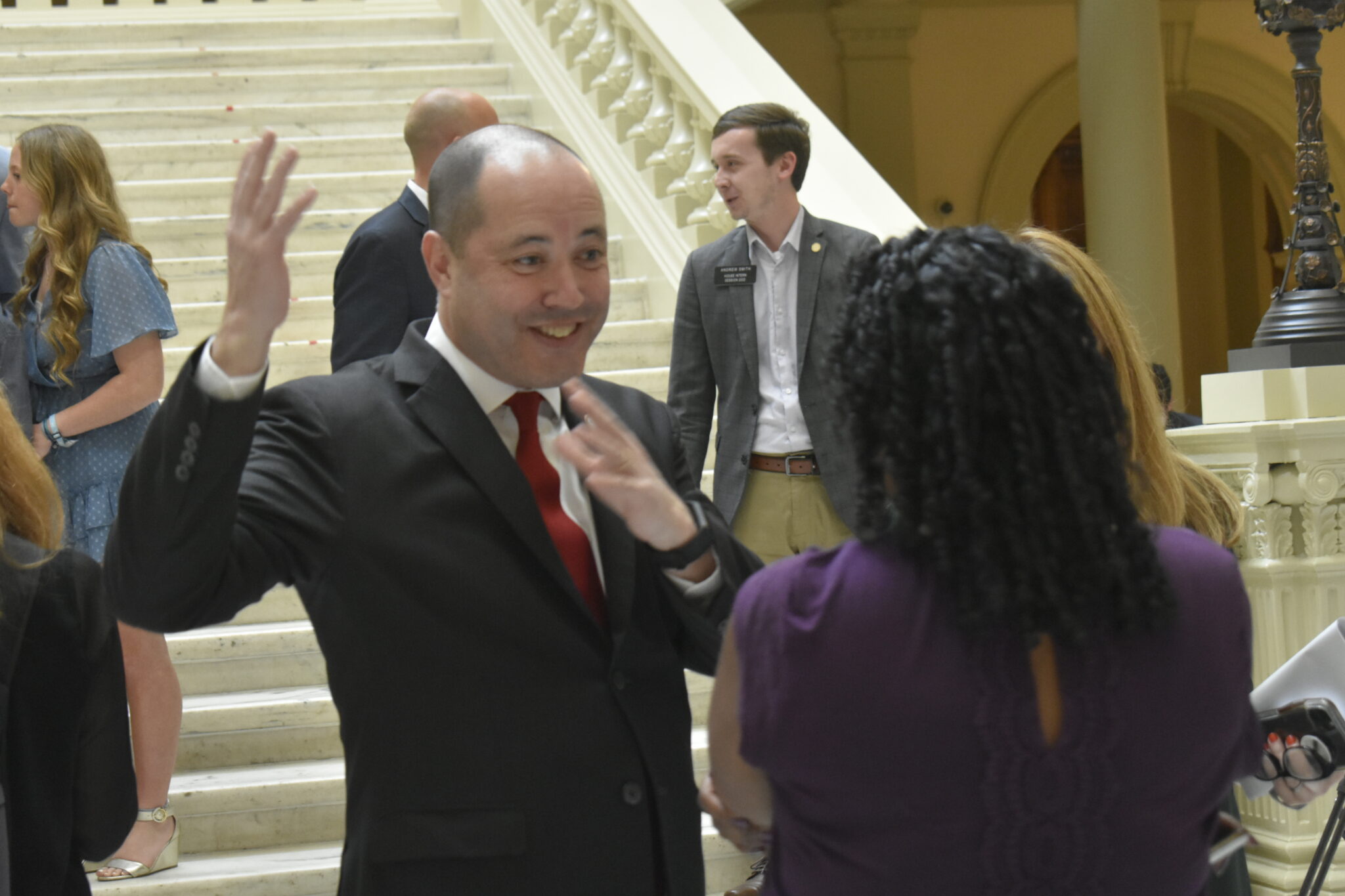
As a result of One Hundred Miles’ open records requests dating back to 2015, the Southern Environmental Law Center filed the lawsuit on its behalf against Camden County and former spaceport consultant Andrew Nelson.

Now that Union Carbide has announced its plans to use the property for conservation, Camden officials can’t rely on the option agreement to avoid sharing spaceport documents, said Megan Desrosiers, president and CEO of One Hundred Miles.

“Camden County has spent millions of dollars on a spaceport that taxpayers have soundly rejected, all the while keeping residents in the dark and refusing to provide funding for critical county services like emergency response, animal shelters, and libraries,” she said. “We need the documents now more than ever to understand how this bad project was greenlighted, and so residents can hold county officials accountable.”

While Camden continues to defend that lawsuit, it’s also going on the offensive against Union Carbide for backing out of a deal that has so far cost the county more than $10.3 million, or 3% of its budget since 2015.

In December 2021, the Federal Aviation Administration granted the county a license to launch up to 12 rockets annually, but it was conditioned on the requirement that the commercial spaceport be built on the land situated at the mouths of the Satilla River and Crooked River, and inland from Cumberland Island and Little Cumberland Island. Residents were able to get a restraining order quickly while they worked on a petition which led to the successful referendum overturning the county commission’s resolutions approving the contract.

Because of the complexities of the FAA approval process, Camden filed an exclusive right to purchase the Cumberland Island property instead of purchasing it in 2015.

Even before Camden’s voters overwhelmingly rejected the project in March, behind-the-scenes negotiations were already faltering.

“Meanwhile, even prior to the referendum, Union Carbide stonewalled and sought to avoid its contractual obligations,” Camden argues in the suit. “Rather than engage with Camden County to work towards completing required items under the option contract, Union Carbide was non-responsive or worked against Camden County’s efforts to perform the contract terms.”

Further, the county claims the Union Carbide agreement was simply a cash grab, and because the company refused to close, the county had no choice but to trigger a 90-day closing window that began on April 12, the county said in its suit.

“Union Carbide’s real reason for repudiating the contract had nothing to do with the referendum but was instead about money: Union Carbide’s intent is to reap more money from the property through lucrative ‘conservation easement tax credits,’ combined with potentially selling the property for more money,” Camden said in the lawsuit.

As Union Carbide announced in July it would no longer sell the property to the county, a company spokesman said the company was committed to safeguarding the property’s conservation value.

Camden officials have promoted the spaceport as the gateway to a $450 billion industry that can diversify the local economy, increase science and technology opportunities for students,‌ ‌and attract‌ ‌high-paying‌ ‌jobs.

Spaceport opponents accuse the backers of exaggerating economic benefits. The National Park Service and conservationists have warned of rocket explosions causing wildfires and contaminating coastal marshes and barrier islands.

White County observes Constitution Day

A small crowd gathered on the lawn at Freedom Park in Cleveland on Saturday in celebration of Constitution Day. (Dean Dyer/WRWH Radio)

On September 17, 1787, the founding fathers of our country signed the U.S. Constitution which calls for three branches of government with equal powers. On Saturday, a small crowd of White County residents came out to help celebrate that day.

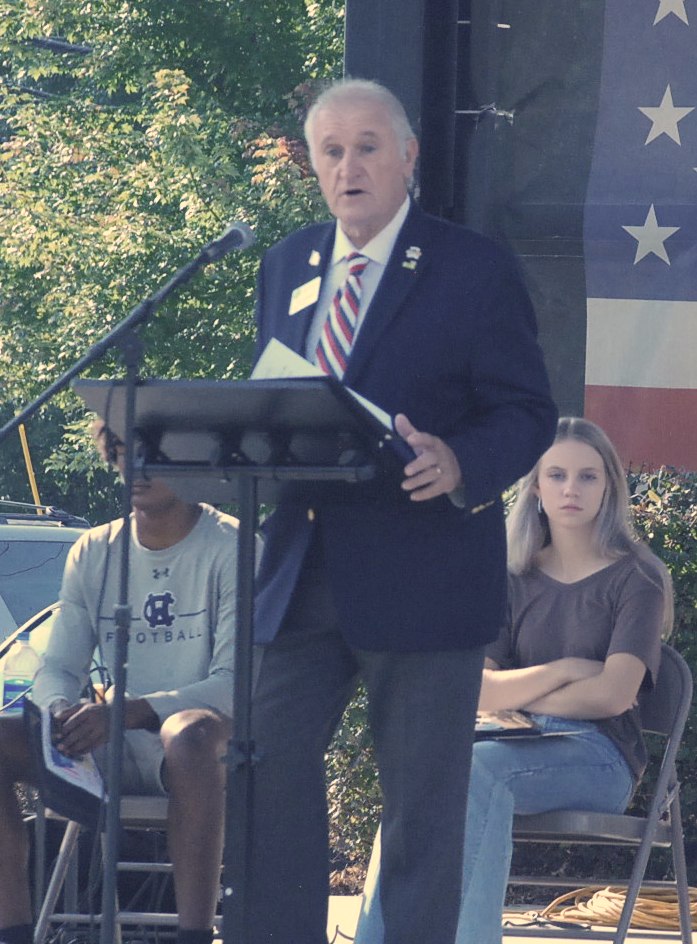
Ron Web, President of Northeast Georgia Veterans Society, speaking to the Constitution Day crowd in Cleveland on Sept. 17, 2022. (Dean Dyer/wrwh.com)

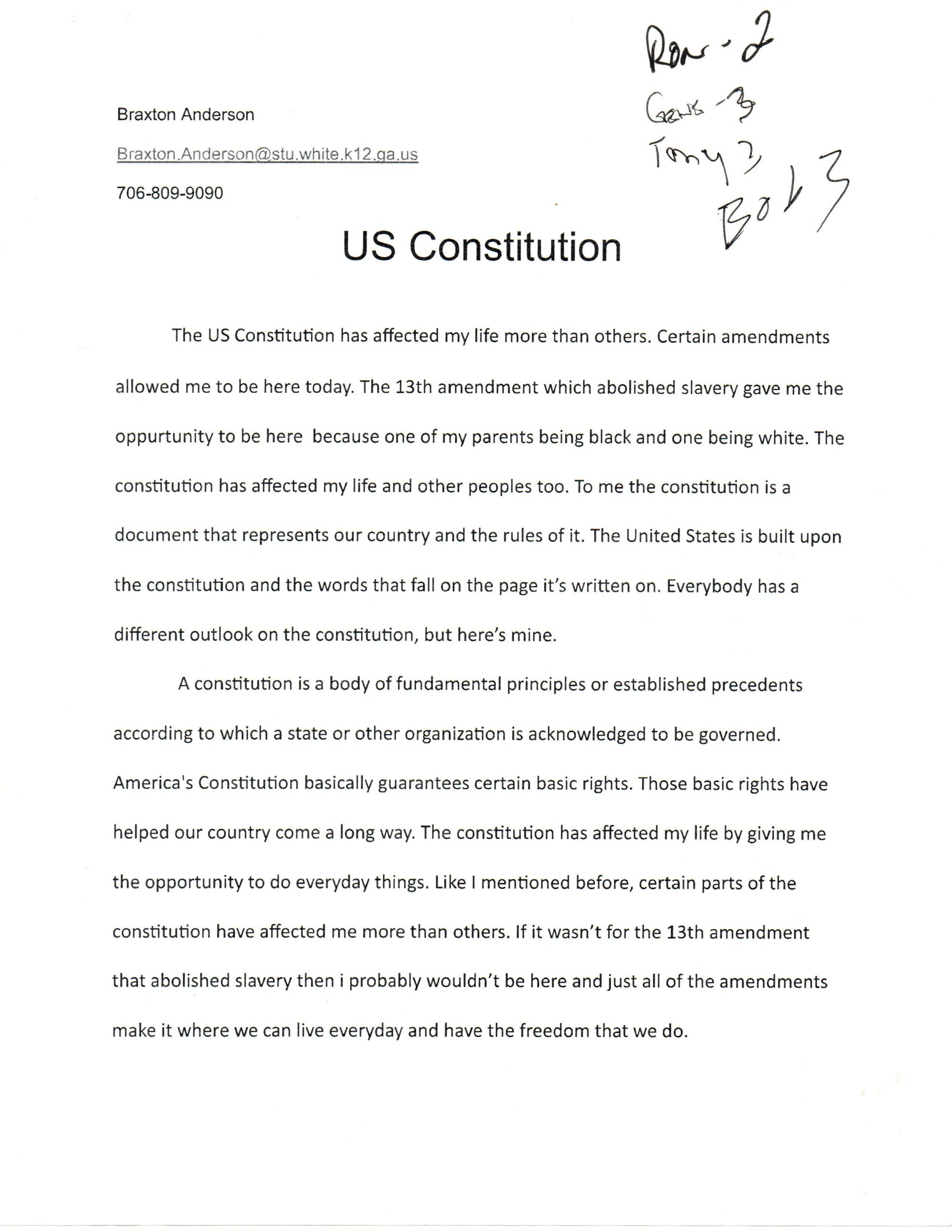
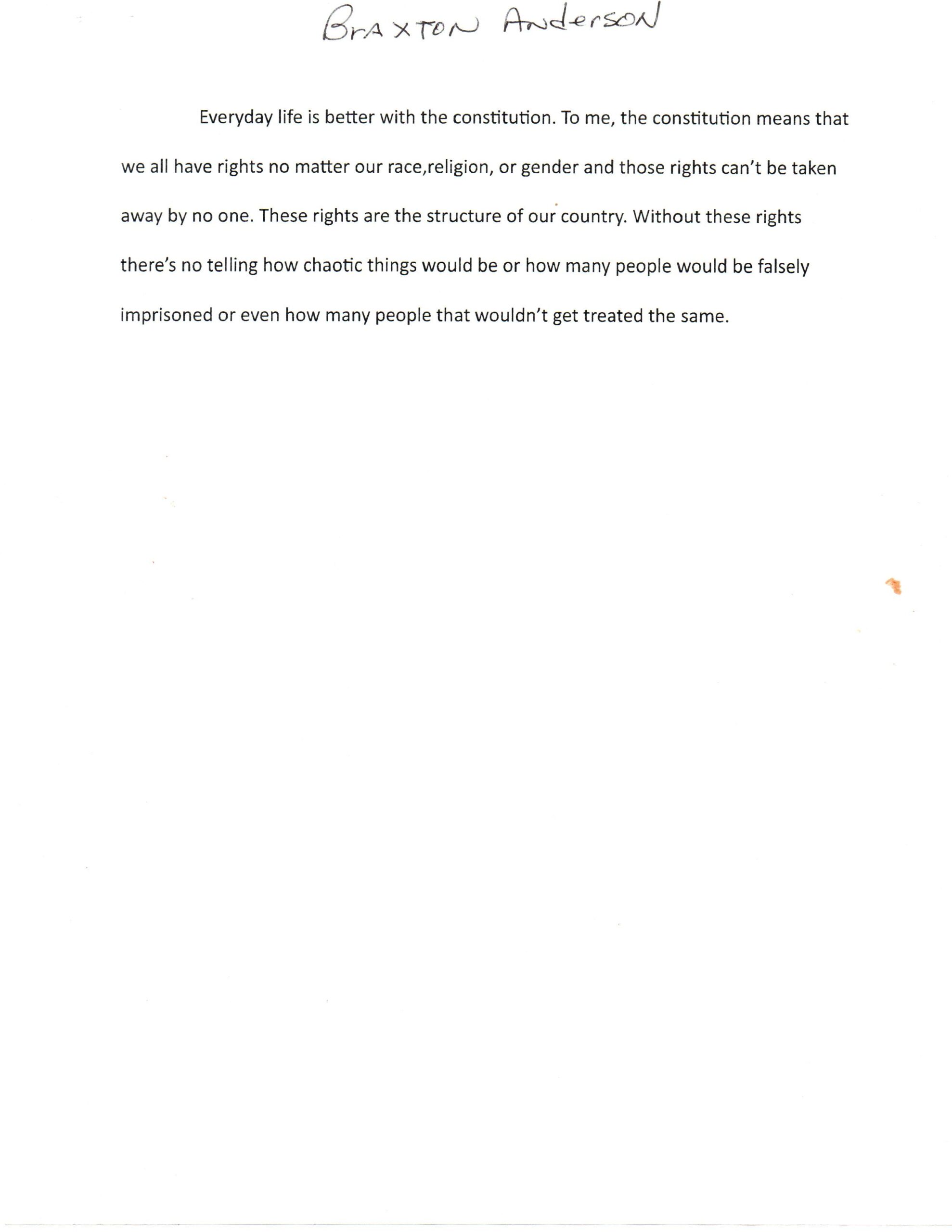
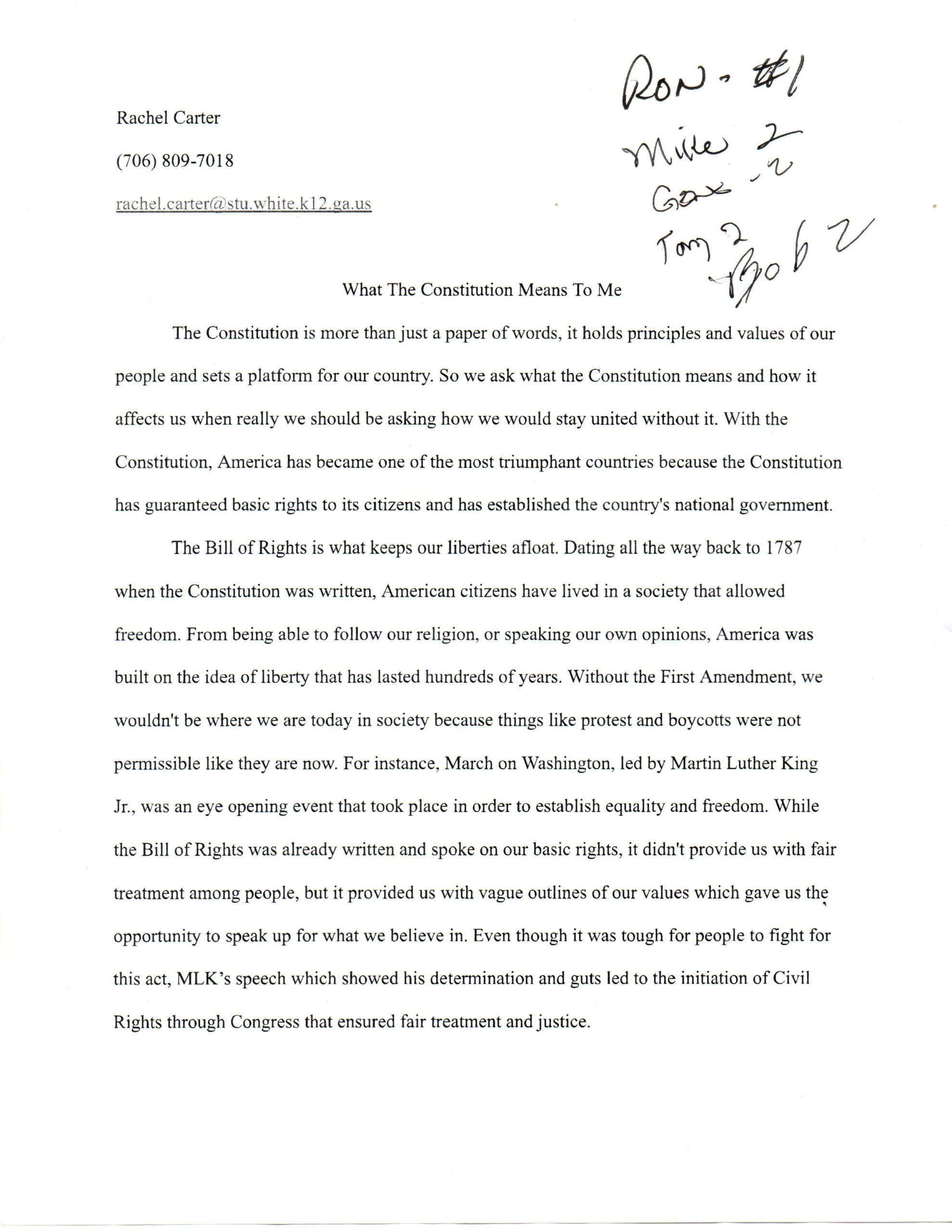
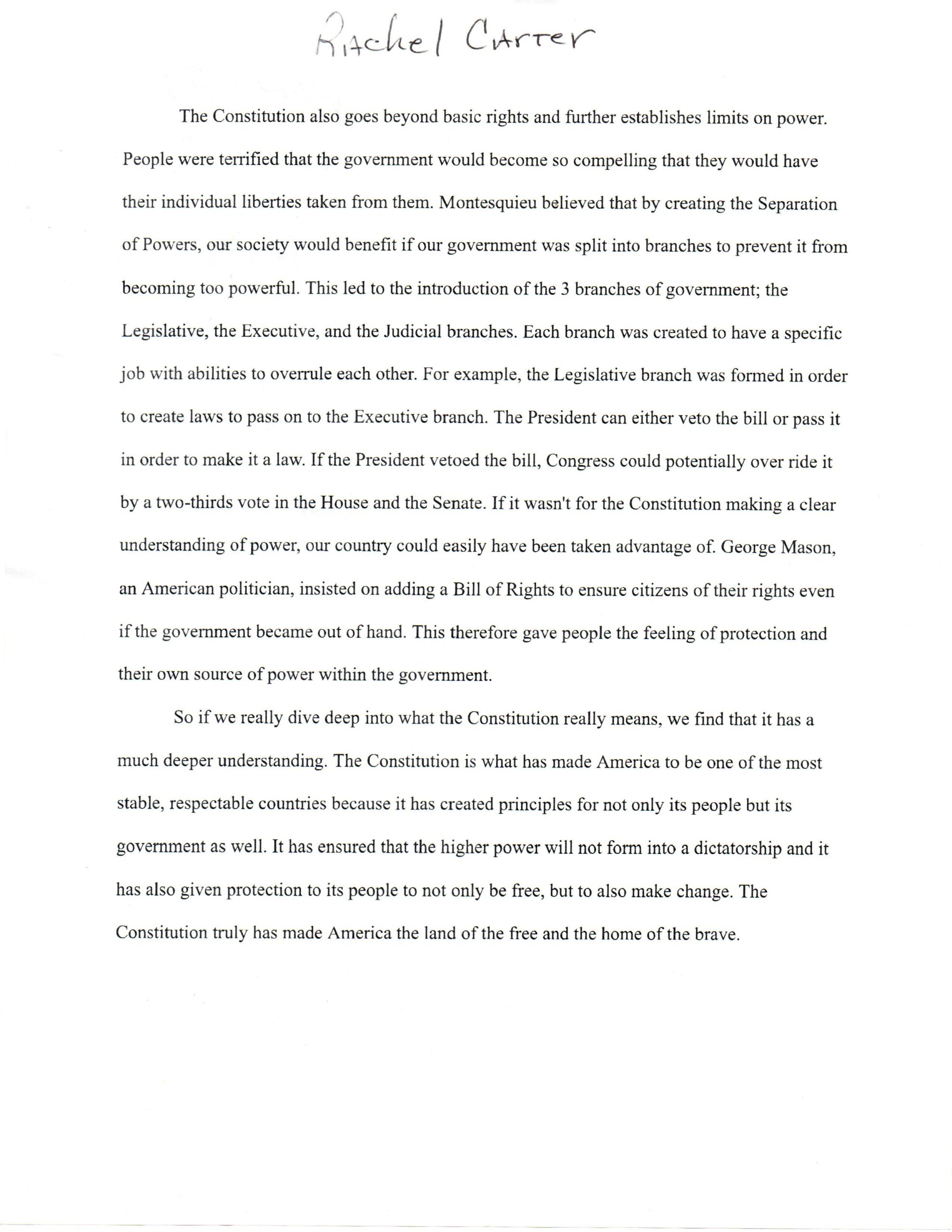
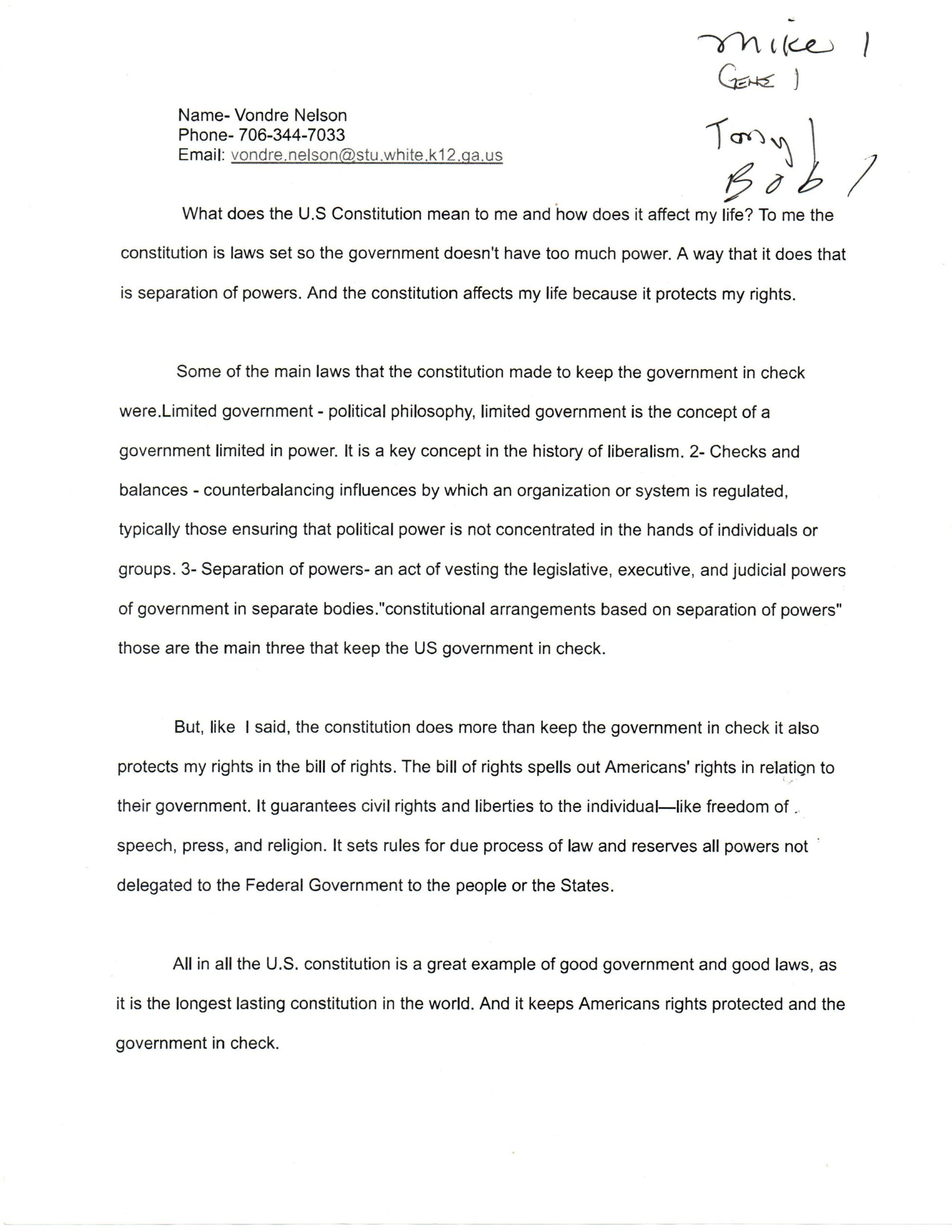
A program was held at Freedom Park in Cleveland by the Northeast Georgia Veterans Society. During the program, three White County High School students, VonDre Nelson, Rachael Carter, and Braxton Anderson were recognized for their essays written about the Constitution.

Ron Webb, President of the Northeast Georgia Veterans Society told the crowd that knowledge about the ideas embodied in the Constitution and the ways it shapes our lives is not passed down from generation to generation.

“It’s not simply to read and memorize the Constitution, rather, we should try to understand the ideas that gave it life and give it strength still today,” commented Webb.

The veteran’s group along with the Blue Ridge Mountains Chapter Georgia Society of Sons of the American Revolution provided special pocket-sized editions of the United States Constitution and Declaration of Independence.

Read the winning essays below


Wright wins 19th, Riley and Rosario homer, Braves beat Nats

Atlanta Braves starting pitcher Kyle Wright works in the first inning of a baseball game against the Washington Nationals, Monday, Sept. 19, 2022, in Atlanta. (AP Photo/John Bazemore)

ATLANTA (AP) — Kyle Wright didn’t exactly feel sluggish, just not quite on top of his game.

Even so, his performance, which Wright said was just “OK,” was good enough to move him closer to 20 wins.

“The more times I can go out there and pitch as long as I can, however long that may be, and hopefully give us chance to win — that’s what I think I’m the most proud of,” he said. “There’s just a lot more confidence when I take the mound.”

Wright won his major league-leading 19th game, Austin Riley and Eddie Rosario homered and the Atlanta Braves beat the Washington Nationals 5-2 on Monday night.

The defending World Series champions won their ninth straight home game to improve to 92-55. Atlanta remained one game behind the first-place Mets in the NL East after New York won 7-2 at Milwaukee to clinch a playoff spot.

Wright (19-5) won his sixth consecutive decision, allowing two runs and eight hits with one walk and seven strikeouts in six innings. The Braves improved to 22-6 in Wright’s starts this season, including seven straight wins. Wright threw 64 of 88 pitches for strikes.

“He’s been sharper, but you’re doing something right when you win that many games and you’re keeping your club in there, and it’s not going to be just without flaws or smooth sailing all of the time,” manager Brian Snitker said. “And probably most of the time not. And the fact that you can maneuver and do things when you’re not hitting on all cylinders is what winners do.”

Riley hit his 37th homer, second-best in the NL, and his eighth against the Nationals in 14 games this year. He went deep in the first off Cory Abbott, his 368-foot shot barely clearing the wall in left field. Rosario connected off Steve Cishek to make it 5-2 in the seventh, his fifth homer traveling 392 feet to right.

Last-place Washington dropped to 51-96 and lost for the seventh time in nine games.

“They’re getting an opportunity to play and they’re showing me some things I want to see, and they’re doing well,” manager Dave Martinez said. “We’re looking for players, right? Come spring training, these guys can make a good case for themselves.”

Wright is 3-0 with a 3.15 ERA in three starts this year against the Nationals. The No. 5 overall draft pick of 2017 gave up a single in the first, the second and the fourth but didn’t allow a runner into scoring position until Ildemaro Vargas doubled to begin the fifth.

Vargas advanced on C.J. Abrams’ single and scored on Victor Robles’ sacrifice fly. Wright issued his lone walk before Alex Call doubled to drive in Abrams to trim the lead to 4-2. Wright gave up singles to Joey Meneses and Vargas in the sixth but struck out Riley Adams to end the threat.

Jesse Chavez faced the minimum in the seventh, Raisel Iglesias faced four batters in the eighth — his 18th consecutive scoreless appearance — and Kenley Jansen pitched a perfect ninth for his NL-leading 35th save in 42 chances.

The Braves scored three runs in the fourth. Riley walked and advanced on a double by Matt Olson that ended an 0-for-22 stretch, then scored on Travis d’Arnaud’s single. Michael Harris II followed with an RBI single. He stole second, advanced to third on a throwing error by Adams and scored on William Contreras’ sacrifice fly.

Olson began the game with four hits in his last 66 at-bats dating to Aug. 28.

“It hasn’t been the easiest go for me personally, but it’s a crazy game and you just stay on top of stuff,” he said. “We’ve been winning some games and that’s all that matters at the end of the day. Trying to get it going in the right direction. A good baby step.”

Atlanta has outscored opponents 39-12 during its home winning streak. The Braves last won nine straight as part of a modern era-record 13-game home winning streak in 2019. At 51-25 at home, the Braves are second in the NL in home winning percentage.

Facing Atlanta for the first time, Abbott (0-3) allowed four runs and six hits in four innings, his ERA rising 51 points to 5.70 in seven starts this season.

Meneses went 4 for 4, each of his hits a single.

The Braves improved to 11-3 against Washington this season.

TRAINER’S ROOM
Nationals: Martinez said DH Nelson Cruz (eye inflammation) is doing better after taking eye drops but might need a couple more days before he rejoins the lineup. … LHP MacKenzie Gore (left shoulder inflammation) will throw a bullpen Tuesday. If that goes well, he will begin a rehab assignment with Triple-A Rochester. … C Keibert Ruiz (testicular contusion) and RHP Cade Cavalli (right shoulder inflammation) are traveling with the team but aren’t expected to return this season. … RHP Victor Arano (right shoulder strain) played catch.

STERLING SEASON
Wright is bidding to become the first Braves pitcher to lead the NL in wins since Russ Ortiz had 21 in 2003. The last Atlanta pitcher to lead the majors in wins was Tom Glavine in 2000. The Hall of Famer won 21 times that year.

UP NEXT
Braves RHP Charlie Morton (8-6, 4.17 ERA) will face LHP Patrick Corbin (6-18, 6.11) as the teams play the second game of a three-game series Tuesday.

Dominant Dogs: Is this Georgia team even better than 2021?

Georgia head coach Kirby Smart congratulates tight end Oscar Delp (4) after he scored a touchdown during the second half of an NCAA college football game against South Carolina on Saturday, Sept. 17, 2022 in Columbia, S.C. (AP Photo/Artie Walker Jr.)

ATHENS, Ga. (AP) — College football coaches are notorious for hyping up their opponents with preposterous accolades.

Still, it was a bit jarring to hear Kent State’s Sean Lewis sizing up the reigning national champion Georgia Bulldogs.

“I don’t think it’s an exaggeration,” Lewis said Monday, “to say this is the greatest collection of talent ever assembled on a football team.”

OK, maybe it was just the desperate ramblings of a coach looking to plant the seeds of complacency in the top-ranked Bulldogs before they tear into his overmatched team on Saturday.

After all, Georgia lost a record 15 players in the last NFL draft — five of them first-rounders from one of the great defenses of the last quarter-century.

But three games into a new season, Lewis’ assessment doesn’t seem that out of line.

Seriously, could this Georgia team be even better than the last one? You know, the one that celebrated in Indianapolis some eight months ago after claiming the school’s first national title in 41 years?

“I think so,” said Bulldogs defensive back Christopher Smith, sounding more matter-of-fact than boastful, “but that just comes with our standard. Our standard is our motivation. We hear a lot of things that people say, but we never fade into that. We just continue to work.”

The Bulldogs have rampaged through their first three opponents while barely breaking a sweat in the southern humidity.

They blew out then-No. 11 Oregon 49-3 in the season opener. They coasted past FCS opponent Samford 33-0. And this past weekend at South Carolina, they demolished their Southeastern Conference rival 48-7 in a performance that was so dominating many of the home fans went streaming for the exits by halftime.

The only touchdown allowed so far by the Bulldogs came in the waning seconds against the Gamecocks, a meaningless score that came long after the starters had been pulled.

Still, it seemed to tick off the Georgia defenders, who have set a very high standard for themselves.

“It definitely bothered me,” Smith said. “We never want to give up any points whenever we step out on the field, and we were so close to keeping a goose egg on the board. But things didn’t work out, so back to the drawing board. That gives us something else to fix.”

While the defense has kept up its dominating ways — even with all those former Dawgs now playing in the NFL — the offense has clearly stepped up its game from a year ago.

Stetson Bennett, the former walk-on quarterback who has worked his way into the early Heisman conversation, directs an offense with a seemingly unlimited supply of weapons at his disposal.

Eleven players had at least one catch against the Gamecocks, all of it adding up to 339 yards and 16.1 yards per reception.

Ten players ran the ball, with no one gaining more than Bennett’s 36 yards on three carries, but the cumulative effort producing 208 yards and a 5.9 average.

“When things are working, you roll with it,” coach Kirby Smart said. “Getting the players out on the perimeter to do their things whether it’s receivers, tight ends, or running backs. I think we have done a good job of dispersing the ball and letting everybody get a piece of the action.”

Last year’s Georgia team had an offense that played it close to the vest, knowing it could win most games simply by being efficient and not making any major mistakes.

Not so with this group, which is willing to attack from anywhere on the gridiron.

Bennett has been on the field for 21 possessions, which have produced 14 touchdowns, four field goals, a missed field goal, and just two measly punts.

Last Saturday, it was Brock Bowers taking the lead role.

The tight end had five catches for 121 yards and two touchdowns — one of them a remarkable, twisting grab before tumbling out of bounds, the other a 78-yard scamper in which he broke one tackle, sidestepped another defender and took off down the middle of the field like Usain Bolt.

For good measure, Bowers scored the first of his three TDs on a 5-yard reverse.

But Bennett has far more players he can go to than just Bowers, which means the defense can’t put too much focus on the tight end described by Kent State’s coach as a “superfreak.”

“I think that’s what is separating us,” Smart said. “It’s not just one player. They can’t key in on one receiver, tight end, or running back.”

Smart refused to get drawn into any speculation about whether this team could actually be better that his 2021 squad.

“I don’t do comparisons,” he said. “You can’t compare anybody to last year, because last year’s team, 15 of them are in the NFL.”

But the way things are going, the biggest challenge facing the Bulldogs might be overconfidence.

“This team has a long way to go,” Smart said. “The worst thing that can happen to this team is to start believing what people say about them.”


GOP leaders target ‘woke’ investments through state pension funds

Georgia Attorney General Chris Carr is among the Republicans in state capitals across the country targeting an investing concept known as environmental, social and corporate governance criteria. (Ross Williams/Georgia Recorder)

(GA Recorder) — Republicans in state capitals across the country are targeting an investing concept known as environmental, social and corporate governance criteria, or ESG for short.

Describing these investment criteria as “woke” and “misguided activism,” GOP officials argue that by taking these factors into account when making investment choices, financial institutions are putting ideology ahead of making money. Experts on this investment criteria say that it’s the other way around and that Republicans are losing money for their constituents by unnecessarily narrowing the options of the financial institutions the state does business with.

Nineteen Republican state attorneys general wrote a letter to BlackRock, the world’s largest asset manager, which manages $10 trillion, according to Insider, in August. The letter accuses BlackRock of making decisions based on its alleged political agenda rather than the welfare of state pensions.

“A governance engagement strategy primarily focused on BlackRock’s climate agenda necessarily overlays ESG factors on the core index portfolios that comprise a substantial part of many state pension funds,” the state attorneys general said in their letter. They added, “BlackRock’s commitment to the financial return of state pensions should be undivided.”

State attorneys general in Arizona, Arkansas, Georgia, Idaho, Indiana, Kansas, Louisiana, Missouri, Montana, Nebraska and Ohio were among those who signed the Aug. 4 letter.

In its response, BlackRock called the attorneys general statements inaccurate and wrote “we are disturbed by the emerging trend of political initiatives that sacrifice pension plans’ access to high-quality investments – and thereby jeopardize pensioners’ financial returns.”

The same group of attorneys general along with Virginia’s AG have joined an investigation by the Missouri Attorney General into whether Morningstar, a financial services company, violated consumer protection law as it evaluated companies performance on ESG issues.

Florida Republican Gov. Ron DeSantis has also taken on the issue. On Aug. 23, he successfully pushed through a ban on considering ESG criteria in state pension fund investments.

DeSantis said of his win against ESG investing, “We are reasserting the authority of republican governance over corporate dominance and we are prioritizing the financial security of the people of Florida over whimsical notions of a utopian tomorrow.”

But Witold Henisz, vice dean and faculty director of the ESG Initiative at the Wharton School of the University of Pennsylvania, said such policy developments are bad news for taxpayers in these states.

“When states say they can’t do business with financial institutions that take climate risk and other ESG factors into account, that means they’re not doing business with the largest and most sophisticated financial institutions in the U.S. and in the world, which means they have to issue bonds and interact with smaller financial institutions which have less economies of scale and economies of scope and as a result, charge higher fees,” he said.

According to Deloitte, by 2024 half of all professionally managed assets globally will have investments in companies that take ESG issues into account. BlackRock has seven of the 10 largest ESG funds, according to Barrons, and its ESG-integrated portfolios covered $2.9 trillion in assets, according to its 2020 sustainability disclosure report.

A 2021 survey on responsible investing by Nuveen, an asset manager, found that 75% of employees strongly agreed or somewhat agreed that employers that have ESG and responsible investing options care about their retirement outcomes.

The Securities and Exchange Commission’s resource for investors notes that the environmental component of such investment strategies “might focus on a company’s impact on the environment or the risks and opportunities associated with the impacts of climate change on the company, its business and its industry.” The social criteria may relate to human rights issues or labor rights, and governance has to do with how the company conducts itself.

Alison Taylor, executive director of Ethical Systems at New York University, said that climate issues, which Republicans have been most critical of when discussing ESG investing, are actually one of the better factors to consider when making these investment decisions.

“Depending on the issue, there is more or less a ‘business case,’ more or less evidence showing that this issue will affect the bottom line of the organization,” she said. “Now where everybody has landed is climate change. I think that that’s problematic for the Republican position because there are some of these issues where there’s mixed evidence or there’s not that much evidence that the issue will have a dramatic impact on the bottom line over the long term. But climate is certainly an issue where there’s plenty of evidence that if you don’t manage climate risk now, that will have a detrimental financial impact over the long term.”

North Carolina and Texas politicians have also spoken out on ESG investing. Texas Comptroller Glenn Hegar (R) prohibited several financial firms from having contracts with his state, which means that Texas pension funds can no longer work with huge companies like BlackRock, UBS Group AG and Credit Suisse Group AG. Hegar said he decided to focus on banning firms that “boycott energy companies” in his announcement of the decision on Aug. 24.

Hegar said that state government entities would have to notify his office no later than 30 days after seeing the list of banned firms of the financial companies in which they have holdings. They also have to turn in an annual report “to the presiding officer of each house of the Legislature and the attorney general that identifies all securities sold, redeemed, divested or withdrawn in compliance with the Texas Government Code.”

Texas has been targeting ESG investing for some time. Wayne Christian, a Republican on the Texas Railroad Commission, which regulates oil and gas, criticized ESG as potentially hurtful to employment in the energy industry in January 2021, according to Bloomberg. In May of 2021, he said the SEC should protect oil and gas companies from ESG investing, the outlet reported. The following month, Texas Gov. Greg Abbott (R) signed a bill into law that says the state’s pension funds must divest, sell, withdraw, and redeem from companies that it characterizes as boycotting energy companies.

North Carolina State Treasurer Dale Folwell, who manages the state’s pension fund, has also criticized ESG investing and told top1000funds.com that the pension fund is going to take a different approach to environmental factors through shareholders voting instead of through a proxy vote by asset managers.

“We don’t want our proxy to be used to promote policies that don’t have anything to do with our fiduciary responsibility; to use these assets and vote these assets in a way that is contrary to our fiduciary responsibilities is not something we are going to do anymore,” said Folwell, who has been criticized for his financial decisions in the past.

Taylor said she sees Republican efforts to attack ESG investing as similar to the Republican focus on critical race theory in the sense that policymakers took a concept that many Americans weren’t familiar with and used that to their advantage to meet certain political goals.

“You can think about ESG as an attempt to sort of bring critical race theory to the private sector,” she said.

Taylor added, “This stuff is wonky and it’s technical and it’s really disputed and a lot of people use the term in different ways. It’s the exploitation of a level of misunderstanding and I think they hope that people will be like, ‘Well, Disney really overstepped the mark.’”

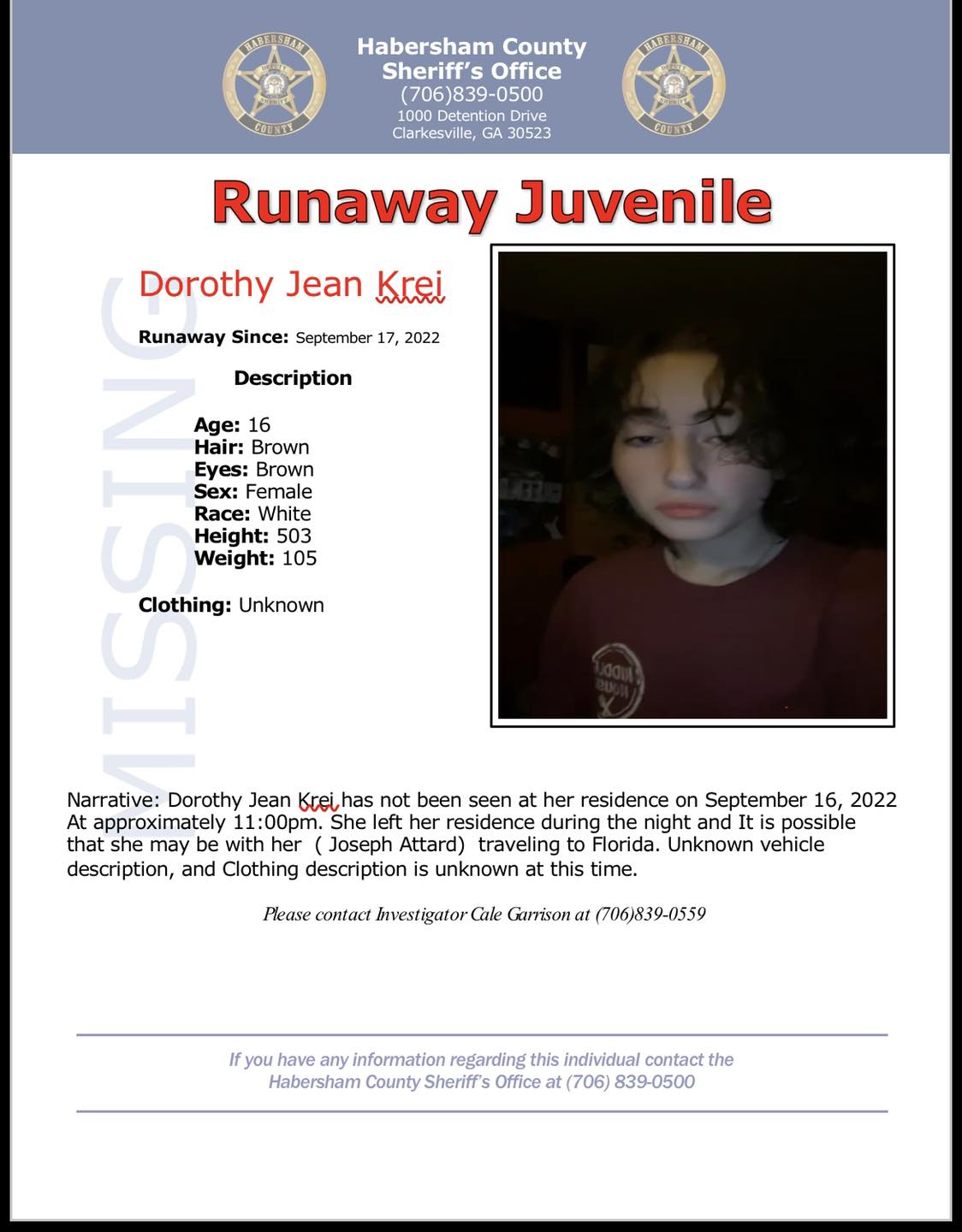
Family offers reward in search for runaway teens

A Habersham couple desperate for their son’s safe return is offering a $10,000 reward hoping that someone, somewhere, will find him.

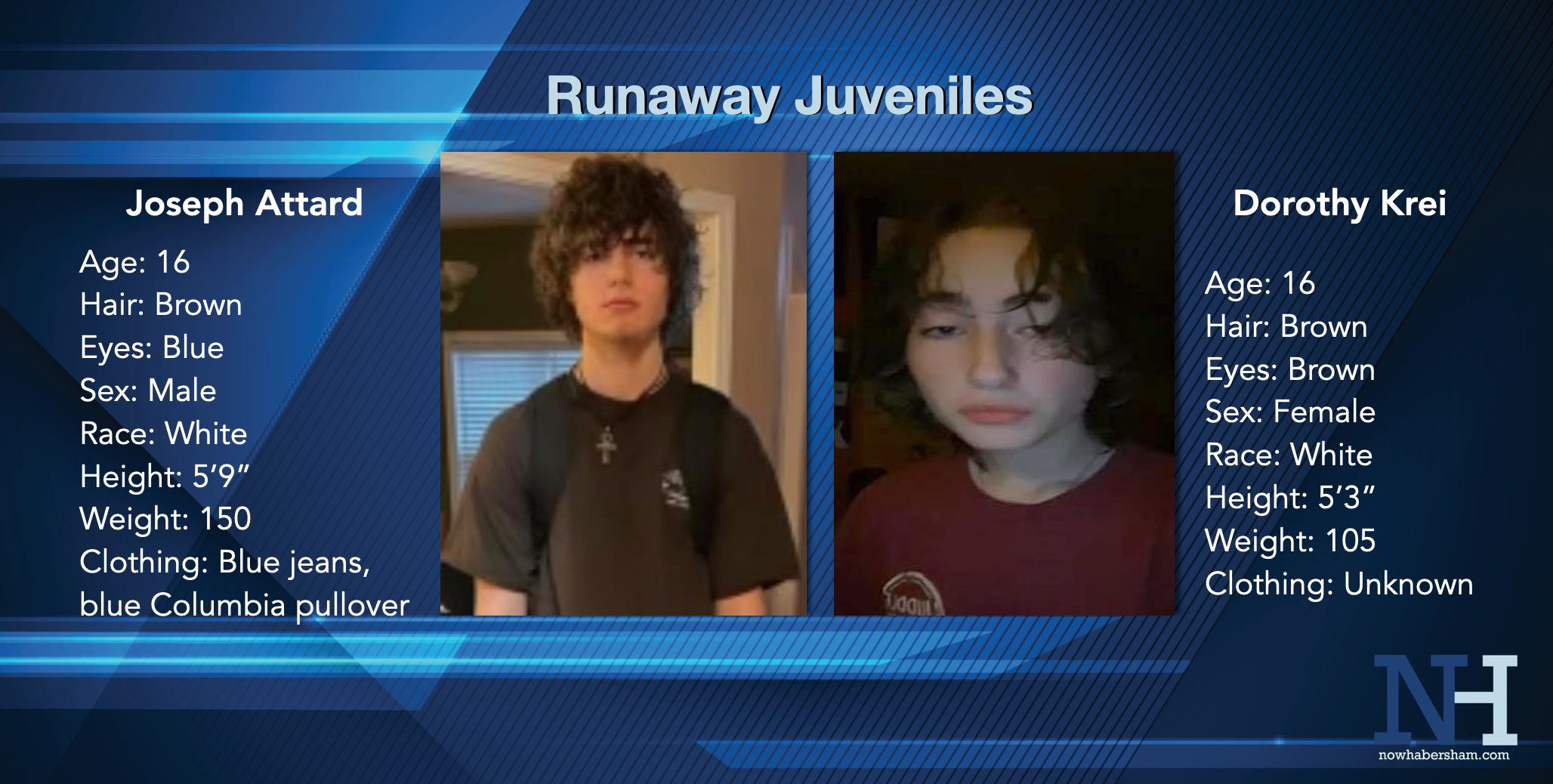
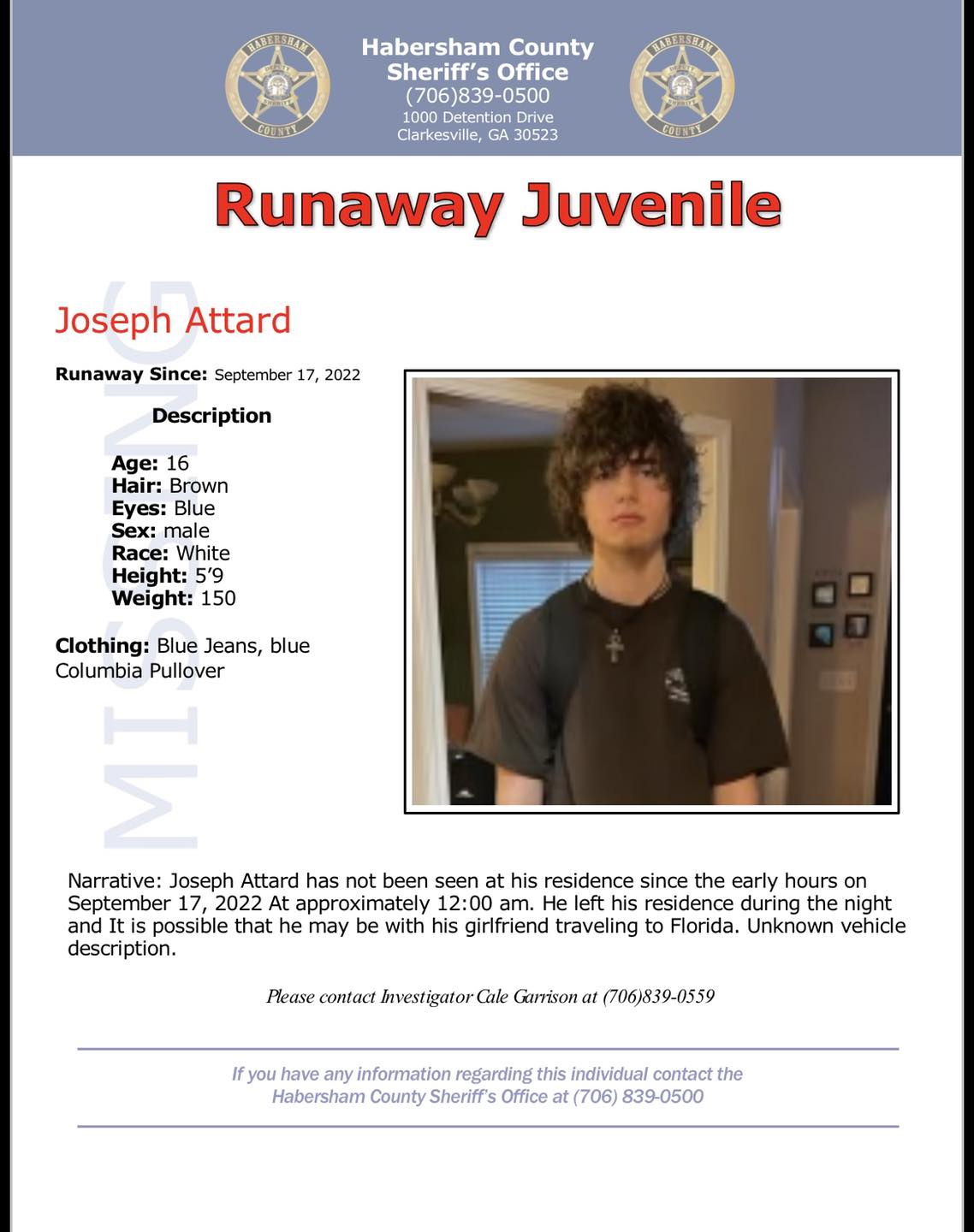
Family members say Joseph Attard, 16, of Cornelia, and his girlfriend Dorothy Krei, 16, of Clarkesville, ran away from home this past weekend. They were last seen in Habersham County around 1 a.m. on September 17 with two of Dorothy’s friends at Pitts Park in Clarkesville, says Attard’s mom, Penny Welborn.

“I just need to know they’re safe,” Welborn tells Now Habersham through her tears.

Reported sighting

Attard and Krei are both eleventh graders at Habersham Central High School. When their parents reported them missing, there was reason to believe the pair might be hitchhiking to Florida. Since then, some of the teens’ friends have said they may be heading to Asheville, North Carolina, or Pigeon Forge, Tennessee, with possible plans to go to California from there.

Bolstering that claim is a family friend who reported seeing Attard and Krei get out of a black Honda Accord on I-85 in Lavonia around 6 a.m. Saturday. That same friend says she saw them nine hours later in South Carolina. At the time, she did not know they were missing.

Both teens left behind notes. In his handwritten note, Attard apologized to his family for leaving.

“I’m sorry I did this out of nowhere, but I’m really struggling with everything in my life more than before…I love you all very much and, again, I’m sorry to put you all through this,” he wrote. “I will be back so I can finish school and everything. I promise I will be safe.”

Reward offered

The Habersham County Sheriff’s Office issued a lookout with a description of the teens. Attard is 5’9″ tall and weighs 150 pounds. He has blue eyes and bushy, brown, naturally curly hair. Krei is 5’3″ tall, weighs 105 pounds, and has brown hair and brown eyes.

According to Welborn, the two have never done anything like this before. They left behind their phones, wallets, IDs, and cars. They’re traveling on foot with little money and Welborn believes her son may be carrying some type of military backpack. He was last seen wearing blue jeans and a blue Columbia pullover. It is not known what Krei was wearing.

With few new leads and no known direction of travel, Welborn says the Habersham County Sheriff’s Office informed her on Monday there is little more they can do. She’s pleading with the public to help. She asks social media users to continue sharing the flyers and photos of the missing juveniles and for everyone to keep an eye out for them. Anyone who sees them or has information about where they may be should contact their local authorities or HCSO Investigator Cale Garrison at 706-839-0559.

“We just need information. We will gladly give the $10,000 reward to get them home safe,” says an overwrought Welborn. “I just want him home safe. They’re not in trouble. I love him and I want him home.”

Standoff with former Hall County school bus driver ends peacefully after SWAT arrives

Marvin Nathaniel Hogan (Hall County Sheriff's Office)

A standoff that lasted more than seven hours at a residence in Oakwood overnight ended peacefully with the arrest of the suspect.

On Sunday night, September 18, Hall County Sheriff’s Office deputies went to a home on Railroad Street to serve warrants for battery and third-degree cruelty to children.

The suspect named in the warrants, Marvin Nathaniel Hogan, 40, refused to exit the house and barricaded himself in the basement, says Hall County Sheriff’s Public Information Officer B.J. Williams.

“Hogan was armed with a handgun and told deputies he would kill himself if they entered the house,” Williams says. “The suspect told deputies he had other weapons in the residence.”

Around 3 a.m. Monday, after negotiations with Hogan appeared to be stalled, deputies called for SWAT assistance. As SWAT members arrived at the scene, negotiations began to progress and deputies were able to talk Hogan into exiting the residence.

“He turned himself in without authorities using any force,” Williams says.

The incident ended just before 6 a.m. Although Hogan was not injured, he was transported to the hospital for evaluation. He will be booked at the Hall County Jail upon his release.

In addition to the warrants for battery and child cruelty, Hogan was on pre-trial release for sexual battery on a child, child molestation, enticing a child for indecent purposes, and contributing to the delinquency of a minor.

Former school bus driver

Hogan is a former Hall County School bus driver. He was removed from his job in February 2021 after allegations came to light that he had sexually abused a young girl that he knew. Detectives first learned of the abuse on February 16, 2021, when a school counselor reported it to a Sheriff’s Office SRO at Flowery Branch High School. 

Investigators arrested Hogan on August 6, 2021.

According to the sheriff’s office, Hogan knew the victim prior to the abuse, which started when she was a young teenager. Additionally, investigators determined that Hogan provided alcohol and marijuana to the victim on several occasions. Hogan’s wife, Amber, was also arrested. Deputies charged her with contributing to the delinquency of a minor.

Officials say Amber Hogan was aware of the alcohol and marijuana but made no effort to stop it, allegedly telling the victim to, “be careful,” in the use of the substances, according to initial details.

Nathaniel Hogan worked as a bus driver for the Hall County School System for a little over a year. The sheriff’s office says now, in addition to the earlier charges against him, he is expected to be charged in connection to the standoff.

Political parties unite in opposition to Habersham County T-SPLOST

Four years after successfully leading the charge against Habersham County’s last proposed Transportation Special Local Option Sales Tax, local party leaders are doing it again. Leaders of Habersham’s Democratic and Republican parties recently released a statement opposing T-SPLOST, and they’re asking voters to join them.

In a joint statement, GOP party chair David Sosby and former Democratic party chair Virginia Webb ask voters to reject “this additional layer of taxation” at the polls in November. They say raising the local option sales tax from 7 to 8% will hit hardest those who are least able to afford it – the elderly, poor, and small business owners. They also caution such a move could motivate shoppers to shop elsewhere.

A spending problem

Sosby and Webb represent the county’s bid for more taxes as little more than a money grab on the heels of a millage rate increase commissioners approved earlier this year. That one mill increase on top of higher property valuations is expected to result in an additional $3.2 million in revenue for the county.

“It seems that the County doesn’t have a revenue (tax collection) problem, they have a spending problem,” their statement reads.

The proposed T-SPLOST would add an extra penny on the dollar to every purchase made in Habersham County; no items would be exempt. The tax is projected to raise $44 million over 5 years. Proceeds would be divided among the county and its seven municipalities. The county’s portion would amount to approximately $33.4 million.

Exactly how that money would be spent is anyone’s guess.

Instead of naming specific projects to be funded by T-SPLOST, the county released a ‘bucket list‘ of general project categories. County officials say they did that to retain flexibility in case tax collections are slow or project priorities change.

Party leaders are skeptical.

“They want us to ‘Trust’ them to spend these funds on items they think are the most important in these buckets. Why is the county afraid of listing these projects?”

Pointing out that the county recently hired a grant writer, Sosby and Webb suggest the county use its new grant writer to secure funding rather than raise taxes.

United

The last time Habersham’s political parties united on an issue was in 2018 when they worked together to defeat the last T-SPLOST the county proposed. Webb was a part of that effort along with then-county GOP chair Carl Blackburn. They cautioned then that passing T-SPLOST could make it harder to convince voters to approve funding for a new jail.

As it turned out, voters rejected both the T-SPLOST referendum in 2018 and the Habersham County jail bond referendum in 2019.

Dusting off the same talking point this year, Webb and Sosby caution that passing T-SPLOST could “jeopardize the importance of building a new Habersham County Detention Center. This should be a priority for our county commissioners. HCDC is a project we both whole heartily support!”

While voters have been more generous lately – they approved a new SPLOST referendum in November and Education SPLOST this past May – those votes did not change the existing tax rate. T-SPLOST would.

After having their taxes already raised once this year, many voters say it’s unlikely they’ll vote for another tax increase. If more voters than not end up deciding that way, it will be fine with party leaders who call T-SPLOST simply “the wrong approach.”

READ Joint letter opposing T-SPLOST

Want to weigh in on Georgia Power’s proposed rate increase? Here’s how.

Georgia Power’s requested rate increase would add $16.29 – about $200 annually – to the average residential customer’s bill over the next three years, starting in 2023 with a $14.32 hike. (John McCosh/Georgia Recorder)

(GA Recorder) — Georgians will be able to voice their concerns about Georgia Power’s plans to raise electricity rates by 12% during a series of hearings beginning later this month before a final vote in December.

The Georgia Public Service Commission has adopted new procedures that allow each person to speak for up to three minutes during the first hour of each hearing day, but after the time runs out, people who wish to speak must return another day and anyone not directly involved in the case will be asked to leave the meeting room. Various energy policy, environmental and consumer watchdog groups have accused the commission and Georgia Power of trying to limit public participation on serious matters that affect how much people pay for utilities.

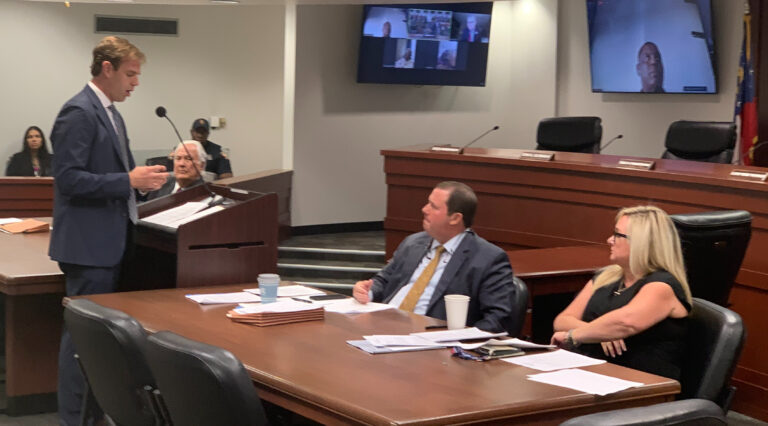
Preston Thomas, a lawyer for the Georgia Public Service Commission, recommends to state regulators during a hearing on Thursday that 25 applicants who wanted to become official parties in the Georgia Power rate case should either work under the umbrella of an environmental justice agency or speak during the public comment periods. (Stanley Dunlap/Georgia Power)

An environmental justice activist zip-tied their wrist to a hearing room door earlier this year to protest the commission’s plan to block the public from attending a vote on Georgia Power’s long-term energy plan, citing the pandemic.

There were a couple dozen people who applied to intervene after an initial scheduling order appeared to limit public involvement. As official intervenors, they could provide expert testimony as well as ask questions of witnesses, including Georgia Power executives and management, utility analysts, and consultants. This is a higher level of involvement than submitting a public comment.

Hearings on the rate case will take place from Sept. 27-29, then resume in November before the final hearing is scheduled for Dec. 15. The rule says that no public comments will be taken during administrative sessions.

The five-member board is set to vote on Dec. 20 on Georgia Power’s request to add $16.29 to the average residential customer’s bill, or about $200 annually, over the next three years, starting in 2023 with a $14.32 hike.

Commission Chairwoman Tricia Pridemore said the general public still has the opportunity to weigh in at commission hearings and that public comments can also be given orally at the end of regular committee meetings. Written comments can also be submitted to the commission’s website at https://psc.ga.gov/public-comments/.

“The Georgia Public Service Commission is a quasi-judicial, quasi-legislative agency,”  Pridemore said. “We make our hearings open to the public. We also have video so people can watch it if the hearing room is full.

“They can talk to us about anything related to utilities,” Pridemore said. “They can talk to us about the color of the sky. They can’t cuss at us and they can’t wear a costume. Those are the only rules.”

There will likely be at least seven hearing days throughout the rate case for people who want to speak their mind and commission meetings are also streamed online, Pridemore said.

“We’re limited in space. It’s first come first serve,” she said. “We have a signup sheet for public witnesses so we do it in order of who gets here first and we’ve got an open facility for them.

On Thursday, commissioners informed 25 applicants seeking to become officially involved in the rate case that they would have to choose to consolidate with another intervenor, Georgia Conservation Voters, or give their own testimony through public comments.

At Thursday’s hearing, some applicants said they were willing to work with the conservation group, while others said they wanted to be official parties to a proceeding that will affect people’s ability to do business and pay their bills.

The vote came after Georgia Power and the PSC’s public interest advocacy staff claimed that adding 25 more intervenors would clog up proceedings for complex matters and argued that working under the umbrella of a single environmental advocacy organization would allow members of the public to pool their resources.

“It’s a much more complicated process and doesn’t offer any opportunity to speak freely like a public witness,” PSC attorney Preston Thomas said.

Deborah Opie, a senior organizer with Georgia Conservation Voters, said the organization helped the people complete their applications, but that their individual concerns and challenges shouldn’t be grouped together.

She criticized Georgia Power and the PSC staff for not wanting the average person to have the same access as intervenors, “yet they’re asking for a $2.8 billion increase from the same people they want to silence.”

Georgia Power attorney Brandon Marzo said Thursday that the company is open to hearing from its 2.7 million customers and has been listening to their concerns over the last year.

With the new plan, Georgia Power argues the rate hikes are needed to improve its electrical grid and provide more clean and reliable forms of energy.

The proposed increase does not include the tab for the company’s troubled and over-budget $34 billion Plant Vogtle nuclear expansion project that is supposed to be online in 2022. Additionally, Georgia Power customers are paying for the closure of coal-fired power plants and coal ash cleanup, estimated to eventually cost $9 billion.

Clarkesville scout restores grave of War of 1812 veteran

For his Eagle Scout project, Mitchell McGhee restored the grave of an 1812 soldier buried in the Old Clarkesville Cemetery. (E. Lane Gresham/Old Clarkesville Cemetery)

Clarkesville Boy Scouts of America Troop No. 5 member Mitchell McGahee has completed the restoration of a grave at the Old Clarkesville Cemetery. The Eagle Scout project for McGahee has aided the mission of the cemetery to restore and preserve this historic landmark, cemetery caretakers say.

Mitchell McGahee (E. Lane Gresham/Old Clarkesville Cemetery)

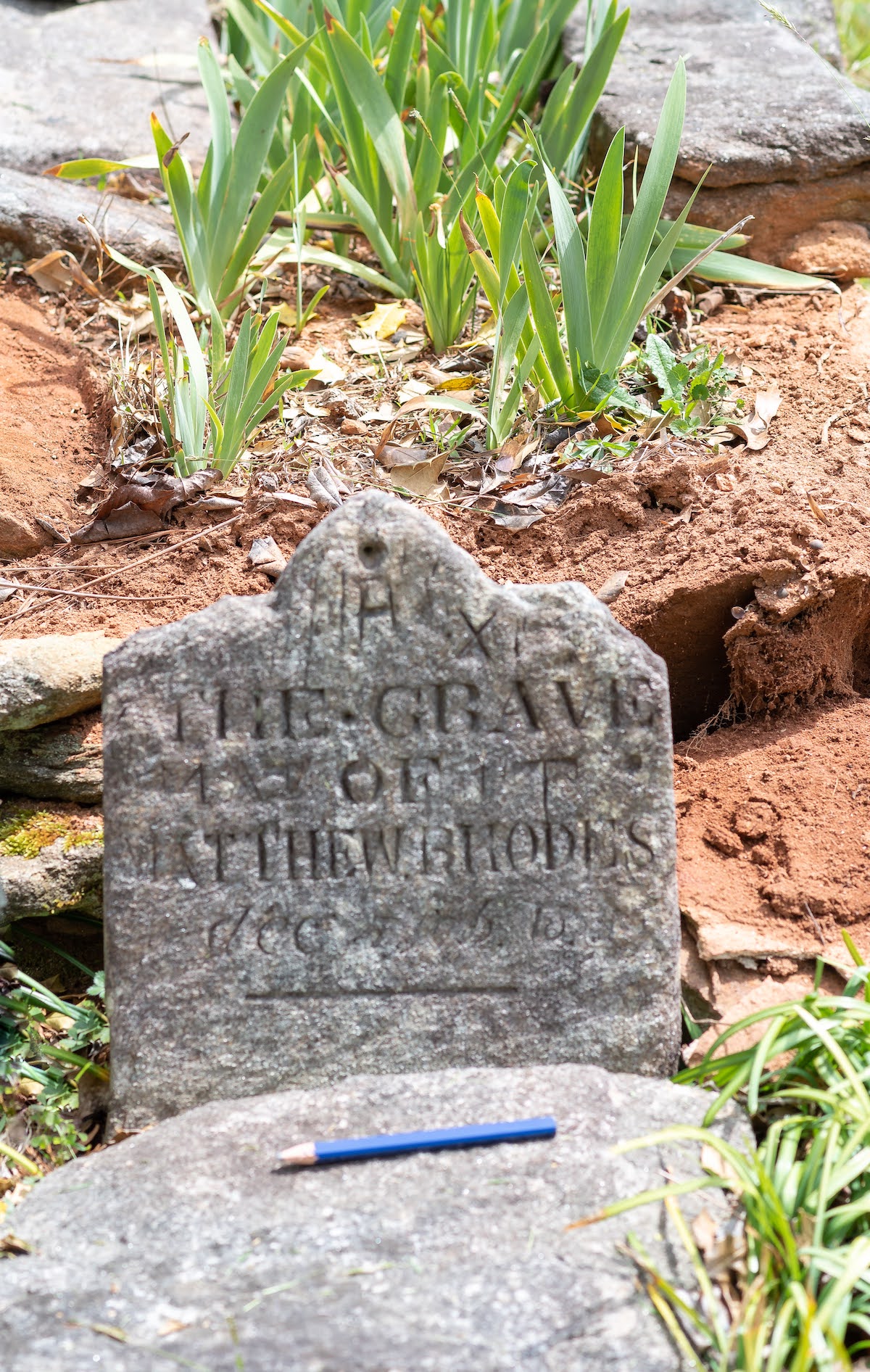
With the help of fellow scouts and scoutmasters, McGahee disassembled the grave of Matthew Rhodes, a veteran of the War of 1812. The stacked stone structure was then reassembled and replanted.

“We are proud of Mitchell’s commitment to preserving history for his Eagle Scout project,” said E. Lane Gresham, chair of the Historic Clarkesville Cemetery Preservation, Inc. “His entire family and the scout troop have been invested in the cemetery for several years. We are grateful for all the help provided by this community-minded group.”

Matthew Rhodes was once noted as a veteran of the Revolutionary War.(E. Lane Gresham/Old Clarkesville Cemetery)

Matthew Rhodes was once noted as a veteran of the Revolutionary War.

Recent research has confirmed Rhodes was a veteran of the War of 1812. The National Society United States Daughters of 1812, General John Baytop Scott Chapter, will rededicate the grave of Matthew Rhodes at 3 p.m., Sept. 25, 2022.

Community members are invited to attend. For more information, visit oldclarkesvillecemetery.com.

Yes, expecting parents in Georgia can now claim their embryo as a dependent

Georgia's new abortion law grants personhood to unborn babies and that makes their parents eligible for a tax break.

(GA Recorder) — Even with a wave of new state-level abortion restrictions passing or taking effect this summer, Georgia’s law stood out because of its so-called personhood provisions that accompanied the better-known six-week ban on the procedure.

One particular change that drew national attention was a new tax break for expecting parents.

The state Department of Revenue released initial guidance last month stating that a taxpayer who is pregnant between July 20 and Dec. 31 may claim their future child as a dependent. The department promised to provide additional information on the new policy later this year.

“In the state of Georgia, House Bill 481 recognizes the fundamental truth, life begins at conception,” said Cole Muzio, president of the conservative Christian lobbying organization Frontline Policy Action and a backer of the legislation that created the new law. “And so we recognize that throughout our code. That means that a woman, as soon as she’s pregnant, can begin claiming that child on her taxes as a dependent.”

Speaking at the conservative Christian Family Research Council’s 2022 Pray Vote Stand for Life Summit in Atlanta last week, Muzio said such provisions are an important public relations component for the movement.

“That’s an important thing, as you’re talking about messaging, we truly value life as a state, as a people,” he said, panning Democrats who opposed the bill. “The idea that we would give pregnant women some tax relief was so repulsive to them, that we recognized the personhood of the unborn, that they wanted to rip just that provision out of the bill. We need to make sure people know that and are aware of that when we’re talking about these things, we are authentically, pro-life, pro-woman, and that carries forward in everything we do.”

Democrats say the sweeping changes could have unforeseen consequences.

“When you are going to start to equate a fetus with a person that is born in the personhood clause, as exemplified by this claiming of a fetus on tax returns, it just opens up a huge host of very thorny questions, constitutional questions, freedom of movement questions that we just haven’t even begun to scratch the surface of, much less answer,” said Atlanta Democratic state Sen. Elena Parent. “This is really a byproduct of the rushed process to pass that legislation.”

An expecting couple takes part in an abortion rights protest in Atlanta, May 14, 2022. (Ross Williams/Georgia Recorder) 

One such unanswered question is how much income tax revenue the state will forego because of the new deduction.

An analysis of the potential cost was not done when the bill passed in 2019, but at the time, the bill’s author put the price tag at about $10 million to $20 million annually.

In Georgia, about 122,500 babies were born in 2020, according to the March of Dimes, but now embryos and fetuses that don’t survive the pregnancy can also be claimed as dependents. The state might ask tax filers to provide “relevant medical records or other supporting documentation ” to prove they are eligible for the tax deduction, but the Department of Revenue has not yet clarified which specific records might be requested.

“I would say that’s true of any tax deduction or tax credit is if you want to claim it, you have got to be prepared to show that you deserve it,” said Kyle Wingfield, president and CEO of the Georgia Public Policy Foundation. “It’s certainly more intimate than whether you bought a house or something like that, but from the standpoint of having to provide documentation, that’s just kind of an expectation with any deduction or credit.

“I can see why people might think about this differently, but I would say it’s more similar to other deductions and credits than not,” he added.

Who benefits? It’s complicated.

For all its complexity, the new deduction may not deliver much money back to Georgia parents, says Richard C. Auxier, a senior policy associate with the Tax Policy Center, which is a joint venture of the Urban Institute and the Brookings Institution.

Once this year’s income tax cut is fully rolled out and coupled with a new higher standard exemption, a single filer in Georgia will need to earn at least $12,000 to benefit, and a married couple will need to earn at least $24,000, Auxier said. And the threshold to benefit will increase the more children a couple has.

“When a state has these policies in place, if you want to provide assistance to certain families, you have to realize that a deduction will not (help) families who have already been helped by existing parts of your tax code,” Auxier said.

“And so this new policy will not be benefiting many people, specifically, many lower-income households because they’ve already benefited from other policies. The only way to help those families who have relatively low income who are benefiting from these policies is to enact a refundable tax credit. Because while a deduction can only reduce your taxable income to zero, a refundable credit, if it’s larger than what you have left, you can get that as a credit.”

Auxier gave the example of a married couple with two children and another on the way earning $30,000.

That couple will list their income and work their way down the tax sheet. Because they’re a married couple, they subtract their standard deduction of $24,000. The deductions for their two older children will cancel out the balance before their third child is factored in, he said.

“So now they have $6,000 in taxable income. Then it says ‘Do you have any dependents?’ They say, ‘Well, we have two,’ and they say multiply that number times $3,000. That’s $6,000, so now, subtract that from your taxable income. Now we’re at zero.”

The state’s new and lowered flat income tax rate means the deductions won’t mean much to any filer, Auxier said. The rate would flatten and drop to 5.49% starting in 2024 and eventually shrink to 4.99% over time, assuming state revenues continue to grow.

“It’s a $3,000 deduction. That’s not a $3,000 check to a person, it’s not a $3,000 benefit,” he said. “It’s lowering your income by $3,000, so you calculate the benefit by saying, hypothetically, what if I didn’t have that deduction? What would I have paid in tax, and using the flat rate, that’s going to come in, with a little simple math, you can calculate that you’re saving $150.”

Wingfield with the Georgia Public Policy Foundation said the limited impact of the new deduction for expecting parents highlights a perk packed into this year’s tax cut bill that was aimed at lower earners, with lawmakers rolling taxpayer deductions into a higher standard exemption.

“If we’re talking about a deduction, and you’re saying, ‘Well, people who are already exempted from taxes won’t benefit from this.’ Well, yes, because they were already exempted. So that’s almost like complaining about a tax code that has already been intentional about trying to be fair to people on the lower end of the spectrum.”

Tax policy is inherently complicated because modern families often do not look like the stereotypical nuclear family, Auxier said.

Often, a child will receive the majority of their financial support from one parent but live with the other, or be cared for primarily by a grandparent, aunt or uncle.

“You have to ask questions like, ‘Do you have children?’ And then you have to also ask, ‘Do you support the child? Who pays for the children’s house and housing and for the children’s food? How many months of the year does a child live with you? How many months a year does this child live with their grandparents, live with the other parent?’”

“To do this with an unborn child becomes even more complicated,” he said. “Because it’s only with the mother, but that does not mean that the mother is providing the support for it, it could be coming from someone else. So does it depend on who’s supporting it, or is this solely for the mother? If it’s solely for the mother, you can imagine if the mother is not working either because of the pregnancy or because she’s a student, or just because she’s unemployed or whatever, but she’s getting financial support, how do you then apply the deduction to the person that’s delivering financial support to the unborn child?”

Mary Frances Jordan Franklin

Mary Frances Jordan Franklin, age 92 of Mount Airy, Georgia went home to be with the Lord on Sunday, September 18, 2022.

Born in Clarkesville, Georgia on December 24, 1929, she was the daughter of the late John Henry and Josephine Taylor Jordan. Frances was a graduate of Clarkesville High School, Class of 1947. She worked for Clarkesville Mill as a cloth inspector where she retired with over 40 years of dedicated service. In her spare time, Frances enjoyed yard work, flower gardening, and bird-watching. She also enjoyed precious time with family and friends. Frances was a member of Victory Baptist Church.

In addition to her parents, she was preceded in death by her husband, Steve Andrew Franklin, Jr.; son-in-law, Benny Morrison; 2 brothers, and 3 sisters.

Survivors include her sons and daughters-in-law, Larry and Sherry Franklin, James “Jim” and Sharon Franklin all of Mt. Airy, GA; daughter, Shelia Franklin Morrison of Clarkesville, GA; grandchildren, Shane Franklin, Jessica Morrison, Steve and Dannielle Franklin, Isaac and Cara Morrison, and Eric and Kristen Franklin; great-grandchildren, Mikayla Franklin, Carter Franklin, & Marlee Morrison; several nieces, nephews, other relatives, and friends.

The family would like to express their deepest gratitude to their wonderful caregiver, Shirley Taylor as well as Ava, Autumn, April, Becky, and the staff of Amedisys Hospice.

Graveside services are scheduled for 11:00 a.m. Saturday, September 24, 2022, at the Victory Baptist Church Cemetery with Rev. Shane Jenkins and Rev. Connie Berry officiating.

The family will receive friends at the funeral home from 2:00 p.m. until 4:00 p.m. and 6:00 p.m. until 8:00 p.m. on Friday, September 23, 2022.

In lieu of flowers, the family requests that donations be made to the Habersham County Animal Shelter.

An online guest registry is available for the Franklin family at www.hillsidememorialchapel.com.

Arrangements are in the care and professional direction of Hillside Memorial Chapel and Gardens, Clarkesville, Georgia. (706) 754-6256