Home Blog Page 1002

Kenneth Eugene Smith executed by nitrogen gas in Alabama

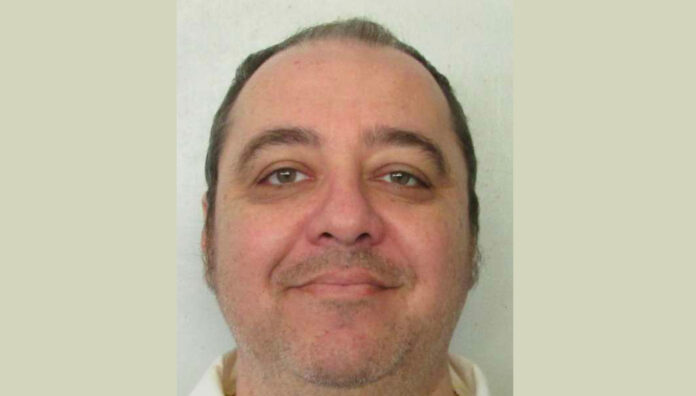
A jury convicted Kenneth Eugene Smith of the 1988 murder-for-hire of Elizabeth Sennett. (Alabama Department of Corrections)

(States Newsroom) — The state of Alabama Thursday executed Kenneth Eugene Smith for the 1988 murder-for-hire of Elizabeth Sennett.

The execution, the first ever carried out with nitrogen gas, began at 7:56 p.m., according to the Alabama Attorney General’s office. Smith was pronounced dead at 8:25 p.m.

Smith, 58, made a final statement through a mask which muffled his words.

“Tonight, Alabama caused humanity to take a step backwards,” Smith said. “I leave with love, peace and light. I love all of you. Thank you for supporting me.”

Media witnesses, including a reporter from Alabama Reflector, saw him dressed in his prison uniform but covered in white sheet up to his chest. Smith laid in the gurney with a slight incline with is arms extended to his side. He was strapped down in two places, one around his stomach and another around his upper chest.

After the death warrant was read and Rev. Jeff Hood, Smith’s spiritual advisor, performed last rites, a staff member closed a vent on the mask, which began the flow of nitrogen. Smith convulsed for two minutes, with seven minutes of heavy breathing, with Smith taking large breaths.

John Hamm, commissioner of the Alabama Department of Corrections, said that it “appeared that Smith was holding his breath as long as he could.”

“That was all expected and in the side effects that we have seen, or researched, on nitrogen hypoxia,” he said.” Nothing was out of the ordinary from what we were expecting.”

Sennett’s husband, the Rev. Charles Sennett, hired Smith; John Forrest Parker and Billy Gray Williams to kill his wife in order to collect insurance money. Parker and Smith entered the home where Elizabeth Sennett was killed. All three were convicted of her death. Parker was executed in 2010; Williams, sentenced to life in prison, died in 2020.

Rev. Charles Sennett died by suicide a week after his wife’s death.

Michael Sennett, Elizabeth Sennett’s son, said after the press conference that Parker and Smith had “been incarcerated almost twice as long as I knew my mom.”

“All three of the people involved in this case years ago, we have forgiven them, not today but we have in the past,” he said.

Smith, who survived a botched execution in November 2022, spent his last 24 hours receiving visits from friends and family, including his wife. He ate a final meal of steak, hash browns and eggs.

The U.S. Supreme Court rejected appeals from Smith on Wednesday and Thursday that argued the method violated his Eighth Amendment protections against cruel and unusual punishment. The court’s three liberal justices dissented.

“Having failed to kill Smith on its first attempt, Alabama has selected him as its ‘guinea pig’ to test a method of execution never attempted before,” Justice Sonia Sotomayor wrote.  “The world is watching.”

In a statement Thursday afternoon, Smith and Rev. Jeff Hood, his spiritual advisor, said “the eyes of the world are on this impending moral apocalypse.”

“Our prayer is that people will not turn their heads,” the statement said. “ We simply cannot normalize the suffocation of each other.”

Murder for hire

Smith was convicted and sentenced to death for his role in Sennett’s death in 1989, but the conviction was later overturned. At a subsequent trial in 1996, Smith was again convicted. A jury recommended Smith be sentenced to life in prison. However, the trial judge overruled the jury and imposed the death sentence.

The Alabama Legislature in 2017 abolished the practice, known as judicial override, but did not make it retroactive.

Smith was brought to the death chamber at Holman Correctional Facility in November 2022 for execution by lethal injection. The U.S. Supreme Court gave approval for the execution to proceed about 90 minutes before a death warrant would expire.

The execution was called off after Department of Corrections Department staff failed to establish a second intravenous line necessary for administering the lethal drugs. Smith’s attorneys have said the process, which resulted in multiple puncture wounds, left him with post-traumatic stress disorder.

Death by nitrogen

The Alabama Legislature approved nitrogen executions in 2018. At the time, Alabama and other states that kill with lethal injection faced shortages of drugs and growing criticism of the use of midazolam, a sedative present in several botched executions, including the 2016 execution of Ronald Bert Smith in Alabama.

Pittman and other supporters argued the nitrogen method would allow the state to continue executions and suggested it would be more humane.

“You basically black out,” Pittman told the Reflector in September. “There is no time for pain or anything else. In fact, nitrous oxide is a way of reducing pain for reducing surgeries.”

Pittman, reached on Thursday, declined comment.

Doctors and anesthesiologists questioned that conclusion. The American Veterinary Medical Association discourages the use of nitrogen in euthanizing animals, in part because of the difficulty of keeping oxygen out, which can prolong death.

“I can’t even begin to imagine what it is like to be in the shoes of someone who is facing execution, but to be waiting for that moment, and to know that you are undergoing a method of execution that is not tested and waiting to suffocate, then that seems like that would be an undue amount of suffering,” Dr. Radha Sadacharan, a practicing family physician, told the Reflector in September.

Mississippi and Oklahoma have also adopted the method, though neither state had used it or scheduled an execution by nitrogen as of Thursday.

The 2018 law also established a 30-day window for people on death row to choose the method.

But attorneys and those incarcerated told the Montgomery Advertiser in 2019 that they were only told of the option days before a deadline, which created confusion.

Many death row inmates are represented by lawyers who live outside Alabama and some had limited time to understand what a nitrogen execution might entail. A federal judge in 2021 called the state’s notification “a mess.

Appeals

Smith did not originally choose to be executed by nitrogen gas, though he expressed his preference for it in a 2022 court filing.

“The execution was lawfully carried out by nitrogen hypoxia, the method previously requested by Mr. Smith as an alternative to lethal injection,” Gov. Kay Ivey said in a statement Thursday. “At long last, Mr. Smith got what he asked for, and this case can finally be put to rest.”

Attorneys for Smith challenged the protocol the state planned to use and the fact that Smith would be the first person it was used on. They also said the mask employed in the procedure could prevent him from praying aloud during the execution.

Smith’s lawyers argued that the mask itself might not fit tightly on his face and so would allow oxygen to creep in, which could prolong his death and cause him to vomit. His attorneys also argued that the state had unconstitutionally moved Smith’s execution up ahead of others on death row who had chosen to die by nitrogen hypoxia and who had exhausted their appeals.

Attorneys for the Alabama attorney general’s office countered that the state had taken precautions to ensure Smith would be exposed to pure nitrogen and that harms were theoretical.

The federal courts sided with the state. U.S. District Judge R. Austin Huffaker Jr. ruled on Jan. 10 that Smith had not provided a sufficient reason to stop the execution, calling the allegations and evidence “speculation.”

A divided three-judge panel of the U.S. 11th Circuit Court of Appeals upheld Huffaker’s ruling on Wednesday.

“There is no doubt that death by nitrogen hypoxia is both new and novel,” the unsigned opinion said. “Because we are bound by Supreme Court precedent, Smith cannot say that the use of nitrogen hypoxia, as a new and novel method, will amount to cruel and unusual punishment in violation of the Eighth Amendment by itself.”

U.S. Circuit Judge Charles Wilson concurred but wrote that he feared Smith might face “a cruel and unusual execution” if the gas led him to choke on his own vomit. U.S. Circuit Judge Jill Pryor dissented, writing that Smith’s PTSD made it very likely for him to face that scenario.

“The cost, I fear, will be Mr. Smith’s human dignity, and ours,” she wrote.
Sylvester C. Brown

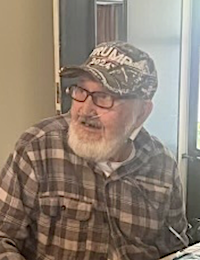
Sylvester C. Brown, age 80, of Baldwin, Georgia, entered rest on Wednesday, January 24, 2024.

Mr. Brown was born on April 26, 1943, in Hall County, Georgia, to the late Moses Pascal Brown and Elma Dodd Brown. In addition to his parents, he was preceded in death by his loving wife, Ellen Armour Brown.

Sylvester enjoyed eBay selling and going to yard sales, flea markets, and auctions.

Survivors include his son and daughter-in-law, Melvin and Pat Brown; daughters and sons-in-law, Wanda and Jimmy Yoder; Sandra and Bobby Hughes; Sonia and Mark Powers; six grandchildren; several great-grandchildren; sisters, LaVerne Brown and Barbara Woods; brothers, Leon Brown, Lamar Brown, and Dwight Brown.

Funeral Services will be held at 2:00 p.m., Saturday, January 27, 2024 at the Whitfield Funeral Home, South Chapel.

The family will receive friends from 12:00 p.m. to 2:00 p.m. Saturday, January 27, 2024, at the funeral home.

Arrangements have been entrusted to the Whitfield Funeral Homes & Crematory, South Chapel, at 1370 Industrial Boulevard, Baldwin, Georgia 30511. Telephone: 706-778-7123.

Georgia’s antisemitism bill fast-tracked amid growing war tensions

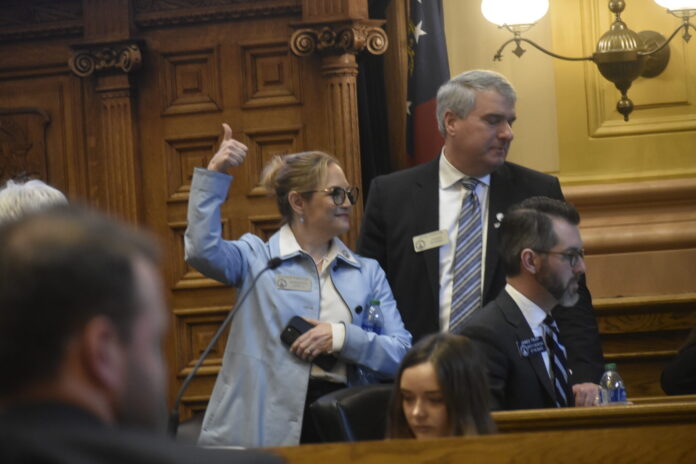
Reps. Esther Panitch and John Carson watch the Senate votes come in for their antisemitism bill. (Ross Williams/Georgia Recorder)

(GA Recorder) — A bill defining antisemitism in Georgia law is on the desk of Gov. Brian Kemp after passing through the state House and Senate with wide majorities Thursday.

The bill calls on state agencies to adopt the definition used by the International Holocaust Remembrance Alliance when considering evidence for discriminatory intent in things like housing or employment discrimination and in criminal cases under the state’s 2020 hate crimes law.

Kemp’s office said a signing date has not been confirmed, but in a statement, the governor said he will “soon be able to sign this important piece of legislation.”

Marietta Republican Rep. John Carson said the bill, which he has been pushing for several years, is needed now more than ever because of a spate of high-profile antisemitic acts around the state, including the distribution of hateful fliers in Jewish neighborhoods and aggressive demonstrations outside of synagogues.

“We’ve seen an unbelievable increase in antisemitic acts; we’ve seen more leaflets in Dunwoody, Brookhaven, really all over our state,” Carson said. “We’ve seen neo-Nazi demonstrations in my county, Cobb County, also in Macon, and folks, I hope you will stand with me one more time and say this activity has got to stop.”

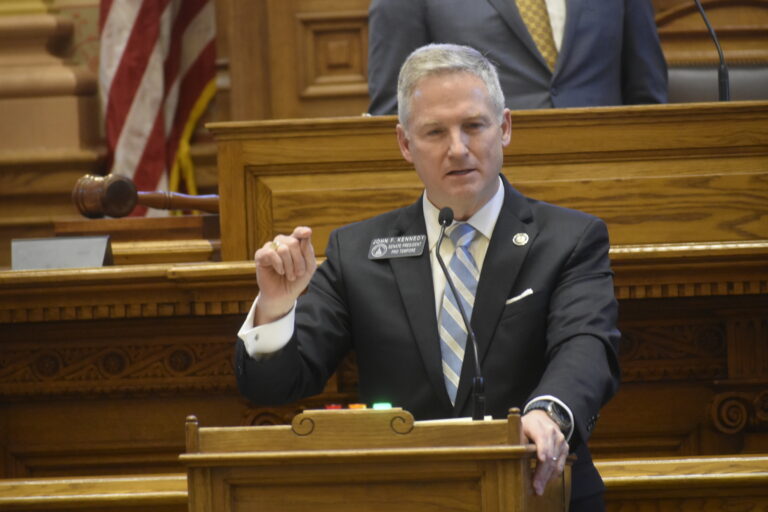
Sen. John Kennedy carried the antisemitism bill in the Senate. (Ross Williams/Georgia Recorder)

All Georgia lawmakers say they want to protect Jewish Georgians, but in past years, efforts have fizzled over parts of the IHRA definition of the state of Israel. Under the definition, certain criticisms of the state, such as claims that it is fundamentally racist, would be considered antisemitic, though there would be no punishment for them unless there was an underlying crime like assault or an allegation of illegal discrimination.

“If you want to go out and say that you hate Israel after this bill is passed, you may absolutely do that, but if you want to commit a crime, you’ve got a problem,” said Senate President Pro Tempore John Kennedy, a Macon Republican. “And if you happen to commit one of those crimes while spewing antisemitic speech, you might just subject yourself to the hate crime statute.”

Most legislators agreed. Six Democrats voted against the bill in the Senate, and in the House, the bill passed with a 129-to-5 vote. In the House, the bill’s final passage was greeted with cheers, applause and hugs among supporters.

“It’s a recognition and a relief that we’ve been heard by the entire state,” said Sandy Springs Democratic state Rep. Esther Panitch, the only Jewish state lawmaker in Georgia and a cosponsor of the bill.

Several representatives, though, did not record a vote, prompting House Speaker Jon Burns to remind them that House rules require lawmakers in the chamber to vote unless there is a conflict of interest or they have been excused.

Afterward, Burns celebrated the bill’s final passage. Last year, the bill had easily cleared the House but stalled in the Senate. He also signaled that he was open to additional measures, such as a bill in the Senate targeting antisemitic fliers.

“We have one priority: that hate will not exist and not be tolerated in Georgia to any group but especially with our Jewish friends who have done so much for us and we care so much about,” Burns told reporters. “It’s the right thing to do.”

The war in Gaza following the Oct. 7 Hamas attacks that left about 1,200 Israelis dead has heightened skepticism about the Middle Eastern U.S. ally. Israeli forces have killed more than 25,000 in Gaza, over 70% of them women and children, according to the United Nations.

Palestinians and their supporters have taken to the streets to protest the bombing campaign responsible for the deaths and what they call decades of occupation and subjugation.

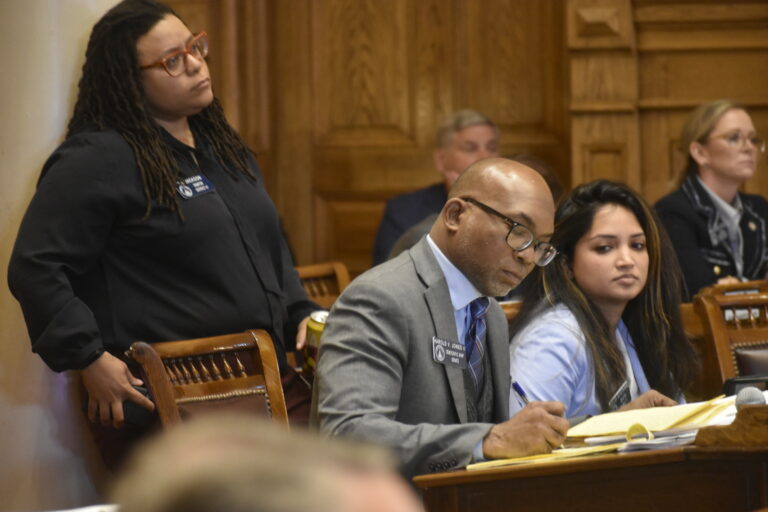
From left, Sens. Kim Jackson, Harold Jones and Nabilah Islam-Parkes watch the debate on the antisemitism bill. The three opposed the bill because of its restrictions on criticisms of Israel. (Ross Williams/Georgia Recorder)

Stone Mountain Democratic Sen. Kim Jackson, an Episcopal priest and the state’s first and only openly LGBTQ senator, said she mourns Oct. 7 victims and rejects antisemitism but opposes the idea that vehemently criticizing Israel should be labeled as antisemitic, referencing Jewish groups that call for change in Israel.

“I will be voting no on HB 30 today because I personally know what it is to be a minority voice within a minority group,” she said. “I know what it is to have people who share my race, my ethnicity, and my religion and they choose to ignore my voice, choose to tell me that I’m not Christian enough or Black enough because of my deeply held convictions that don’t align with the loudest voices.”

In a floor speech supporting the bill, Senate Minority Leader Gloria Butler referenced Georgia’s history of antisemitism and said hatred of Jews has reared its head on the left and the right.

“Let me be clear: the poison of antisemitism affects the political left on our college campuses. This must end,” she said. “As one of Georgia’s political leaders, I’m doing everything I can to find an antidote to this poison, made up of resentment, prejudice and hate, but antisemitism is not exclusive to one coalition or party.”

After the Senate vote, Azka Mahmood, Georgia president of the Council on American-Islamic Relations, said her group will monitor how the law will be implemented, but she has concerns.

“The determination of intent as designed in this bill is problematic, and that’s the fear across a lot of communities, not just the Muslim community or the Palestinian community, but anyone who’s advocating or who’s critical of the state of Israel,” Mahmood said.

“And you know, it is a valid fear,” she added. “We’re not sure how this is going to be applied – if it’s going to be fair. It really depends on the prosecutors on how they want to take this kind of law. But historically, we do know that this kind of legislation is used disproportionately against immigrants, minorities, and people of color, and that’s our fear.”

The American Jewish Committee cheered lawmakers’ decision to adopt the IHRA’s definition of antisemitism.

“It offers common-sense guidance to help people understand what is antisemitism, so they are better equipped to recognize it when it happens and help fight it,” said Dov Wilker, the committee’s Atlanta director. “It does nothing to inhibit free speech and, in fact, distinguishes between legitimate criticism of Israel and attacks that are antisemitism in disguise.”

A big crowd came to the Georgia Capitol to support the new Georgia definition for antisemitism. (Ross Williams/Georgia Recorder)

Panitch told the reporters she is hopeful the bill will discourage those who distribute hateful fliers from bothering Georgia Jews.

“Hopefully, this will give a deterrent effect because if any of those people went one step further, if they did anything violent or if they deface property, if they commit any type of crime, then their sentence could be enhanced based on this definition of antisemitism,” she said.

Panitch said she will continue to work with members of her party whose opinions differ on the definition of antisemitism, but she can’t speak for all of their Jewish constituents.

“We’ve been working together the entire time, disagreements notwithstanding,” she said. “But it’s a shame because our Jewish community will see them as somebody who doesn’t support them.”

Georgia Recorder Deputy Editor Jill Nolin contributed to this report.

New South Precinct to open ahead of presidential primary

Habersham County Facilities Manager Mike Bramlett, left, discusses ongoing renovations at the Haberhsam South Precinct in Cornelia. Joining them are Elections Supervisor Laurel Ellison and contractor Tim Canup. (Jerry Neace/NowHabersham.com)

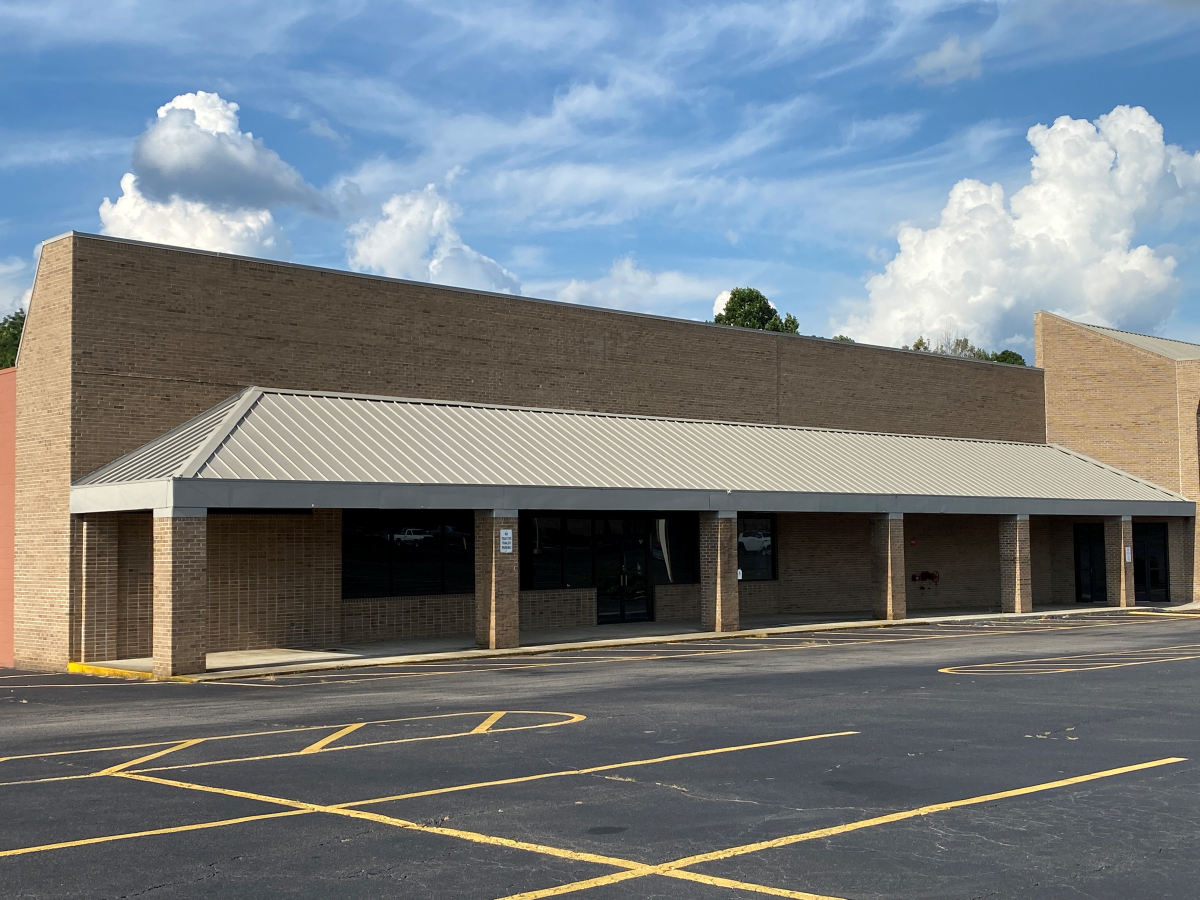
Voters on the south end of Habersham County will soon have their own precinct again. Renovations to the old Sears building in Cornelia are moving along. County Election Supervisor Laurel Ellison says the new precinct will be open in time for advance voting in the presidential primary starting February 19.

The 8,500-square-foot facility, which the county rents, will also house Habersham’s elections office.

More space with plenty of outlets

On Wednesday, Ellison toured the building with Habersham County Manager Alicia Vaughn to check on the progress. The building has been undergoing renovations since last year.

Ellison says the building will give the elections office more space across the board. It will have ample storage space for voting machines, printers, and scanners that cannot be housed at the elections office’s current location inside the county administration building.

The new South Precinct will also have plenty of space for voting machines to be set up on election day.

The voting area of the south precinct will accommodate numerous voting machines during elections. (Jerry Neace/NowHabersham.com)

Last June, Habersham County hired Soque Contracting Services to renovate the building. Owner Tim Canup says the facility is equipped with 139 electrical outlets. He says the vast majority of those are in the voting area. Ellison says having that many outlets in the voting area will allow her staff to set up more machines on voting day and perform the state-mandated Logic and Accuracy tests much more quickly before elections.

Ellison points out there are other advantages to having this much larger space.

The area devoted to Elections Management is equipped with a large window so that the media, poll watchers, and citizens can watch as election workers tally votes. According to Ellison, there will also be cameras in the room transmitting video to a large TV screen just outside the room.

The Elections Management room has a large window so that the media, poll watchers, and citizens can watch as elections workers tally votes. (Jerry Neace/NowHabersham.com)

‘Can’t wait!’

Ellison and Vaughn both say they are excited about the new facility and the progress being made.

“I can’t wait to get more space. We’re going to have room for growth, and I hope we will be here for many, many years,” says Ellison excitedly.

It’s been seven months since the county contracted with Soque to do the renovations. At the time, the estimated cost was just over $263,000. Officials say they won’t know the final actual cost until the renovations are complete.

The Habersham County Voter Registration and Elections Office will be moving to Cornelia and will be open for elections next month in time for advance voting. (NowHabersham.com)

Election officials had anticipated moving into the space sooner, but renovations didn’t begin in earnest until September 2023. Still, Vaughn does not hint at any concerns over the timeline.

“We are very grateful to Canup and his crew for squeezing us in and making it happen,” she says, adding that the new location is about “convenience.”

“We’re excited to have a location where it’s convenient for everyone to come and vote. We want to get people out to vote.”

Jurassic Empire arrives in Clarkesville this weekend

'Ride' a T-Rex at Jurassic Empire's interactive display.

Have you ever wondered what Dinosaur has the longest name? What were the tail spikes of a stegosaurus called? Or which dinosaur is considered the fastest runner? You can learn the answers to these and many other questions you have about dinosaurs at ‘Jurassic Empire’ this weekend in Clarkesville.

This interactive, traveling dinosaur exhibit will be held in the Dewey H. Tench Pavilion at the Habersham County Fairgrounds on Saturday, Jan. 27, and Sunday, Jan. 28.

A realistic prehistoric indoor journey

Organizers describe Jurassic Empire as “the largest, most realistic dinosaur event ever seen.” It is a family-friendly exhibit and interactive display that lets you walk among, even ride, the dinosaurs. From the Jurassic to the Ice Age periods, children can experience the history of dinosaurs and mammals that ruled the Earth for over 200 million years.

The main exhibit features “ultra-realistic dinosaurs in their natural habitats,” says event promoter Mike Henschel, “Each dinosaur is painstakingly recreated from scientific specifications and is true-life in size and overall appearance. They even move and roar!”

Kids can interact with the creatures by riding on their backs or petting the adorable baby dinosaurs. Visitors will meet Tracey – a friendly young T-Rex who greets guests while walking around and playing with the kids.

In addition, there is a fossil dig area where young paleontologists can dig up ancient bones, a Virtual Reality Ride that stimulates children’s imagination, and a Jurassic-themed bounce area with inflatable bounce houses.

Henschel calls Jurassic Empire an “unforgettable family event that will leave you feeling happy and refreshed.”

Jurassic Empire runs from 10 a.m. to 8 p.m. Saturday and 10 a.m. to 6 p.m. Sunday at the fairgrounds located at 4235 Toccoa Highway in Clarkesville.

January 27 – 28 at the Habersham Fairgrounds in Clarkesville

Ticket sales

Tickets are now on sale for this prehistoric adventure. Henschel says previous events have sold out, so buying tickets in advance is highly recommended.

Visit JurassicEmpire.com to purchase tickets online. General admission tickets are $20 plus processing fees. Kid’s VIP tickets with unlimited rides are $33 plus fees.

Raheem Morris hired as head coach by Atlanta Falcons, who pass on Bill Belichick

(Credit: AP Photo/Kyusung Gong, File)

ATLANTA (AP) — The Atlanta Falcons have hired Los Angeles Rams defensive coordinator Raheem Morris as their head coach after an exhaustive search that included six-time Super Bowl winner Bill Belichick, a person familiar with the decision told The Associated Press.

The person spoke on condition of anonymity because the team had not made the announcement.

Morris is a familiar name in Atlanta, having served as the Falcons’ interim head coach for the final 11 games of the 2020 season after the firing of Dan Quinn. He previously coached the Tampa Bay Buccaneers for three seasons.

This article comes to Now Habersham in partnership with GPB News

Joe D. Trotter

Joe Donald Trotter, age 87, of Lawrenceville, Georgia, passed away on Wednesday, January 24, 2024.

Born in Clarkesville, Georgia, on October 29, 1936, Joe was the third child of the late Chester Terrell and Cora Blanche Trotter.

Joe began his career at HEMC in March 1955 as a lineman’s helper. After a time of service in the Army Reserves, he returned to HEMC to work his way up and, in 1966, began his long tenure as a staking technician in the Engineering Department. He retired in 2000. Joe’s work with HEMC allowed him to meet and befriend most of the population of Habersham and surrounding counties. When Joe went into public, it was pretty much a guarantee that he was going to bump into a friend and have a chat, whether it was at the grocery store or in the buffet line while on vacation at the beach.

It was at HEMC where he met Frances, who became his bride on June 17, 1962. They built their home on Amy’s Road in Clarkesville, where they lived until late 2018. Joe and Frances raised their sons at Hills Crossing Baptist Church, where Joe served as a deacon, was an active supporter of many programs, and participated in countless mission trips. Throughout his life, Joe was thankful to God in all things.

Joe was a band booster at HCHS and a member of the Lions Club for many years. He also owned Trotter Electric and Plumbing Supply, which he and Frances operated until 1989.
In retirement, Joe spent two decades faithfully caring for Frances with loving devotion. In the last few years, dementia advanced and gradually robbed him of his memories. It did not, however, take his sweet smile and gentle gaze, which had his caregivers fighting over him, and gave his children and grandchildren glimpses of the kind and loving father and grandfather that he was. The way he lit up when he remembered and called you by name is something his family will always treasure.

Survivors include sons David Trotter of Auburn, GA, Doug (Shari) Trotter of Snellville, GA, Tim (Jean) Trotter of Macon, GA; grandchildren Ella and Cara Trotter of Macon, GA, Zayden Trotter of Stafford, VA, and Jasmine Chloupek (and great-granddaughter Aurora) of Plainfield, IN; sisters-in-law Lois (Zach) Zaccagnino of Lompoc, CA, and Vera Roberts of Mt. Airy, GA; brother-in-law Jerry Dawkins of Oakwood, GA; many nieces, nephews, other relatives, and friends.

In addition to his parents, Joe was preceded in death by his wife, Frances Stamey Trotter, brother, Louis B. Trotter, and sister, Bobby Jean Weaver.

Joe’s family extends a heartfelt “Thank You” to Delmar Gardens, Agape Hospice, Ellen Smart, and the staff at Kinder Kare.

Funeral services will be held at 11:00 AM on Monday, January 29, 2024, at Hillside Memorial Chapel.

The family will receive friends at the funeral home on Sunday, January 28, 2024, from 4:00 PM until 6:00 PM and on Monday prior to the service from 10:00 AM until 11:00 AM.

In lieu of flowers, please consider making a donation to Habersham EMC, Joe Trotter Memorial Fund, 6135 Highway 115 West, Clarkesville, GA 30523. The funds will be used to assist those in need to pay their power bill.

Online condolences may be sent at www.hillsidememorialchapel.com.

Arrangements are in the care and professional direction of Hillside Memorial Chapel & Gardens, Clarkesville, GA. 706-754-6256

Royce Wiley

Royce Wiley, age 88, of Alto, passed away on Wednesday, January 24, 2024.

Born on August 20, 1935, in Hall County, he was a son of the late Albern and Maebell Woodall Wiley. Mr. Wiley was a self-employed poultry and cattle farmer for approximately 50 years. He was one of the hardest working men you’ll ever know and he enjoyed the work he did. Royce took delight in hunting, fishing, gardening, the outdoors, and watching “Shepherd’s Chapel” on TV. He was a member of Calvary Baptist Church.

In addition to his parents, he was preceded in death by his beloved wife, Velma Evelyn McClure Wiley; brothers: George Wiley, M.E. “Sharper” Wiley, Dayton Wiley, and Elijah “Minor” Wiley; and sisters, Eunalou Wade and Henrietta King.

Survivors include his sons, Brad Wiley of Alto and Rickey Wiley of Toccoa; daughters and sons-in-law, Judy Crumley (Jackie) of Alto and Linda Sanders (Graylen) of Lula; grandchildren: Christy, Scott, Kayla, Lindsey, Brian, Stephen, and Makenzie; nine great-grandchildren; sisters, Kathleen Wiley Sexton of Flowery Branch and Maebell Wiley Lovell of Alto; and numerous nieces, nephews, other relatives, and friends.

Funeral services are scheduled for 2:00 pm on Sunday, January 28, 2024, in the Chapel of McGahee-Griffin & Stewart, with Rev. Steve Brannon officiating. Interment will follow in Mt. Zion United Methodist Church Cemetery.

The family will receive friends from 12:00 noon until the service hour on Sunday at the funeral home.

An online guest register is available and may be viewed at www.mcgaheegriffinandstewart.com.

McGahee-Griffin & Stewart Funeral Home of Cornelia, Georgia (706/778-8668) is in charge of arrangements.

HABCO Commission winter retreat in Cornelia Jan. 26

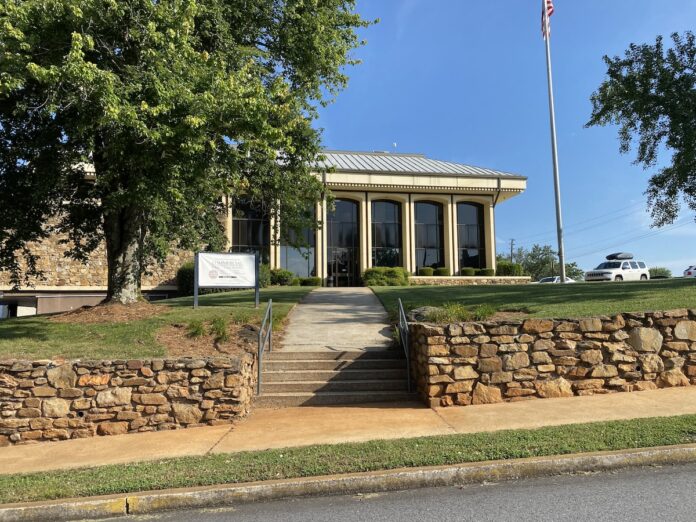
The Habersham County Commission will hold its winter retreat at Commercial Executive Suites in the old Regions Bank building on Larkin Street in downtown Cornelia. The public is welcome to attend. (Joy Purcell/NowHabersham.com)

At their winter retreat in Cornelia, Habersham County commissioners will discuss options to secure a Local Option Sales Tax and try to map out the future of the county landfill, among other things.

The gathering, set for Friday, Jan. 26, will take place from 8:30 a.m. to 4 p.m. at the Commerical Executive Suites in the old Regions Bank building in downtown Cornelia. The public is welcome to attend.

The all-day retreat gives commissioners dedicated time to focus on the issues facing the county. It also allows them an opportunity to discuss potential solutions and long-range goals.

On the agenda

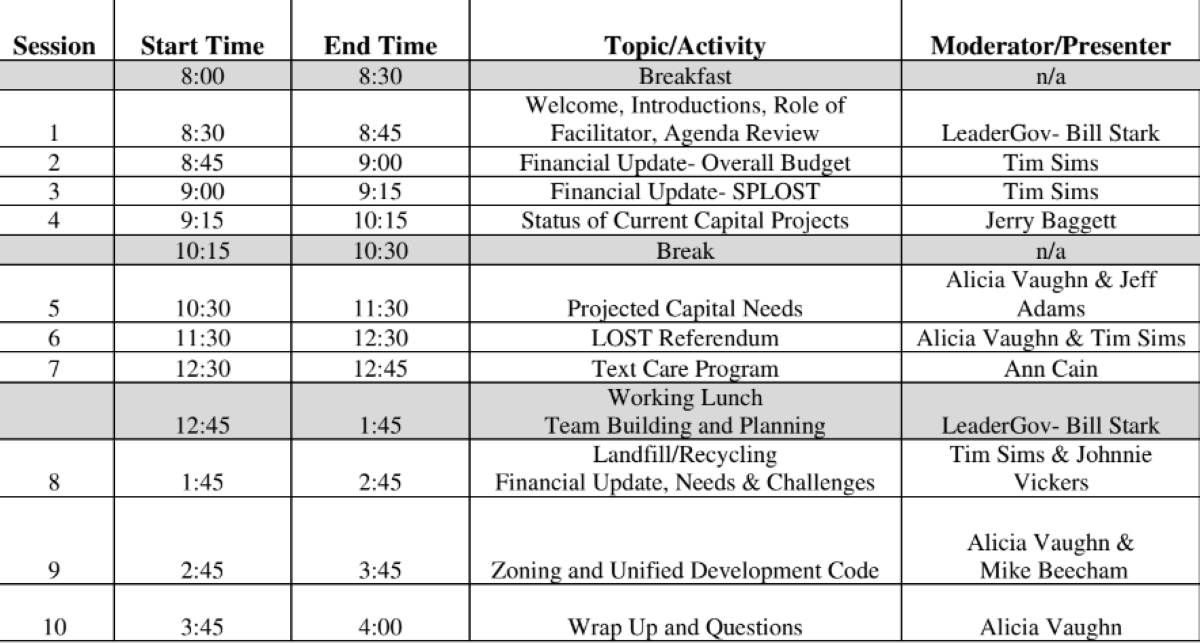
On Thursday, the county released the retreat schedule.

The HABCO Commission winter retreat agenda outlines topics and times discussed on January 26. (Habersham County Government)

Bill Stark, co-founder of the local leadership development company LeaderGov, is among Friday’s scheduled speakers. He’ll present a session on team building and planning.

Habersham County Manager Alicia Vaughn will address the commission along with county department heads. Public Works Director Jerry Baggett, Emergency Services Director Jeff Adams, Landfill Director Johnnie Vickers, Development Authority Director Mike Beechum, and county Finance Director Tim Sims are scheduled to deliver presentations.

Juvenile faces 7 felony counts for property damage

(NowGeorgia.com)

The White County Sheriff’s Office charged a juvenile with seven felony counts connected to property damage south of Cleveland.

Deputies responded to the area of Partin Road and Mobile Home Drive on Jan. 23 after multiple residents reported damage and windows being broken by an unknown male subject.

Investigators obtained a photo of the suspect and posted it to Facebook in an effort to identify him. With the community’s help, investigators ID’d him the following day and brought charges against him, says Capt. Clay Hammond.

Since he’s a juvenile, the suspect’s name can not be released.

Deputies charged the juvenile with seven felony counts of second-degree criminal damage to property.

Commerce man arrested for assaulting daughter after losing wrestling match

Steven Slaton (Hall County Sheriff's Office)

A Commerce man is out of jail on bond after being arrested for allegedly assaulting his daughter after a wrestling match in Hall County.

Deputies arrested 38-year-old Steven Mathue Slaton on Jan. 20 following the incident at Cherokee Bluff Middle School in Flowery Branch. They charged him with felony first-degree child cruelty.

The preliminary investigation revealed Slaton became angry with his daughter for losing the match. According to the arrest warrant, Slaton punched the girl in the back, slapped her face, and then picked her up by her ears, lifting the girl over his head. The child was not physically injured, according to the Hall County Sheriff’s Office.

A sheriff’s office spokesperson says the victim is not a student in the Hall County School District. She and her family had traveled to Hall County for the private youth wrestling event, which was not sponsored by the school district.

Slaton was released from jail on Jan. 22 after posting an $11,200 bond.

Georgia now home to world’s first sustainable jet fuel factory

LanzaJet's Freedom Pines facility is located in Soperton, Georgia, about halfway between Savannah and Macon. (Credit: LanzaJet)

Georgia is now home to the world’s first sustainable jet fuel factory to use “alcohol-to-jet” technology, which converts ethanol to lower-carbon jet fuel for commercial aircraft.

Suburban Chicago-based LanzaJet unveiled on Wednesday its Freedom Pines facility in rural Soperton, about halfway between Savannah and Macon, before an audience of more than 200 people including state and federal government leaders.

Known within the aviation and energy industries as sustainable aviation fuel (SAF), the fuel produced at Freedom Pines will reduce greenhouse gas emissions by more than 70% compared to conventional jet fuel, according to LanzaJet.

“It’s importantly a milestone for us as an industry because we’ve been working together to do this for 14 years,” said LanzaJet CEO Jimmy Samartzis, referring to the company’s research and development in collaboration with the federal government’s Pacific Northwest National Laboratory. “It’s an impact on aviation sustainability, clean tech, agricultural climate, tech industries across the board.”

Freedom Pines will produce 9 million gallons of SAF and 1 million gallons of renewable diesel fuel each year. Much of the ethanol used in the process will come from feedstocks such as corn and soybeans sold to the company by farmers, as well as niche crops meant specifically for SAF, such as carinata.

The federal government, in 2021, released a plan for the aviation sector to achieve net-zero greenhouse gas emissions within the industry by 2050. The plan defines greenhouse gases as carbon dioxide, nitrous oxide, and methane.

“If we’re really to mitigate the consequences of a changing climate, the transportation sector clearly has to get to a net-zero future,” U.S. Secretary of Agriculture Tom Vilsack said at the event. “In order for it to get to a net-zero future, aviation has to get there as well. And it can’t get there without a sustainable aviation fuel.”

The local Treutlen County economy will see an estimated $5 million in new wages and $70 million in annual economic activity, according to LanzaJet. Freedom Pines will create 30 direct jobs and 30-50 indirect jobs during its ongoing operations.

“They’re joining the ranks of many others that are coming here as a result of Georgia being such a great place to do business,” Georgia Public Service Commissioner Tim Echols, a Republican, said. “I mean, would you ever think that a ruby-red state like Georgia would capture so much of this clean energy money? Rivian Hyundai, SK Battery, the largest solar plant in North America. We are just gobbling it up.”

Construction of Freedom Pines, which began in August 2022, is mostly complete. LanzaJet expects to begin production of SAF by the end of March.

The world’s first transatlantic flight powered entirely by SAF took off from Georgia last November when a Gulfstream jet performed an experimental flight from its Savannah headquarters to Farnborough Airport near London.

This article comes to Now Habersham in partnership with GPB News