
Northeast Georgia’s small Jewish community has joined roughly 15 million Jews worldwide in observing the Jewish calendar’s holiest period.
Known as the “Days of Awe,” the 10-day observance begins with Rosh Hashanah, the Jewish New Year, and ends with Yom Kippur, the Day of Atonement. This year, it began at sundown Friday, Sept. 11, and will conclude about an hour after sunset Monday, Sept. 21, with a festive meal ending the Yom Kippur fast.
In Hebrew, the period is called the “Yomim Noraim.” It is a time of prayer, reflection, self-examination, and renewal.
Northeast Georgia’s Jewish community gathers at two locations in Gainesville.
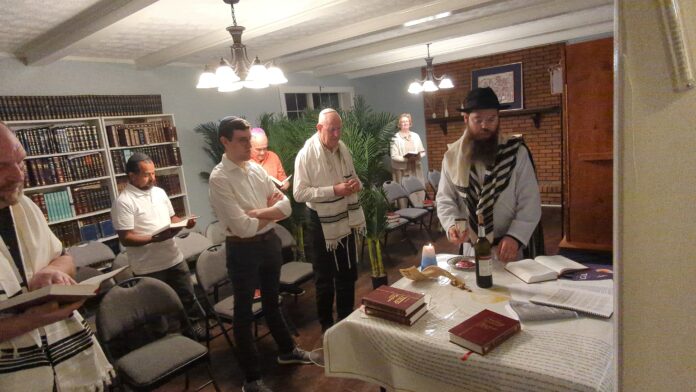
Shalom B’Harim, meaning “Peace in the Mountains,” is a community of Reform and Conservative Jews that meets at Unity of Gainesville. Founded in Dahlonega, the congregation recently celebrated its 25th anniversary.
The Chabad Jewish Center of Hall County is one of more than 5,000 outreach centers sponsored by the Brooklyn-based Chasidic movement Chabad Lubavitch. Established in Gainesville four years ago, the congregation generally meets in a synagogue adjoining the home of Rabbi Nechemiah Gurevitz and his wife, Shaina. Larger services are held at the Gainesville Civic Center or other public venues.
Rosh Hashanah begins with the new moon in Tishrei, the first month of the Hebrew calendar. During the holiday, Jews pray to be written into the metaphorical Book of Life for a good, happy and prosperous year.
The traditional blessing is “L’Shana Tovah Tikotevu,” meaning, “May you be inscribed for a good year.”
Because the Hebrew calendar follows both lunar and solar cycles, Jewish holidays fall on different Gregorian dates each year. Rosh Hashanah can begin between Sept. 5 and Oct. 5, while Yom Kippur can fall between Sept. 12 and Oct. 12.
Seeking forgiveness from God and others
During the Days of Awe, observant Jews seek forgiveness for two types of wrongdoing: sins against God and sins against other people.
The first category generally involves religious obligations, such as observing the Sabbath, following the dietary laws of kashrut and celebrating holidays as prescribed in the Hebrew Bible.
But the rabbis teach that prayer alone cannot resolve wrongs committed against another person. Those who have caused harm must approach the person they wronged, identify the offense, apologize and express a sincere intention not to repeat it.
Jewish tradition also requires people to accept a sincere apology.
The observance culminates with Yom Kippur, a solemn day of fasting and extended prayer. Traditionally, Jews refrain from food, drink, work and marital relations while seeking forgiveness for sins ranging from harboring grudges and speaking ill of others to failing to be charitable, forgiving and kind.
When three stars appear
The fast ends when darkness falls and three stars can be seen in the sky—about 8:15 p.m. Monday this year. Families and congregations then gather for a festive meal.
Not every Jew follows each tradition, but the practices are rooted in the Talmud, the collection of Jewish law and wisdom compiled by rabbis and scholars in ancient Babylon and Jerusalem during the first centuries of the Common Era.
Shalom B’Harim is welcoming a guest rabbi and cantor for this year’s High Holidays. Its rabbi of the past two years, Matan Peled, moved to Boston with his family this summer, and the congregation is considering several candidates as it searches for its next spiritual leader.
Leading this season’s services is Trienah Anne Meyers, a recently ordained rabbi and former attorney from Daytona Beach, Florida. She is joined by Dr. David Goldblatt, a cantor who led the congregation in song and played keyboard accompaniment during Rosh Hashanah. Both will return for Yom Kippur.
‘Not repentance, but return’
Speaking from his Gainesville home, Gurevitz described Yom Kippur as more than a day of repentance.
“The Hebrew word ‘teshuvah,’ generally translated as ‘repentance,’ actually means ‘to return,’” he said.
“It’s not only about correcting our character, but it’s more about returning to our true inner core, which was always good. The day of Yom Kippur, when we fast and refrain from our bodily needs, is an opportunity to be more in touch with our spiritual side, based on the belief that each one of us has a spark of God and a potential to be good.”
Don’t miss what everyone in town is talking about.
Join 4,000+ locals and choose our free newsletter covering news, events and the stories shaping our region.