
WASHINGTON (States Newsroom) — The U.S. Senate approved a nearly $70 billion package early Friday, moving Republicans one step closer to funding immigration and deportation activities for the next three years without negotiating new constraints on federal agents with Democrats.
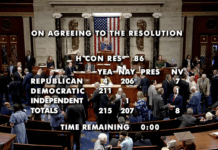
The 52-47 mostly party-line vote sends the measure to the House, where GOP lawmakers in that chamber could send it to President Donald Trump for his signature as soon as next week.
Alaska Sen. Lisa Murkowski was the only Republican to vote no. Colorado Democratic Sen. Michael Bennet did not vote.
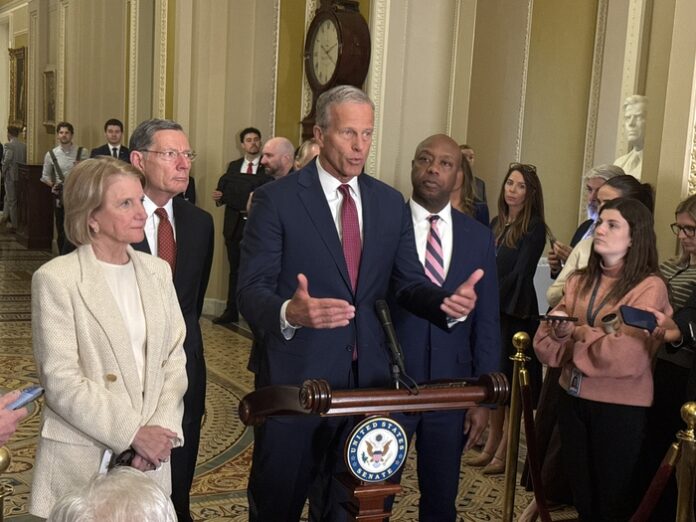
Majority Leader John Thune said GOP leaders were forced to draft the package after Democrats “walked away” from negotiations that could have placed restrictions on federal immigration agents.
“Republicans are going to continue to ensure that these agencies have the funding that they need to fulfill their national security responsibilities,” the South Dakota Republican said.
Minority Leader Chuck Schumer, D-N.Y., argued the measure shows that Republicans are more focused on funding deportations than lowering the cost of living.
“Apparently, Republicans think we cannot afford a single penny to help Americans cover the skyrocketing costs of gasoline, of healthcare, of housing, of food, of energy, you name it,” he said. “But somehow we can afford to give another $70 billion to Trump’s rogue agencies.”
Senate approval followed a marathon amendment voting session that stretched throughout Thursday and overnight as Democrats sought to challenge Republican senators on policy differences just months before the November midterm elections. No amendments were approved.
Building on “big,beautiful” law
The bill would provide a second hefty cash infusion to the agencies carrying out the president’s immigration crackdown, building on the $170 billion Republicans included in their “big, beautiful” law.
This legislation would provide:
- $38.53 billion for Immigration and Customs Enforcement
- $26.02 billion for Customs and Border Protection
- $5 billion for the Secretary of Homeland Security.
The money would be available through Sept. 30, 2029, the end of the fiscal year. Republicans decided not to include any new guardrails on federal immigration agents.
The measure Republican senators approved was somewhat different from the original version released in early May, which included $1 billion for the Secret Service to make security upgrades associated with the president’s ballroom, dubbed the East Wing Modernization Project.
Republicans also removed $1.46 billion that would have bolstered funding for several Justice Department programs.
Additionally, GOP lawmakers bolstered ICE funding by $350 million compared to the earlier version of the bill.
Republican leaders are moving the package through the complex budget reconciliation process, avoiding the need to secure Democratic votes in the Senate that would otherwise be required to end debate on the measure.
GOP leaders opted to use the special legislative maneuver after they were unable to broker agreement with Democrats to place constraints on federal immigration officers.
Democratic lawmakers said new guardrails, including body cameras and preventing the use of masks, were necessary after federal agents shot and killed two U.S. citizens in Minneapolis in January.
The impasse led to a 76-day shutdown at the Department of Homeland Security that didn’t end until late April, when Congress approved the annual spending bill without funding for ICE or the Border Patrol.
June 1 deadline missed
The reconciliation process comes with several strict rules that require each section of the legislation to address federal revenue, spending, or the debt limit. Proposals also cannot be deemed “merely incidental” to the federal budget.
Trump wanted Congress to approve the funding package ahead of a self-imposed June 1 deadline. But work on the measure ground to a halt after the administration announced plans to establish a $1.776 billion fund to pay people who believe they were wrongly prosecuted by the Justice Department.
Floor debate on the bill resumed again this week after acting Attorney General Todd Blanche testified before a House subcommittee Tuesday the administration was “not moving forward with the fund, period.”
Trump, however, muddied the waters a bit Wednesday when asked during an Oval Office event whether the fund was “dead or on hold.”
“I’d have to ask my lawyers. I don’t know,” he said. “Are you talking about the weaponization fund? The weaponization fund, as far as I’m concerned, was a beautiful thing.”
Don’t miss what everyone in town is talking about.
Join 4,000+ locals and choose our free newsletter covering news, events and the stories shaping our region.