
BEIJING (AP) — President Donald Trump on Thursday kicks off the busiest portion of his China visit, a summit expected to be long on pageantry and symbolism but unlikely to feature major breakthroughs on key issues like trade, U.S. relations with Taiwan or the war in Iran.
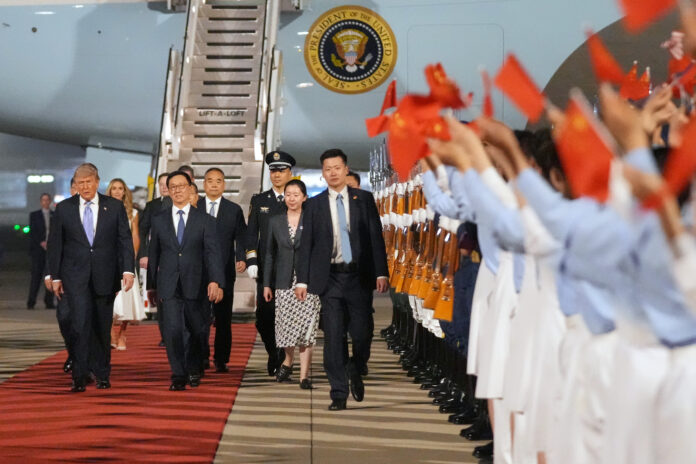
He arrived at an elaborate welcome ceremony on Wednesday night, and his motorcade rolled past a series of American and Chinese flags, as well as skyscrapers lit with Chinese characters reading “Beijing Welcome.” The Republican president headed to his hotel afterward and had no public events.
Chinese leader Xi Jinping is set to meet Trump during a ceremony on Thursday at the Great Hall of the People, a hub for legislative action by the communist government and a center for key cultural and social events on the Western side of Tiananmen Square.
They will have a bilateral meeting before Trump visits the Temple of Heaven — a religious complex dating to the 15th century that symbolizes the relationship between heaven and earth. Trump and Xi will also attend a state banquet.
On Friday, Trump and Xi are planning a working tea and lunch.
The White House has insisted that Trump wouldn’t be making the trip without an eye toward securing results before he leaves — suggesting that there could be announcements coming on trade, including a Chinese commitment to buy U.S. soybeans, beef and aircraft. Trump administration officials also want to work toward establishing a Board of Trade with China to address commercial differences between the countries.
But neither side has yet offered concrete details on what might come out of the three-day visit at a time when Beijing’s close economic ties to Iran could complicate matters.
Economic questions follow Trump to China
The president’s Beijing swing comes as Iran continues to dominate his domestic agenda and stoke fears about the prospect of a weakening U.S. economy as the election season ahead of November’s midterms — when Republicans will be looking to maintain control of Congress — begins heating up.
The U.S. and Israel’s war in Iran has led to the effective closure of the Strait of Hormuz, stranding oil and natural gas tankers and causing energy prices to spike, threatening global economic growth.
Spending so much time with Xi — especially against splendiferous backdrops — will afford ample time for Trump to discuss a series of thorny topics. Those include Iran and trade, but also Taiwan and a possible three-way nuclear arms deal featuring Washington, Beijing and Russia.
Still, progress beyond pleasantries — and lots of praise between Trump and Xi, who have spent years effusively complimenting each other publicly — might prove elusive.
“Neither side will make much progress on the two major foreign policy issues,” predicted Jim Lewis, a tech policy fellow at the Center for European Policy Analysis. “Trump will press the Chinese to help him on Iran. They’ll be unwilling. The Chinese will press Trump to make concessions on Taiwan. We’ll see what we get out of that.”
Back in Washington, the politics of the war got more complicated. Senate Republicans on Wednesday again blocked Democratic legislation to halt hostilities in Iran — but Alaska Republican Sen. Lisa Murkowski bucked her party, becoming the third Republican in the chamber to vote against continuing the war.
China is the largest purchaser of Iranian oil, yet Trump has sought to downplay suggestions that he will press Xi to do more to pressure Iran to open the strait — even as White House officials say he will be making that case to China’s leader behind closed doors.
The president also says pressure on the U.S. economy won’t compromise U.S. demands as he negotiates with Iran in the midst of a fragile ceasefire. Asked as he left the White House if the financial stability of ordinary Americans factors into Iranian negotiations, Trump responded, “Not even a little bit.”
“I don’t think about Americans’ financial situation. I think about one thing: We cannot let Iran have a nuclear weapon,” Trump said, before going on to suggest that “every American understands” such a position.
But the administration has struggled to deliver a consistent message on inflation and the war.
Vice President JD Vance insisted at a Wednesday news conference that Trump was “laser focused” on inflation, but he denied Trump’s own words that the U.S. economy was not a factor in resolving the war.
“Well, I don’t think the president said that,” Vance said after being asked about the comments. “I think that’s a misrepresentation of what the president said.”
Trade and Taiwan discussions also could be intense
Looming large is the status of Taiwan, given that China is displeased with U.S. plans to sell weapons to the self-governing island that the Chinese government claims as part of its territory.
The Trump administration has approved an $11 billion weapons package for Taiwan, but has yet to begin fulfilling it. Trump has also demonstrated greater ambivalence toward Taiwan — an approach that’s raising questions about whether he might be open to dialing back support for the island democracy.
Taiwan is the world’s leading chipmaker, producing components essential to the development of artificial intelligence. Trump has sought to bolster trade deals with Taiwan that can stimulate chip production in the U.S.
Trump personally called Nvidia’s Jensen Huang to invite him to hop on Air Force One during a refueling stop in Alaska on the way to Beijing — one of a large group of CEOs from the tech, defense, finance and agriculture sectors who are part of the delegation. Other officials on the visit include Secretary of State Marco Rubio, Treasury Secretary Scott Bessent and Defense Secretary Pete Hegseth, as well as Trump’s son Eric and Lara Trump, his daughter-in-law.
Also in China is Elon Musk, the SpaceX chief who once led Trump’s effort to slash federal jobsand cut back the size of government.
The U.S. and China reached a trade truce last year that calmed each side’s threats to impose steep tariffs on the other. The White House says there have been ongoing discussions and mutual interest in extending the agreement, though it is unclear whether any such announcement could come during Trump’s visit.
Trump has said he will ask Xi to give U.S. firms greater access to the Chinese market, urging his Chinese counterpart to “’open up’ China so that these brilliant people can work their magic.” He’s also seeking to extend a deal that allows China to continue exporting rare earth minerals to the U.S., prompting China to hold off on limiting the global supply in response to Trump’s threatened tariffs.
Top American officials have also said Trump will raise the idea of the U.S., China and Russia signing a pact setting limits on the nuclear weapons each nation keeps in its arsenal — an idea Beijing has previously viewed skeptically.