
(Georgia Recorder) – An income tax cut bill that the governor signed into law Monday has caused a $1.3 billion revenue shortfall for next year’s budget, which takes effect in July.
Gov. Brian Kemp, who is term-limited and serving his final year in office, had budgeted for an income tax cut that would lower the rate from 5.19% to 4.99%, fulfilling a campaign promise to bring the rate below 5%.
But what lawmakers ultimately sent him in the final hours of this year’s session did that and more.
“I strongly support cutting taxes and giving hard-working Georgians more relief, which is exactly what we accomplished this legislative session,” Kemp said. “But our job is to deliver on that relief while at the same time protecting the future fiscal standing of our state.”
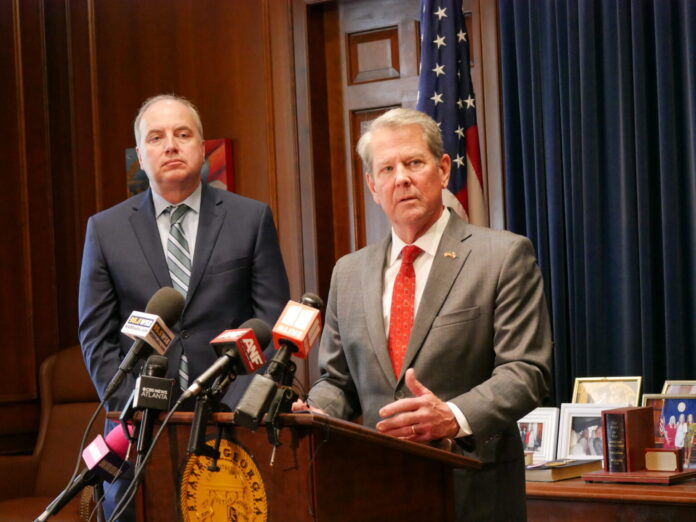
Kemp signed the income tax reduction measure Monday and then on Tuesday announced that he had made about $300 million in cuts to new spending to help cover the resulting deficit.
Some new spending – most notably funding to pay for a literacy initiative – survived untouched. But many areas of the budget took a hit, including $9.3 million for services for people with disabilities and $30.7 million for transportation funding for schools.
“(Lawmakers) know it put us in a tough position to either veto the tax cut and pay for all this stuff, or either to sign the tax cut and not be able to pay for it, and you know, I like cutting taxes. I’m proud we’ve done that four years in a row,” Kemp told reporters Tuesday.
Not making the cuts, he said, would have left “a mess for somebody in the big budget next year after I’m gone.”
The rest of the shortfall will be made up using the state’s rainy day funds and through revenue growth between now and the time lawmakers return to Atlanta to start working on what’s called the amended budget, said Richard Dunn, director of the governor’s Office of Planning and Budget.
“The big thing we’re looking at is for the next budget, (fiscal year) 28, we want to be sure that we have – with revenue growth, that withholding the spending – that we have the capacity to meet our growth needs in FY 28 without having to go and impact existing state operations,” Dunn said.
Dunn said the $1.3 billion deficit is due to the income tax bill, House Bill 463, which also increased the standard deduction and exempted some overtime and tips from being taxed.
The measure was in addition to another round of bonus income tax rebates and one-time tax relief for homeowners in the current year’s budget. Kemp also signed off on a plan to cap local property tax assessments at the rate of inflation, which Democrats argued was unconstitutional because of how it passed.
The governor vetoed a dozen bills Tuesday, including several because of their cost. That includes a bill that was celebrated as a boost for conservation efforts in Georgia.
“The General Assembly failed to account for this loss of revenue in the appropriations process, instead prioritizing general taxpayer relief,” Kemp wrote in his veto statement.
Republican leaders in both chambers pushed competing tax cut proposals in an election-year session. Some Senate leaders have pushed to eliminate the income tax entirely while House Republicans championed a proposal to nix local property taxes.
“The House was proud to pass a sound, fiscally responsible budget that made historic, strategic investments across the state all while putting more money back in the pockets of the hardworking Georgians who earned it,” House Speaker Jon Burns, a Newington Republican, said in a statement Tuesday.
Lt. Gov. Burt Jones, a Republican candidate for governor, praised Kemp in a statement and renewed his vow to end the state’s income tax, which funds about half of the state’s budget.
“I look forward to continuing this great work, while giving every family a five percent raise through the complete elimination of our state income tax,” Jones said in a statement.
The income tax plans won over some Democratic support, but largely, Democrats raised concerns throughout the session about the disproportionate benefit of the cuts to wealthy Georgians and the impact the tax breaks would have on the revenues needed to pay for public services.
Rep. David Wilkerson, a Powder Springs Democrat, said Republicans spent the “entire legislative session pushing policies that destabilize state and local governments.”
“Gov. Kemp could have vetoed the reckless and unconstitutional tax cuts rushed through by the Republican majorities in the late hours of the final legislative day,” Wilkerson said in a statement. “Less than a year ago, Georgia had a surplus exceeding $14 billion. Today, as Governor Kemp himself has acknowledged, we are facing a structural deficit in our Fiscal Year 2027 budget.”
Don’t miss what everyone in town is talking about.
Join 4,000+ locals and choose our free newsletter covering news, events and the stories shaping our region.