

DEMOREST, Ga. — After months of work on a new unified development code, Habersham County commissioners spent much of their annual planning retreat Tuesday refining proposed zoning changes that will shape where and how future housing can be built.
The rewrite, which has been underway since last year, prompted commissioners to adopt — and later extend — a housing moratorium to prevent new subdivisions from being approved under rules they are in the process of changing.
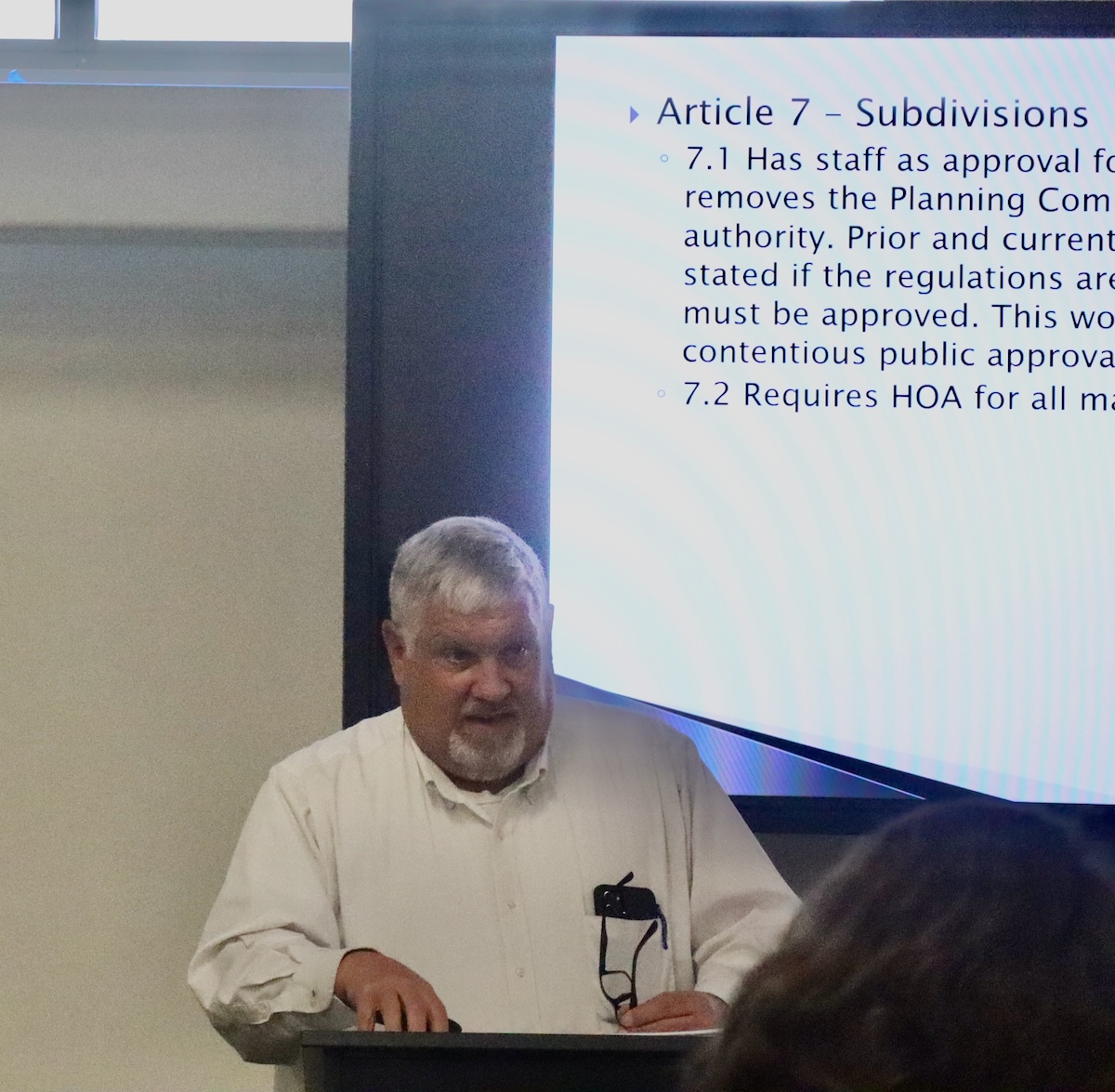
Planning and Zoning Director Mike Beecham told commissioners the current zoning map still leaves large portions of the unincorporated county open to subdivision development with limited discretion once technical standards are met.
“A subdivision could come anywhere in the blue area today, and there wouldn’t be a whole lot we could do,” Beecham said, referring to land zoned low intensity. “That’s why we’re going through this process.”
Directing growth toward infrastructure
The draft unified development code reorganizes zoning districts and attempts to steer higher-density development toward areas near existing cities and infrastructure.
Agricultural zoning would remain at three-acre minimum lots. A conservation district would maintain a five-acre minimum. A new rural residential category would apply to areas already developed below five acres without making existing properties nonconforming.
A proposed suburban residential district — generally near city limits — would require one-acre minimum lots on septic systems but allow half-acre lots where public sewer is available.
“On public sewer, you can go smaller,” Beecham said. “I was just trying to give them some options of preserving open space.”
He said the intent is to encourage development where roads and utilities already exist.
“I don’t want to see it become Hall County either,” Beecham said.
Commissioner Kelly Woodall said residents have repeatedly asked the board to limit density and protect rural character.
“I think the central thing that I’ve heard from constituents is one, limit your density,” Woodall said. “You want to keep as much natural as we can.”
Woodall described the proposed zoning structure as putting “headwind on development” in more rural areas while allowing growth closer to cities.
Cluster option preserves open space
The draft would expand use of cluster subdivisions, allowing developers to group homes on smaller lots if overall density remains the same and remaining acreage is permanently protected as open space.
Under that approach, a 100-acre tract in a five-acre district that might otherwise yield roughly 16 lots could still produce 16 homes — but on smaller lots — with the balance preserved under deed restriction.
“It’s got to be permanently deed-protected open space,” Beecham said.
Higher subdivision standards
The proposal also tightens subdivision requirements.
Major subdivisions — defined as four lots or more — would be required to install curb-and-gutter streets, underground utilities, minimum 1,800-square-foot homes, two-car garages, street trees and landscaped entrance signs. Homeowners associations would be mandatory to maintain drainage systems and common areas.
Subdivision road standards would be upgraded, and developers would be required to maintain performance bonds for two years or until 90% of homes are sold — an extension of the current 18-month requirement.
Commission Chairman Bruce Harkness said residents are frustrated with subdivisions built to minimum standards that later require county intervention.
“People build subdivisions, put down base code, then they bail out,” Harkness said. “Then there’s potholes, and the roads aren’t — we have to take the roads over.”
Beecham noted the county already requires developers to post a bond equal to 15% of infrastructure costs but said extending the timeframe offers additional protection.
Administrative approvals
Under guidance from the county attorney, the draft shifts subdivision approvals to staff if projects meet all ordinance requirements.
“It’s either yes, it meets it so it’s approved, or no, it doesn’t,” Beecham said. “There’s no saying we don’t like that subdivision.”
Preparing for future growth
Beecham said zoning decisions — and how future boards apply them — will ultimately determine whether the county achieves its growth goals.
“We need to determine where we want the growth to occur and then put the zoning in place in those places, and limit it in other places,” he said.
The unified development code remains under review as commissioners continue refining language. The housing moratorium will remain in place until the board finalizes and adopts the new regulations governing residential development in unincorporated Habersham County.
Don’t miss what everyone in town is talking about.
Join 4,000+ locals and choose our free newsletter covering news, events and the stories shaping our region.